
NASA Reports Week of Botany and Biomedicine Aboard the International Space Station
NASA reported on November 13 that space botany and biomedical research filled the scientific schedule aboard the International Space Station at the end of the week. Expedition 75 is also continuing to load a U.S. cargo spacecraft before its upcoming departure and return to Earth.
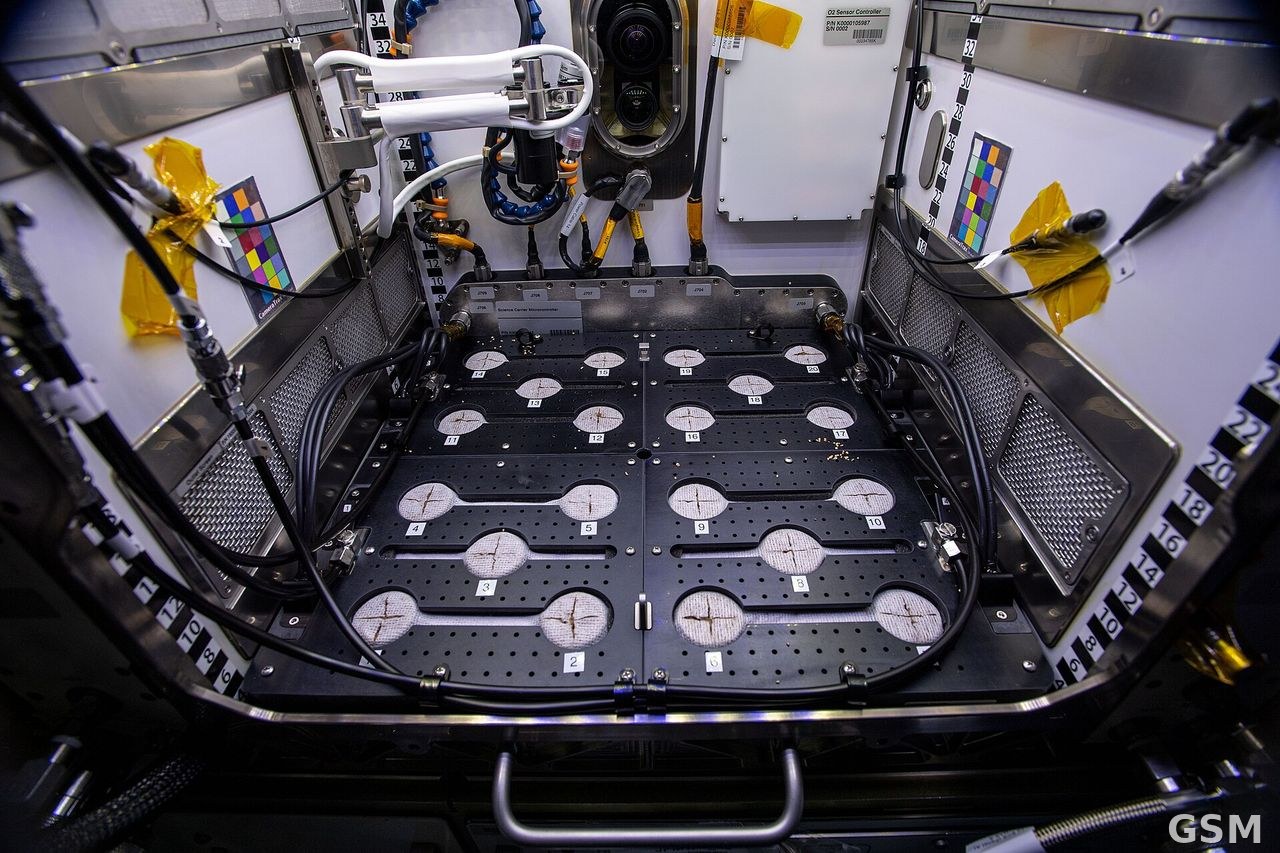
NASA flight engineer Luke Delaney investigated how plants grow and fight disease in microgravity. He began his shift harvesting thale cress plants grown inside the Kibo laboratory module's Multi-use Variable-g Platform, then treated plant samples inside Kibo's Life Science Glovebox for preservation and return to Earth. NASA said the results may lead to healthier plants grown on spacecraft and better agricultural techniques on Earth for stronger disease resistance.
The crew also serviced research gear designed to study phenomena difficult or impossible to achieve in Earth's gravity. NASA flight engineer Anil Menon swapped sample-containing cassettes and hard drives inside the Advanced Space Experiment Processor-4, which recently supported pharmaceutical and microbiology research. NASA flight engineer Jessica Watkins activated student-designed hardware that will examine how critical physical, chemical and biological processes behave in microgravity.
Flight engineer Joshua Kutryk of the Canadian Space Agency, assisted by Watkins, collected his blood sample, spun it in a centrifuge and stowed it in a science freezer for later analysis. He then conducted two workout sessions using resistance and rowing techniques on the European Enhanced Exploration Exercise Device, or E4D, in the Columbus laboratory module. NASA described the E4D as a new compact exercise device being investigated for its ability to support muscle and bone health on missions to the Moon, Mars and beyond.
Some research samples are being prepared for return to Earth aboard a SpaceX Dragon cargo spacecraft that arrived at the station on October 15. Menon and Watkins spent part of their Friday shift packing and securing cargo inside Dragon, which will be retrieved by NASA and SpaceX personnel after splashdown in the Pacific Ocean.
Roscosmos cosmonauts Pyotr Dubrov and Anna Kikina studied how to use super intelligence (SI) tools to transcribe crew audio reports for review by mission controllers on the ground. Dubrov conducted a photographic inspection of windows inside the Zvezda service module, Kikina measured her blood pressure using arm, wrist and finger cuffs to monitor spaceflight's effect on her cardiovascular system, and flight engineer Sergey Teteryatnikov tested a medical monitoring device by simulating a health check and downlinking the data to doctors on Earth.
Source: NASA
Published by GSM · USA (original Chinese edition)
Photo: 图:国际空间站上的植物培育实验硬件(Plant Habitat-02 实验记录照片)。作者:NASA Johnson Space Center,公共领域,维基共享资源。 / Photo: Plant research hardware aboard the International Space Station (Plant Habitat-02 documentation photo). Credit: NASA Johnson Space Center, public domain, via Wikimedia Commons.