Indian Prime Minister Modi Meets Trump at the White House: $500 Billion Trade Goal Set for 2030
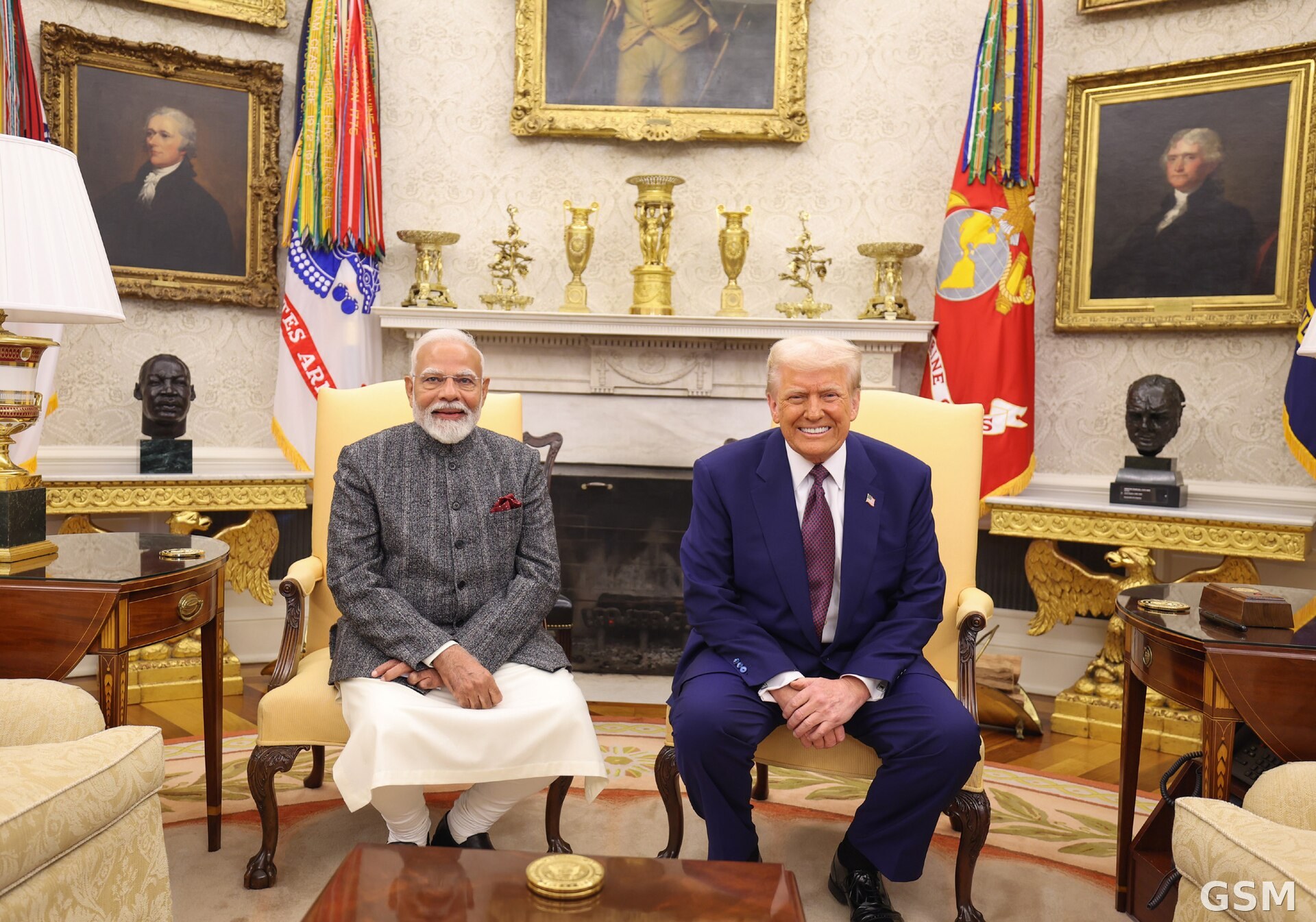
On February 13, 2025, Prime Minister Narendra Modi of India paid an official working visit to Washington, D.C., and met President Donald Trump at the White House in Washington, D.C. In a joint leaders' statement issued after the meeting, the two leaders reaffirmed the strength of the India-U.S. Comprehensive Global Strategic Partnership and launched a new initiative, the "U.S.-India COMPACT (Catalyzing Opportunities for Military Partnership, Accelerated Commerce & Technology) for the 21st Century," committing to a results-driven agenda with initial outcomes this year.
Trade was a central subject of the meeting. The leaders set a new goal for bilateral trade, "Mission 500," aiming to more than double total bilateral trade to $500 billion by 2030. To that end, they announced plans to negotiate the first tranche of a mutually beneficial, multi-sector Bilateral Trade Agreement (BTA) by the fall of 2025, increasing market access, reducing tariff and non-tariff barriers and deepening supply chain integration. The statement said the United States welcomed India's recent measures to lower tariffs on U.S. bourbon, motorcycles, ICT products and metals, and to enhance market access for U.S. agricultural products such as alfalfa hay and duck meat, and for medical devices, while India expressed appreciation for U.S. measures to enhance exports of Indian mangoes and pomegranates to the United States. The leaders also welcomed ongoing investments by Indian companies worth approximately $7.35 billion, including Hindalco's Novelis in finished aluminum goods in Alabama and Kentucky, JSW in steel manufacturing in Texas and Ohio, Epsilon Advanced Materials in critical battery materials in North Carolina, and Jubilant Pharma in injectables in Washington, which they said support over 3,000 high-quality jobs for local families.
On defense, the leaders announced plans to sign this year a new ten-year Framework for the U.S.-India Major Defense Partnership in the 21st Century, and determined that the United States would expand defense sales and co-production with India to strengthen interoperability. They announced plans to pursue this year new procurements and co-production arrangements for "Javelin" anti-tank guided missiles and "Stryker" infantry combat vehicles in India, and expected completion of procurement for six additional P-8I maritime patrol aircraft following agreement on sale terms. The two countries will review their arms transfer regulations, including the International Traffic in Arms Regulations (ITAR), and will open negotiations this year for a Reciprocal Defense Procurement agreement; the United States announced a review of its policy on releasing fifth-generation fighters and undersea systems to India. The leaders also announced a new Autonomous Systems Industry Alliance (ASIA), with partnerships between Anduril Industries and Mahindra Group and between L3 Harris and Bharat Electronics. At the joint press conference after the meeting, Trump said the United States would be increasing military sales to India by many billions of dollars starting this year, and was paving the way to ultimately provide India with the F-35 stealth fighters. The "Tiger Triumph" tri-service exercise will be hosted in India at a larger scale and complexity.
On energy, the leaders committed to increase energy trade and to establish the United States as a leading supplier of crude oil and petroleum products and liquefied natural gas to India, to enhance investments in oil and gas infrastructure, and to expand trade in natural gas, ethane and petroleum products; the U.S. side affirmed its firm support for India to join the International Energy Agency as a full member. The leaders announced their commitment to fully realize the U.S.-India 123 Civil Nuclear Agreement, moving forward with plans to build U.S.-designed nuclear reactors in India through large-scale localization and possible technology transfer. India has announced in its recent budget amendments to the Atomic Energy Act and the Civil Liability for Nuclear Damage Act, the two sides decided to establish bilateral arrangements in accordance with that law, and the path forward will also enable collaboration to develop, deploy and scale up nuclear power generation with advanced small modular reactors.
On technology, the leaders launched the U.S.-India TRUST ("Transforming the Relationship Utilizing Strategic Technology") initiative to promote the application of critical and emerging technologies in areas including defense, artificial intelligence, semiconductors, quantum, biotechnology, energy and space, and committed to put forward a U.S.-India Roadmap on Accelerating AI Infrastructure by the end of the year. They also launched INDUS Innovation, a new innovation bridge, and the Strategic Mineral Recovery initiative, a program to recover and process critical minerals including lithium, cobalt and rare earths from heavy industries such as aluminum, coal mining and oil and gas. The leaders hailed 2025 as a pioneering year for U.S.-India civil space cooperation, with plans for a NASA-ISRO effort through Axiom to bring the first Indian astronaut to the International Space Station and the early launch of the joint NISAR mission to systematically map changes to the Earth's surface using dual radars, and announced a new partnership between the U.S. National Science Foundation and India's Anusandhan National Research Foundation.
The leaders also committed to strengthen cooperation against terrorism. The statement said they would work against terrorist threats from groups including Al-Qa'ida, ISIS, Jaish-e-Mohammad and Lashkar-e-Tayyiba in order to prevent acts like the attacks in Mumbai on 26/11 and the Abbey Gate bombing in Afghanistan on August 26, 2021, and that the United States announced that the extradition to India of Tahawwur Rana, a planner of the 2008 Mumbai attacks, has been approved. The leaders further called on Pakistan to expeditiously bring to justice the perpetrators of the 26/11 Mumbai and Pathankot attacks and to ensure that its territory is not used to carry out cross-border terrorist attacks.
On people-to-people ties and immigration, the statement noted that the more than 300,000-strong Indian student community contributes over $8 billion annually to the U.S. economy. The leaders committed to streamlining avenues for legal mobility of students and professionals and facilitating short-term tourist and business travel, while aggressively addressing illegal immigration and human trafficking by taking strong action against bad actors, criminal facilitators and illegal immigration networks, and to strengthening law-enforcement cooperation against illegal immigration networks and organized crime syndicates. Prime Minister Modi also looks forward to hosting President Trump in New Delhi for the Quad leaders' Summit.
(Source: The White House)
Source: The White House
Published by GSM · USA (original Chinese edition)
Photo: 图:2025年2月13日,特朗普与印度总理莫迪在白宫椭圆形办公室会晤(印度新闻信息局,GODL-India)。 / Photo: President Trump meets Indian Prime Minister Narendra Modi in the Oval Office on February 13, 2025 (Press Information Bureau of India, GODL-India).