Vance at the Munich Security Conference: Europe's Greatest Threat Is From Within
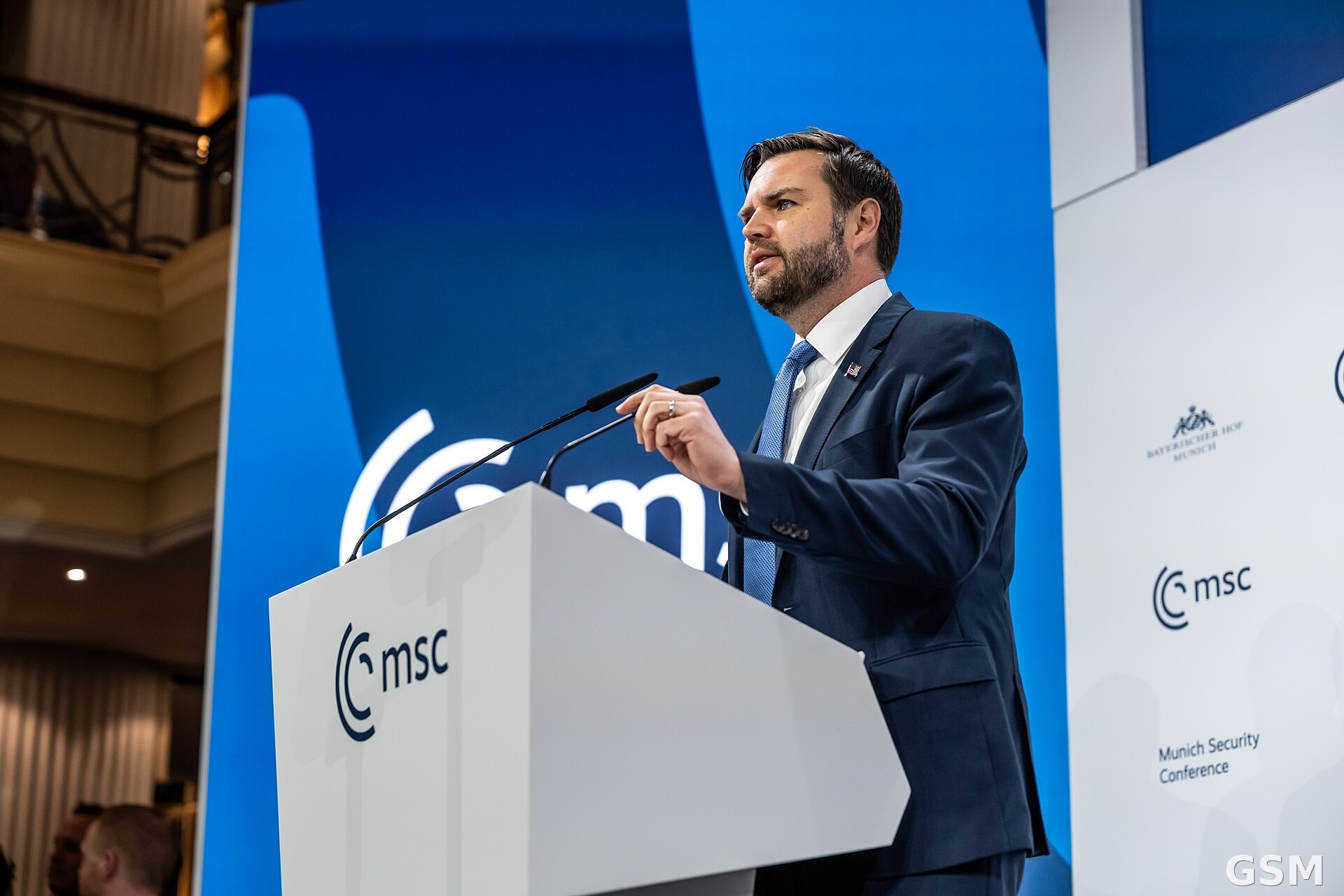
On February 14, 2025, U.S. Vice President J.D. Vance delivered a speech at the 61st Munich Security Conference in Munich, in the German state of Bavaria. The 61st Munich Security Conference was held from February 14 to 16 at the Hotel Bayerischer Hof in Munich. Vance said he had attended the conference in Munich the previous year as a United States senator. He first offered his thoughts and prayers to Munich and to everyone affected by the previous day's horrendous attack in the city.
Vance's central argument was that the greatest threat facing Europe comes from within. "The threat that I worry the most about vis-à-vis Europe is not Russia, it's not China, it's not any other external actor," he said. "And what I worry about is the threat from within, the retreat of Europe from some of its most fundamental values — values shared with the United States of America." He also said the Trump administration was very concerned with European security, believed a reasonable settlement between Russia and Ukraine could be reached, and believed it was important in the coming years for Europe to step up in a big way to provide for its own defense.
Vance cited a series of European cases in criticizing what he described as a retreat from democracy and free speech: European Union commissars warning citizens that they intended to shut down social media during times of civil unrest the moment they spotted what they judged to be "hateful content"; police in Germany carrying out raids against citizens suspected of posting anti-feminist comments online as part of "combating misogyny on the Internet, a day of action"; and Sweden, two weeks earlier, convicting a Christian activist for participating in Quran burnings that resulted in his friend's murder. "In Britain, and across Europe, free speech, I fear, is in retreat," he said.
He singled out conscience rights in the United Kingdom: Adam Smith-Connor, a 51-year-old physiotherapist and army veteran, had been charged a little over two years earlier with standing 50 meters from an abortion clinic and silently praying for three minutes, was found guilty of breaking the government's new "buffer zones" law — which criminalizes silent prayer and other actions that could "influence" a person's decision within 200 meters of an abortion facility — and was sentenced to pay thousands of pounds in legal costs to the prosecution. Vance also said the Scottish government had begun distributing letters the previous October to citizens whose houses lay within so-called "safe access zones," warning them that even private prayer within their own homes might amount to breaking the law.
Vance devoted considerable attention to Romania's cancellation of its presidential election results in December. He said Romania had straight up canceled the results based on the flimsy suspicions of an intelligence agency and enormous pressure from its continental neighbors, on the argument that Russian disinformation had infected the election. "You can believe it's wrong for Russia to buy social media advertisements to influence your elections. We certainly do," he said. "But if your democracy can be destroyed with a few hundred thousand dollars of digital advertising from a foreign country, then it wasn't very strong to begin with." He also criticized the Munich conference's own organizers for banning lawmakers representing populist parties on both the left and the right from participating, saying shutting people out of the political process was the most surefire way to destroy democracy.
He also turned on the previous U.S. administration, saying the Biden administration had threatened and bullied social media companies to censor so-called misinformation, such as the idea that the coronavirus had likely leaked from a laboratory in China. "In Washington, there is a new sheriff in town," he said. "And under Donald Trump's leadership, we may disagree with your views, but we will fight to defend your right to offer it in the public square, agree or disagree." He added that speaking up and expressing opinions was not election interference.
Mass migration was the speech's other main thread. Vance said that of all the pressing challenges facing the nations represented, there was nothing more urgent than mass migration: almost one in five people living in Germany had moved there from abroad, an all-time high, with a similar figure in the United States, also an all-time high; and the number of immigrants who entered the European Union from non-EU countries had doubled between 2021 and 2022 alone and had risen much higher since. He said no voter had gone to the ballot box to open the floodgates to millions of unvetted immigrants, that voters across Europe were increasingly voting for political leaders who promised to put an end to out-of-control migration, and that the previous day's attack in Munich showed the horrors wrought by such policy decisions.
Vance also addressed defense and democratic mandates, saying President Trump had made clear that Europe's allies must play a bigger role in the future of the continent and that Europeans should step up while America focused on areas of the world in great danger, but asking how budgeting questions could be thought through without knowing what was being defended in the first place. "I believe deeply that there is no security if you are afraid of the voices, the opinions, and the conscience that guide your very own people," he said. "If you're running in fear of your own voters, there is nothing America can do for you." He closed by saying democracy rests on the sacred principle that the voice of the people matters and that there is no room for firewalls, quoting Pope John Paul II: "Do not be afraid."
German Defense Minister Boris Pistorius responded to Vance's speech at the same conference that day. Pistorius said he could not refrain from commenting on the speech by the U.S. vice president; that the democracy in question had just been called into question by the U.S. vice president, and not just Germany's democracy but Europe's as a whole; and that, if he had understood correctly, Vance was comparing the condition of Europe with what prevails in some authoritarian regimes. "This is not acceptable," Pistorius said. He said that in Germany's democracy every opinion has a voice and that parties that are partly extremist can campaign just as any other party can, and that this is democracy; that democracy does not mean a vociferous minority is automatically right or can decide what truth is; and that he explicitly opposed the impression that European democracies oppress and silence minorities, saying Europe defends democracy, freedom of opinion, the rule of law and the dignity of each and every person.
(Source: The White House)
Source: The White House
Published by GSM · USA (original Chinese edition)
Photo: 图:2025年2月14日,美国副总统万斯在第61届慕尼黑安全会议上发表演讲(慕尼黑安全会议,CC BY 4.0)。 / Photo: U.S. Vice President J.D. Vance speaks at the 61st Munich Security Conference on February 14, 2025 (Munich Security Conference, CC BY 4.0).