Starmer Meets Trump at the White House: Trump Accepts King Charles III's Invitation for a Second State Visit
On February 27, 2025, British Prime Minister Keir Starmer visited the White House in Washington, D.C., for talks with President Donald Trump. The two men spoke to reporters in the Oval Office, then held a working lunch and further work sessions, and closed the day with a joint news conference in the East Room of the White House, which began at 3:28 p.m. It was a formal White House visit by Starmer as prime minister; the two leaders had met twice before.
The most closely watched moment of the Oval Office session was Starmer's delivery, by hand, of a letter from King Charles III inviting Trump to make a second state visit to the United Kingdom. Starmer said the invitation was really special, that it had never happened before and was unprecedented, that the King wanted to make this visit even better than the last state visit, and that it was a truly historic and unprecedented second state visit; the letter also mentioned Windsor. After checking the signature, Trump replied: "The answer is yes. On behalf of our wonderful First Lady, Melania, and myself, the answer is yes. And we look forward to being there and honoring the King and honoring, really, your country." At the joint news conference that followed, Trump again called the historic second state visit extended by letter from King Charles through the prime minister a great honor "because it's never happened before," and asked Starmer to convey America's acceptance.
Ukraine was the central subject of the talks. At the news conference, Trump said he had provided Starmer with an update on efforts to end the war between Russia and Ukraine: he had held back-to-back calls with President Vladimir Putin of Russia and President Volodymyr Zelenskyy of Ukraine, his team had spoken with the NATO secretary general on numerous occasions, and the next step was toward a very achievable cease-fire. He also announced that Zelenskyy would visit the White House the next day, February 28, to sign a historic agreement that would make the United States a major partner in developing Ukraine's minerals, rare earths and oil and gases, under which American taxpayers would effectively be reimbursed for the money poured into helping Ukraine defend itself, and which would provide the basis for a more sustainable future relationship between the United States and Ukraine. He said approximately 1 million Ukrainians and Russians had been senselessly killed in more than three years of conflict, and that in just over one month his administration had achieved more progress toward peace than the previous administration had in years.
Asked whether the United States could be persuaded, as part of a peace settlement, to provide air cover — a backstop security position — for contributions Europe might make, Trump said in the Oval Office that having a lot of American workers in Ukraine under the minerals agreement would itself be a backstop: "I don't think anybody is going to play around if we're there with a lot of workers." He added, however, that no deal had been made yet and that he did not like to talk about peacekeeping until a deal existed. Starmer said in the Oval Office that Britain would play its full part in making sure any deal was a lasting one. At the news conference, asked whether he had received a satisfying answer on a backstop, he said the two sides had held a very productive discussion, that the deal had to come first, and that their teams would be talking about how to make sure the deal sticks, is lasting and is enforced. In his opening remarks he stated plainly that the United Kingdom was ready "to put boots on the ground and planes in the air to support a deal, working together with our allies, because that is the only way that peace will last," and that it could not be a peace that rewards the aggressor or encourages regimes like Iran's, saying history must be on the side of the peacemaker, not the invader.
At the news conference, Trump said he supported Article 5 of the NATO treaty but did not think there would be any reason for it, predicting a successful, long-lasting peace. Starmer said he would host 18 countries on Sunday, March 2, to further discussions on Ukraine, and that Europe had to step up: Britain would give more military aid to Ukraine this year than ever, and he had set out that week the biggest sustained increase in British defense spending since the Cold War. Trump said the United Kingdom and other NATO partners needed to make large investments in their defense capabilities, that in many cases 4 percent or 5 percent of gross domestic product would be appropriate, and he welcomed Britain's increase.
The Chagos Islands were raised directly by a reporter in the Oval Office, who asked whether Trump would approve the deal Starmer had signed to give the Chagos Islands to Mauritius. Trump replied that the two governments would have discussions about it very soon and that he had a feeling it was going to work out very well; that they were talking about a very long-term, powerful and very strong lease — "about 140 years, actually. That's a long time" — and that the United States would be inclined to go along with Britain's country, though it was a little early, the details had to be provided, and it did not sound bad. In the transcript, Trump did not name the Diego Garcia base in connection with the agreement; his remarks were limited to the lease and his inclination in principle.
On trade, the two leaders announced at the news conference that work would begin on a new economic agreement. Starmer said the two countries had $1.5 trillion invested in each other's economies, creating over 2.5 million jobs across both economies; that the trading relationship was fair, balanced and reciprocal; that the two nations were the only two Western countries with trillion-dollar tech sectors and were leaders in artificial intelligence; and that they had decided that day to begin work on a new economic deal with advanced technology at its core. Trump said: "We're going to have a great trade agreement. One way or the other, we're going to end up with a very good trade agreement for both countries, and we're working on that as we speak." Asked whether Starmer had persuaded him not to put tariffs on the United Kingdom, Trump said, "He tried. He was working hard at lunch," and added that there was a very good chance the two countries could "end up with a real trade deal where the tariffs wouldn't be necessary. We'll see."
Trump also noted at the news conference that the bust of Winston Churchill was back in its rightful place in the Oval Office. Starmer called the visit very good and very productive, said Britain and America remained each other's first partner in defense with no two militaries more intertwined, and said their teams would now work together to set a date for the second state visit.
(Source: The White House)
Source: The White House
Published by GSM · USA (original Chinese edition)
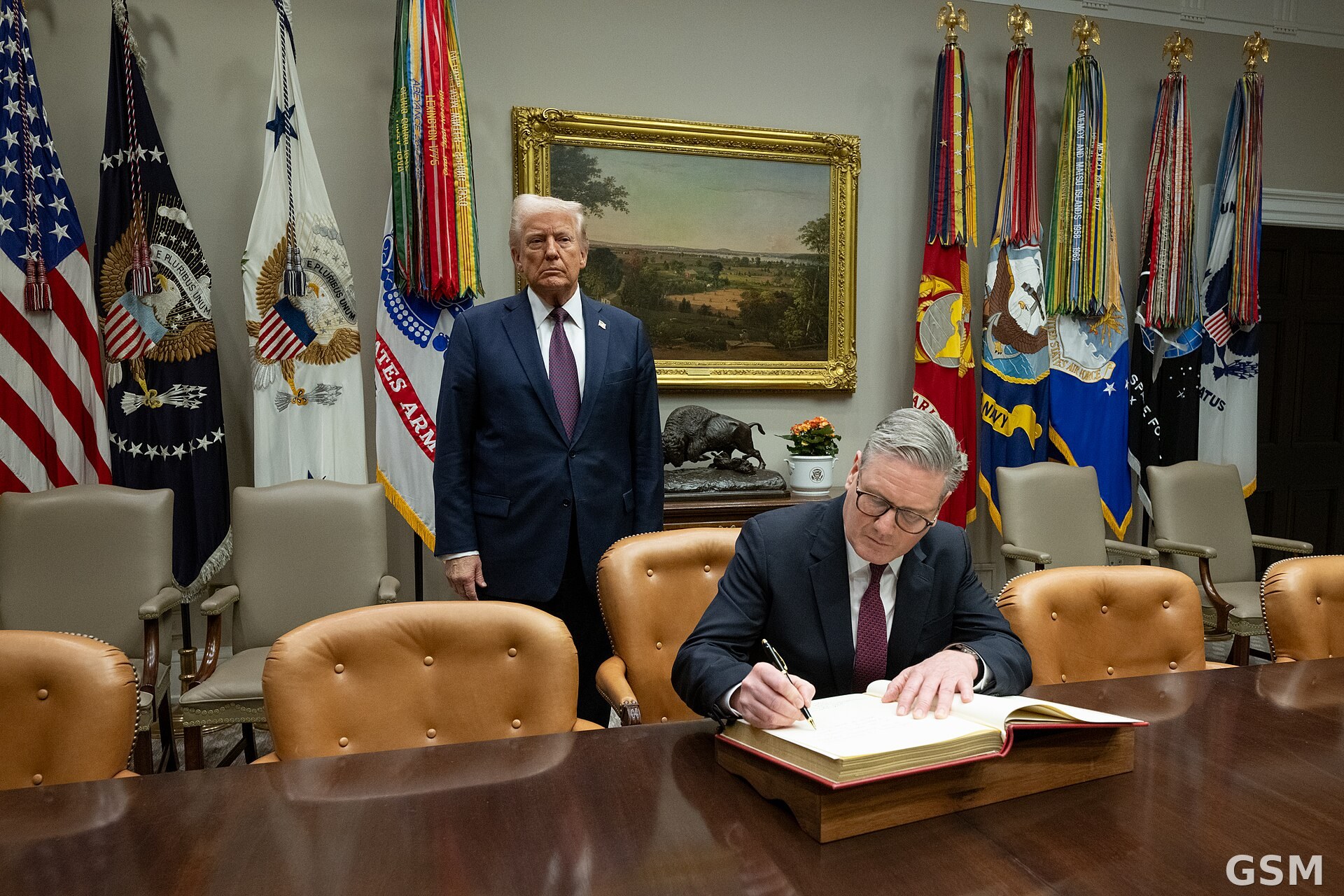
Photo: 图:2025年2月27日,英国首相斯塔默在白宫罗斯福厅签署留言簿,特朗普总统在旁(白宫官方照片,公共领域)。 / Photo: British Prime Minister Keir Starmer signs the guest book in the Roosevelt Room of the White House as President Trump looks on, February 27, 2025 (official White House photo, public domain).