Supreme Court Rules 6-3 That Federal Courts Lack Authority to Issue Universal Injunctions
On June 27, 2025, the Supreme Court ruled 6-3 in Washington that universal injunctions, also called nationwide injunctions, likely exceed the equitable authority that Congress granted federal courts in the Judiciary Act of 1789. The Court granted the federal government's applications for a partial stay, narrowing the injunctions entered in three cases to no broader than necessary to provide complete relief to each plaintiff with standing to sue.
The three consolidated cases, Trump v. CASA, Inc., Trump v. Washington, and Trump v. New Jersey, all grew out of Executive Order No. 14160, signed by President Trump on January 20, 2025. The order provides that a person born in the United States is not recognized as a citizen when the person's mother was unlawfully present, or lawfully but temporarily present, and the father was not a U.S. citizen or lawful permanent resident at the time of the birth. Individuals, organizations, and states sued, arguing that the order violates the Citizenship Clause of the Fourteenth Amendment and Section 201 of the Nationality Act of 1940; district courts for the District of Maryland, the Western District of Washington, and the District of Massachusetts each entered a universal preliminary injunction barring enforcement of the order against anyone, and each court of appeals denied the government's request to stay that sweeping relief.
Justice Amy Coney Barrett delivered the opinion of the Court, joined by Chief Justice John Roberts and Justices Clarence Thomas, Samuel Alito, Neil Gorsuch, and Brett Kavanaugh. The opinion held that the equitable authority granted by the Judiciary Act of 1789 covers only the sorts of remedies traditionally accorded by courts of equity at the founding, and that universal injunctions are not sufficiently analogous to any relief available in the English court of equity at that time. It also held that complete relief is not synonymous with universal relief: prohibiting enforcement of the order against an individual plaintiff's child gives that plaintiff complete relief, and extending the injunction to everyone similarly situated would not make her relief any more complete. The historic bill of peace invoked by the plaintiffs was no valid analogy either, the Court said; its modern analogue is the class action governed by Rule 23 of the Federal Rules of Civil Procedure. The Court left the states' argument, that only a universal injunction could give them complete relief, for the lower courts to consider in the first instance.
The Court expressly did not address whether Executive Order No. 14160 itself violates the Citizenship Clause or the Nationality Act, a question that remains before the lower courts. When a court concludes that the Executive Branch has acted unlawfully, the answer is not for the court to exceed its power, too, the majority wrote in closing. Justice Sonia Sotomayor filed a dissenting opinion joined by Justices Elena Kagan and Ketanji Brown Jackson, and Justice Jackson filed a separate dissent; Justices Thomas, Alito, and Kavanaugh each filed concurring opinions.
Related: Federal Judge Temporarily Blocks Trump's Order Ending Birthright Citizenship
(Source: Supreme Court of the United States)
Source: Supreme Court of the United States
Published by GSM · USA (original Chinese edition)
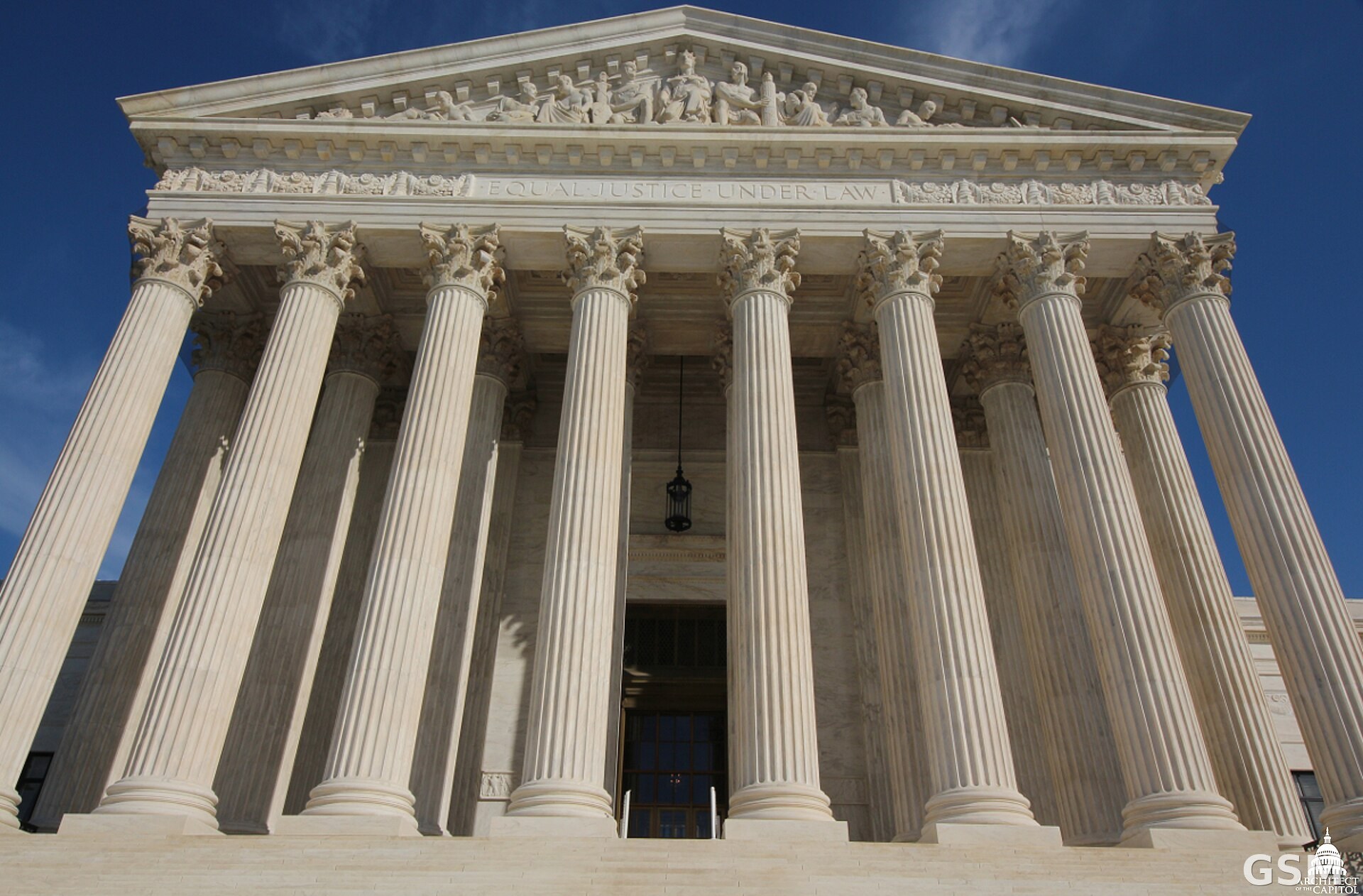
Photo: 图:位于华盛顿特区的美国最高法院大楼西立面。Architect of the Capitol 摄,公共领域,经 Wikimedia Commons。 / Photo: The west front of the U.S. Supreme Court Building in Washington, D.C. Photo by the Architect of the Capitol, public domain, via Wikimedia Commons.