Supreme Court Stays Injunction on Los Angeles Immigration Stops, Letting Federal Agents Continue Patrol Questioning
On September 8, 2025, the U.S. Supreme Court in Washington granted the federal government's application for a stay, freezing a July 11 order of the U.S. District Court for the Central District of California. That order had barred federal immigration agents in the Los Angeles area of California from stopping residents based on four factors alone, in a case that directly affects daily travel and work in Los Angeles County, California, and several neighboring counties.
The case is Noem v. Vasquez Perdomo, No. 25A169, under district court case No. 2:25-cv-5605. The Supreme Court's order states that the July 11 order is stayed pending disposition of the appeal in the U.S. Court of Appeals for the Ninth Circuit and disposition of a petition for a writ of certiorari, if one is timely sought; if certiorari is denied, the stay terminates automatically. The application was presented to Justice Kagan and referred by her to the Court, and the order itself carries no majority reasoning.
The four factors restricted by the stayed district court order are a person's apparent race or ethnicity, speaking Spanish or speaking English with an accent, presence at particular locations such as bus stops, car washes, day laborer pickup sites and agricultural sites, and the type of work the person does. The district court had found that the government's pattern of stops rested on those four factors alone.
Justice Kavanaugh wrote a separate concurrence. He wrote that the government had shown a fair prospect of success both on the plaintiffs' standing and on the Fourth Amendment issue, and that apparent ethnicity alone cannot furnish reasonable suspicion but can be a relevant factor when considered along with other salient factors. He also wrote that immigration officers may only briefly stop a person to inquire about immigration status, and that a person who is a U.S. citizen or otherwise lawfully present will be free to go after the brief encounter.
In his concurrence, Kavanaugh cited the government's estimates that at least 15 million people are in the United States illegally, and that about 10 percent of the people in the Los Angeles region, about 2 million out of a total population of 20 million, are illegally in the country. The Los Angeles area he described is the Central District of California, which includes Los Angeles, Ventura, Santa Barbara, San Luis Obispo, Orange, Riverside and San Bernardino counties.
Justice Sotomayor wrote a dissent, joined by Justices Kagan and Jackson. She wrote that in early June 2025 the government launched an immigration enforcement operation called Operation At Large across Los Angeles and its surrounding counties, with armed and masked agents stopping people at car washes, tow yards, farms and parks, and made nearly 2,800 immigration-related arrests over the course of the next month. She called the stay yet another grave misuse of the Court's emergency docket, writing that people should not have to live in a country where the government can seize anyone who looks Latino, speaks Spanish, and appears to work a low wage job.
The stay is only an interim arrangement while the appeal proceeds and does not decide the ultimate question of whether stops based on the four factors are constitutional. The case will continue first in the Ninth Circuit, after which the government may also seek Supreme Court review by certiorari. (Source: U.S. Supreme Court)
Source: U.S. Supreme Court
Published by GSM · USA (original Chinese edition)
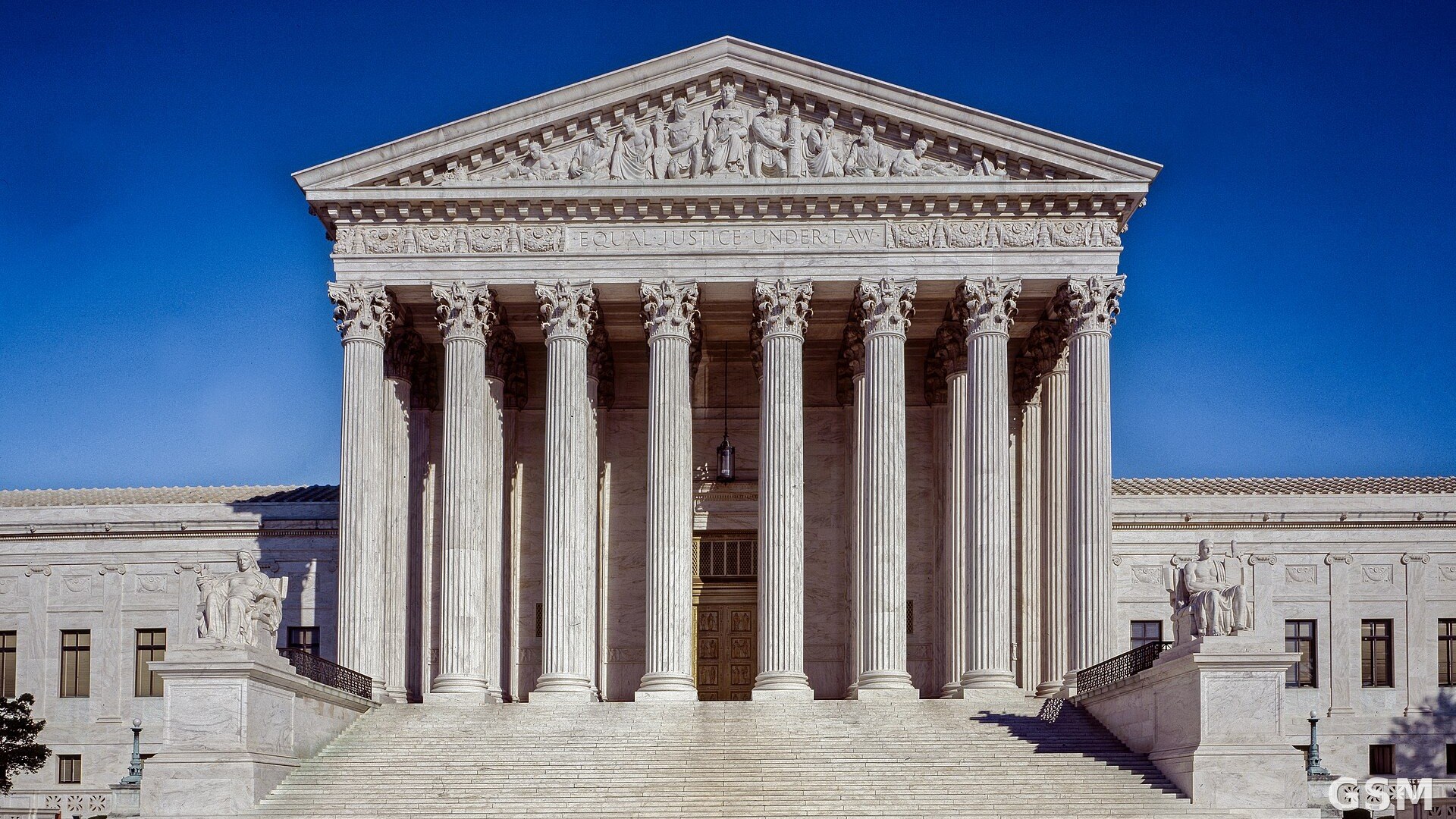
Photo: 图:位于华盛顿的美国最高法院大楼西立面(资料图)。摄影:Carol M. Highsmith,美国国会图书馆藏,无已知出版限制,经 Wikimedia Commons(File:U.S. Supreme Court building-m.jpg)。 / Photo: The west facade of the U.S. Supreme Court building in Washington, D.C. (file photo). Photo by Carol M. Highsmith, Library of Congress, no known restrictions on publication, via Wikimedia Commons (File: U.S. Supreme Court building-m.jpg).