Three Scientists Win the 2025 Nobel Prize in Physics for Discovering Macroscopic Quantum Tunnelling in an Electric Circuit
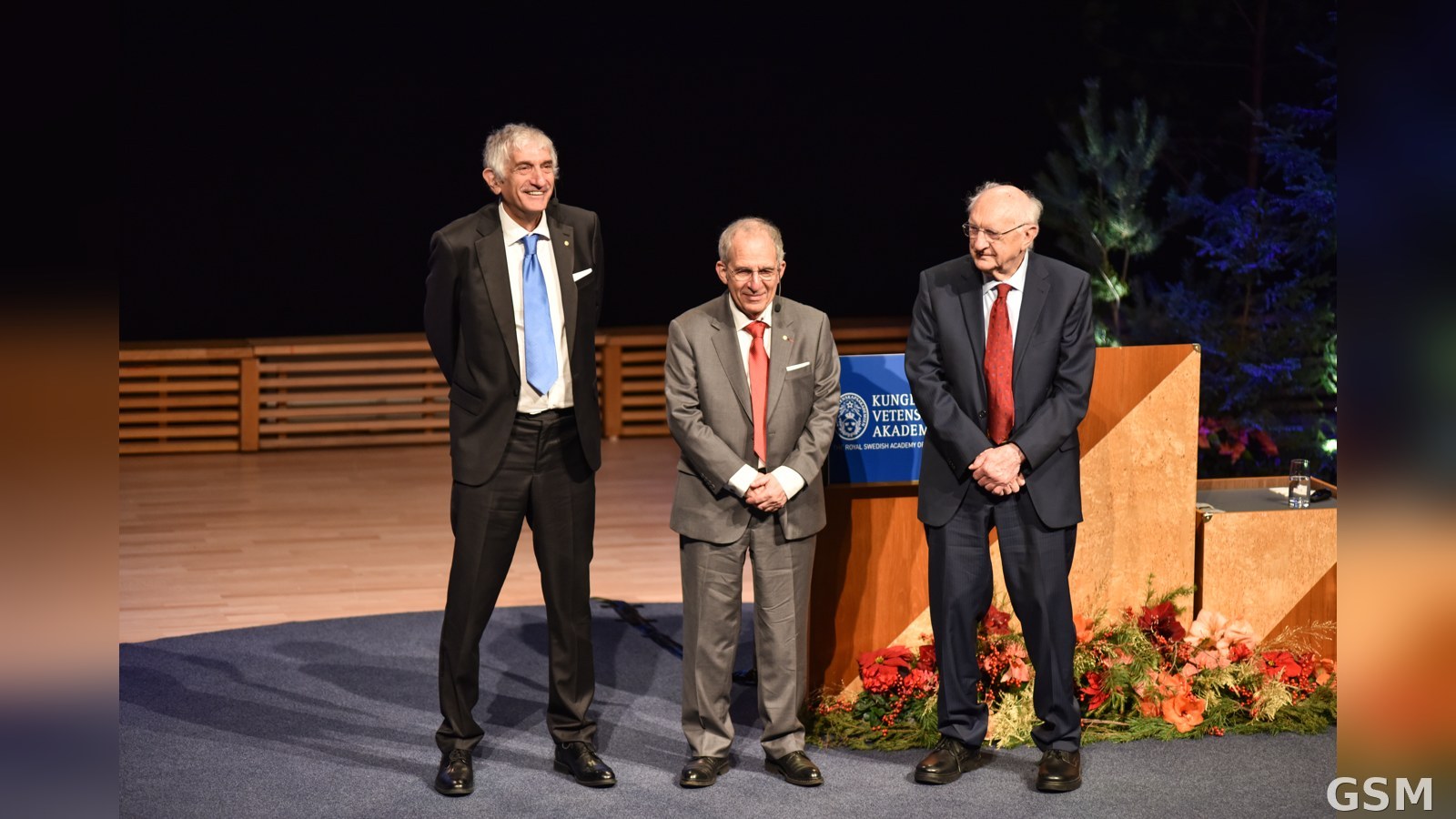
On October 7, 2025, in Stockholm, Sweden, the Royal Swedish Academy of Sciences announced that the Nobel Prize in Physics 2025 was awarded to John Clarke, Michel H. Devoret and John M. Martinis, for the discovery of macroscopic quantum mechanical tunnelling and energy quantisation in an electric circuit. The three will share the prize of 11 million Swedish kronor equally.
A major question in physics is the maximum size of a system that can demonstrate quantum mechanical effects. Working with an electrical circuit, the laureates demonstrated both quantum mechanical tunnelling and quantised energy levels in a system big enough to be held in the hand, showing that quantum mechanical properties can be made concrete on a macroscopic scale.
The experiments were conducted in 1984 and 1985. The circuit was built of superconductors, components that can conduct a current with no electrical resistance, separated by a thin layer of non-conductive material, a setup known as a Josephson junction. Together, the charged particles moving through the superconductor behaved as if they were a single particle that filled the entire circuit. The system began in a state in which current flowed without any voltage, as if trapped behind a barrier, and showed its quantum character by escaping that state through tunnelling, detected through the appearance of a voltage. The laureates also showed that the system only absorbs or emits specific amounts of energy, as quantum mechanics predicts.
Olle Eriksson, chair of the Nobel Committee for Physics, said it is wonderful to celebrate the way that century-old quantum mechanics continually offers new surprises, and that quantum mechanics is the foundation of all digital technology. The Academy said the prize has provided opportunities for developing the next generation of quantum technology, including quantum cryptography, quantum computers and quantum sensors. Clarke is at the University of California, Berkeley, Devoret is at Yale University, the University of California, Santa Barbara, and Google Quantum AI, and Martinis is at the University of California, Santa Barbara, and Qolab.
Related: Venezuelan Opposition Leader Machado Wins the 2025 Nobel Peace Prize
(Source: The Royal Swedish Academy of Sciences)
Source: The Royal Swedish Academy of Sciences
Published by GSM · USA (original Chinese edition)
Photo: 图:2025年诺贝尔物理学奖三位得主在斯德哥尔摩诺贝尔讲座期间合影。Karen Zhou,CC BY-SA 4.0,经 Wikimedia Commons。 / Photo: The three 2025 Nobel Prize in Physics laureates together during the Nobel Prize lectures in Stockholm. By Karen Zhou, CC BY-SA 4.0, via Wikimedia Commons.
- 2025-10-06Three Scientists Win the 2025 Nobel Prize in Medicine for Discovering the Immune System's Guard Cells
- 2025-10-07Three Scientists Win the 2025 Nobel Prize in Physics for Discovering Macroscopic Quantum Tunnelling in an Electric CircuitThis story
- 2025-10-08Three Scientists Win the 2025 Nobel Prize in Chemistry for Developing Metal-Organic Frameworks
- 2025-10-09Hungarian Author László Krasznahorkai Wins the 2025 Nobel Prize in Literature
- 2025-10-10Venezuelan Opposition Leader Machado Wins the 2025 Nobel Peace Prize
- 2025-10-13Three Scholars Win the 2025 Prize in Economic Sciences for Explaining Innovation-Driven Economic Growth