Supreme Court Grants Stay, Allowing Texas to Use New Congressional Map in the 2026 Midterms
The U.S. Supreme Court on December 4 granted Texas's application for a stay in Abbott v. League of United Latin American Citizens, No. 25A608, in Washington, pausing a federal district court's November 18 order that had barred Texas from using its newly drawn congressional map in the 2026 elections. The new map may therefore be used in the 2026 midterm elections.
In its order, the Court said that, based on a preliminary evaluation, Texas satisfied the traditional criteria for interim relief: Texas was likely to succeed on the merits because the district court had committed at least two serious errors, first by failing to honor the presumption of legislative good faith when it construed ambiguous direct and circumstantial evidence against the legislature, and second by failing to draw a dispositive or near-dispositive adverse inference against challengers who had not produced a viable alternative map. Texas had also made a strong showing of irreparable harm, the Court said, and the equities and public interest favored it, because lower federal courts should ordinarily not alter election rules on the eve of an election and the district court had improperly inserted itself into an active primary campaign, causing confusion and upsetting the delicate federal-state balance in elections.
Justice Samuel Alito, in a concurrence, wrote that the impetus for the Texas map, like the map subsequently adopted in California, was partisan advantage pure and simple, which was indisputable, and that although challengers bore the burden of disentangling race and politics, they had produced no alternative map serving the state's partisan aims, giving rise to a strong inference that the map was indeed based on partisanship, not race. Justice Kagan, in dissent, wrote that the district court, after a nine-day hearing with nearly two dozen witnesses and thousands of exhibits, had found that Texas largely divided its citizens along racial lines to create its new pro-Republican map in violation of the Fourteenth and Fifteenth Amendments, and that the Supreme Court's reversal on a cold paper record over a holiday weekend disrespected the district court's work and disserved the millions of Texans found to have been assigned to their new districts based on their race.
Texas adopted the first new map in this round of mid-decade redistricting, California responded with Proposition 50, and North Carolina followed suit. The stay remains in effect pending the Supreme Court's action on a timely filed appeal; if the appeal is dismissed or the judgment affirmed, the stay terminates automatically.
Related: Indiana Senate Rejects Congressional Redistricting 31 to 19, With 21 Republicans Voting No
Source: Supreme Court of the United States
Published by GSM · USA (original Chinese edition)
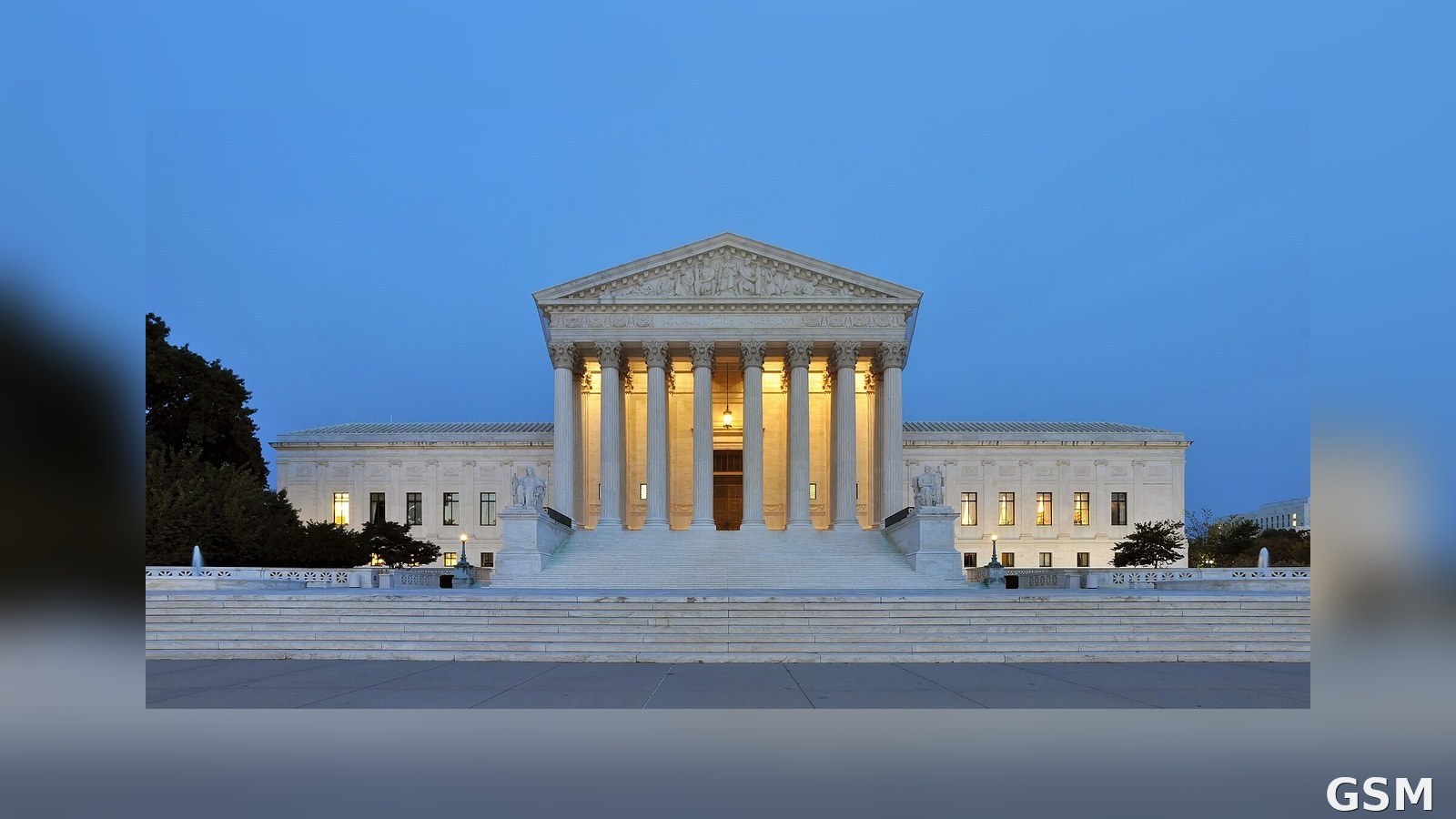
Photo: 图:位于美国华盛顿的美国最高法院大楼。Joe Ravi 摄,CC BY-SA 3.0,经 Wikimedia Commons(联邦固定图库标准图)。 / Photo: The Supreme Court building in Washington. Photo by Joe Ravi, CC BY-SA 3.0, via Wikimedia Commons (federal fixed-library image).
- 2025-12-04Supreme Court Grants Stay, Allowing Texas to Use New Congressional Map in the 2026 MidtermsThis story
- 2025-12-11Indiana Senate Rejects Congressional Redistricting 31 to 19, With 21 Republicans Voting No