CDC Analysis of 4,861 Sudden Unexpected Infant Deaths: At Least 73% Involved Unsafe Sleep Factors, With About 3,400 U.S. Infant Deaths Each Year
The U.S. Centers for Disease Control and Prevention (CDC) published an analysis in Morbidity and Mortality Weekly Report (MMWR) on September 10, 2026: researchers reviewed 4,861 sudden unexpected infant deaths (SUIDs) recorded across 31 jurisdictions during 2020-2024 and found that at least 73 percent involved unsafe sleep factors. SUID includes sudden infant death syndrome, accidental suffocation and strangulation in bed, and deaths of unknown cause, and accounts for approximately 3,400 deaths among U.S. infants under age 1 each year.
Most decedents were aged 0-3 months (66 percent), male (57 percent), Black or African American (38 percent) or White (37 percent), born full-term at 37 or more weeks of gestation (74 percent), and insured by Medicaid (69 percent). The CDC case registry covers 32 jurisdictions and captures roughly two in five U.S. SUIDs, compiling sleep-environment details that vital statistics alone do not contain.
Unsafe sleep factors were common: 78 percent of the infants had soft bedding in the sleep environment, 75 percent were on a surface other than a crib, 59 percent were sharing a sleep surface, 46 percent were found in a nonsupine position, and 28 percent had documented full airway obstruction. Under the registry classification algorithm, 19 percent were categorized as explained suffocation with unsafe sleep factors; among those, soft bedding accounted for 74 percent of attributed mechanisms, overlay by a person or animal for 24 percent, and wedging for 8 percent.
The American Academy of Pediatrics recommends that infants sleep supine on a flat, firm, nonshared surface such as a crib or bassinet, without soft bedding. The report notes that U.S. SUID rates fell during the 1990s as safe-sleep guidance spread, but rose again from 92.9 to 100.9 per 100,000 live births between 2020 and 2022.
Nearly all cases had an autopsy (98 percent) and a death investigation (98 percent), including toxicology testing (95 percent) and imaging (89 percent), yet only 50 percent documented a death-scene re-creation and information on found position or airway obstruction was missing in 15 percent and 33 percent of cases. The authors note the registry population, drawn from 31 jurisdictions and about 40 percent of U.S. SUIDs, is not fully generalizable nationwide.
Published by GSM · USA (original Chinese edition)
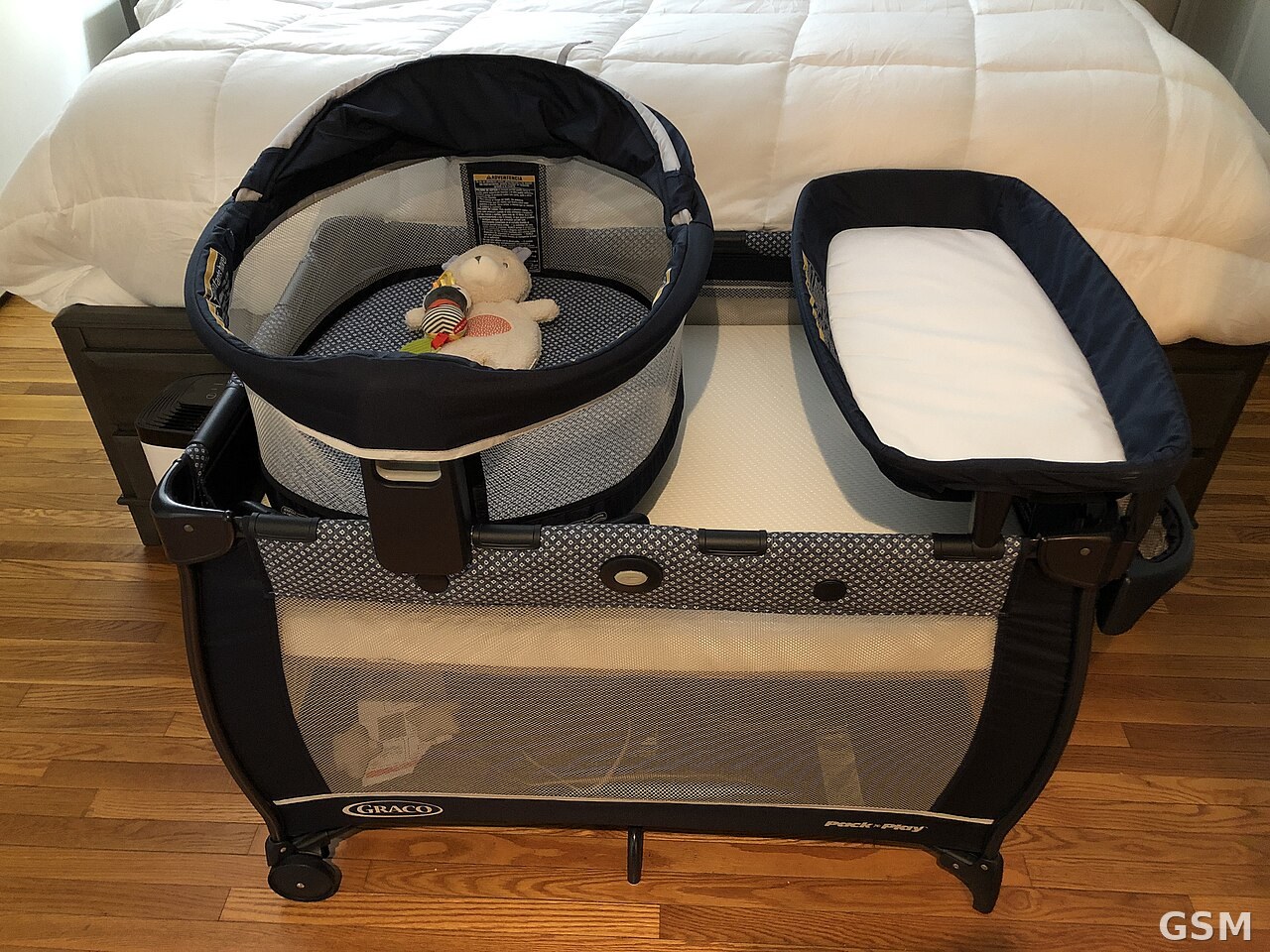
Photo: 图:婴儿游戏床与摇篮(资料图)。图片来源:Famartin 摄,Wikimedia Commons,CC BY-SA 4.0。Photo: An infant play yard and bassinet (illustrative). Credit: Famartin, Wikimedia Commons, CC BY-SA 4.0.