2026 Nobel Economics Prize Awarded to Hall and Woodford for Microfoundations of Macroeconomic Stabilisation
The final prize of the 2026 Nobel season has been announced. The Royal Swedish Academy of Sciences announced in Stockholm on October 12 that the 2026 Sveriges Riksbank Prize in Economic Sciences in Memory of Alfred Nobel has been awarded to American economists Robert E. Hall and Michael Woodford, "for microeconomic foundations of macroeconomic stabilisation." The two laureates will share the 12 million Swedish kronor prize (about $1.2 million) equally.
The Academy said the laureates developed new macroeconomic models that have significantly improved policymakers' ability to implement effective stabilisation policy: on the basis of these models, well-timed fiscal and monetary measures can reduce the economy's peaks and troughs. This is not abstract for ordinary people — when the economy swings wildly, the poorest families with the least room to absorb risk suffer most.
The prizewinning work addressed a half-century crisis in macroeconomics. Since Keynes, cutting rates and expanding spending in recessions and tapping the brakes in booms has been the basic logic of stabilisation policy. But the oil crises of the 1970s shattered the old models: traditional Keynesian models, built on statistical links between macro variables such as inflation, unemployment and consumption, failed in the face of stagflation — unemployment rose while inflation ran out of control, leaving a decade of low growth and high inflation. As later laureate Lucas and others argued sharply, the old models' fatal flaw was assuming macro relationships were fixed; to rebuild stabilisation policy, models had to start from the micro level — understanding how the decisions of millions of households and businesses aggregate into macro outcomes. Hall and Woodford are the two who completed this reconstruction, and their work is collectively known as the "New Keynesian paradigm."
Hall's breakthrough began with a 1978 paper. He turned consumption research upside down: since how much a household spends depends on expectations of future income, consumption itself is the best indicator of expectations; only unpredictable new information changes expectations and thus spending — so changes in consumption should in theory be unpredictable. With Mishkin in 1982, he tested this with household microdata and found about 80 percent of households consume in this forward-looking way, while the rest live hand to mouth — a measurable split that remains a standard component of central-bank models today. Hall, born in Palo Alto, California in 1943, earned his PhD at MIT in 1967 and is now a professor at Stanford University. He has chaired the NBER Business Cycle Dating Committee — the body that dates U.S. recessions — since 1978, and served as president of the American Economic Association in 2010.
Woodford completed the synthesis. His 2003 book Interest and Prices presented the complete three-equation New Keynesian model that became the prototype for all such models since — a policy laboratory for decision-makers, where one can simulate in advance where rate cuts would push GDP and inflation, or how much to raise rates to contain inflation. He modernised Swedish economist Wicksell's "natural rate" idea, showing central banks can stimulate or restrain the economy by adjusting interest rates rather than controlling the money supply. He showed that with sticky prices, firms' price-setting must be forward-looking, yielding a conclusion of profound influence on modern central banks — expectations matter enormously, and a central bank's credibility and transparent communication are themselves policy tools. This is the theoretical origin of today's emphasis on "forward guidance." His concept of the "output gap" gave a yardstick for how far an economy stands from efficient resource use; stabilisation policy's task is to push the gap toward zero. Woodford, born in Chicopee, Massachusetts in 1955, earned his PhD at MIT in 1983 and is now a professor at Columbia University.
Today the New Keynesian model is standard equipment at central banks and finance ministries worldwide. The Academy noted that recessions and high inflation have not disappeared, but they last shorter than before, and recent major crises have not degenerated into 1930s-style depressions — not unrelated to this policy framework.
The economics prize was not among the five prizes established in Nobel's will; it was created by Sweden's central bank in 1968 to mark its 300th anniversary and first awarded in 1969. The award ceremony will be held in Stockholm on December 10. With Monday's announcement, the 2026 Nobel season is complete.
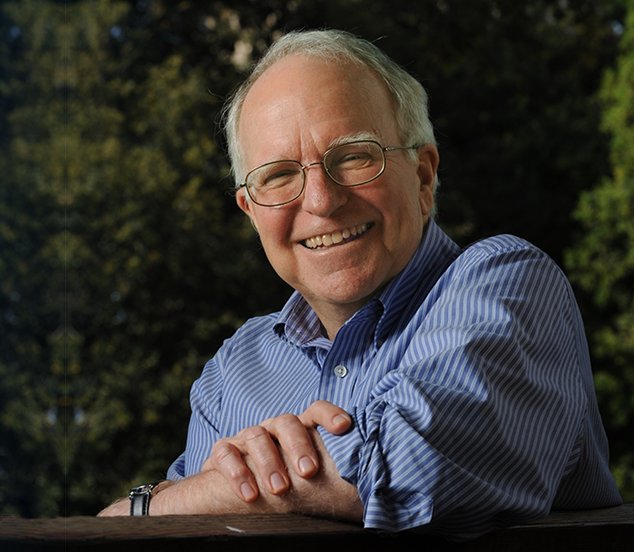
(Image: Robert E. Hall, Wikimedia Commons, CC0)
Related:
2026 Nobel Prize in Physiology or Medicine: Optogenetics Pioneers Deisseroth, Hegemann and Nagel
Source: GSM · USA (original Chinese edition)
Photo: 图:2026年诺贝尔经济学奖得主之一、斯坦福大学胡佛研究所经济学家罗伯特·霍尔(资料图)