Belgium's Public Sector Strike Enters a Second Day as Budget Deadlock Forces PM to Cancel State of the Union Address
BRUSSELS — Belgium's public sector was partially shut down on Monday, October 12, as unions staged a second day of nationwide strike action against planned government budget cuts, disrupting rail services, public transport, public broadcasting and schools across the country, Reuters reported. Political pressure on Prime Minister Bart De Wever is mounting over a stalled federal budget agreement.
The action began on Friday, October 9, when thousands of protesters marched in Brussels in a mass demonstration that ended with a small group clashing with police. No large-scale demonstration was planned in the capital on Monday, but the disruption to daily services widened: train frequencies were reduced, urban transit ran restricted schedules, public broadcasters adjusted programming, and some schools closed or curtailed teaching.
At the heart of the dispute is the federal budget. Over the weekend, the prime minister's office said coalition partners had failed to reach agreement on a new budget, forcing De Wever to cancel his planned State of the Union address to parliament on Tuesday, October 13, while talks continue. De Wever said on Thursday that painful budget measures are needed now to avert a looming debt and interest-cost spiral that would otherwise leave future generations with a heavy bill.
Belgian media reported that a budget deal could be delayed until late October or early November, and that a prolonged deadlock would strain the cohesion of the governing coalition. Belgium hosts the headquarters of the European Union and NATO, so public-sector strikes directly affect residents, cross-border commuters and international-institution staff alike. The unions frame the walkout as pressure against the planned cuts, and the course of the budget talks will determine whether larger actions follow.
The operational impact sharpened on Monday: the rail strike ran from 22:00 on Sunday until the last train on Monday, with national operator SNCB/NMBS running a reduced timetable of about seven in ten intercity trains, half of local and suburban services and only about one in five peak-hour extras; Flemish operator De Lijn reported around 39 percent of its vehicles off the road, and waste collection was also affected. Brussels Airport expected flights to operate normally, though surface access to the terminal was much harder. The unions are also demanding fairer taxation of wealth, arguing that workers should not shoulder the cost of austerity alone.
Source: Compiled from Reuters reporting from Brussels, October 12, 2026.
Source: GSM · USA (original Chinese edition)
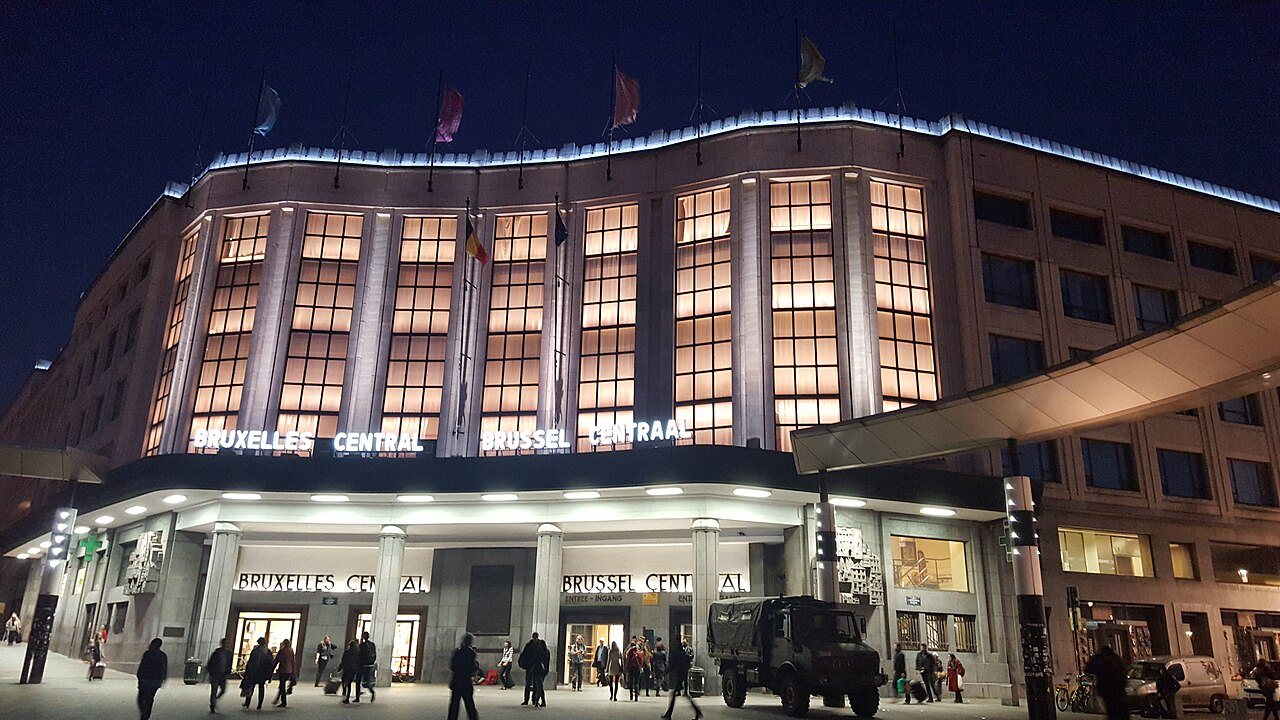
Photo: 布鲁塞尔中央车站夜景,Romaine 摄,CC0(Wikimedia Commons)