Stanford Seminar on Innovation Clusters Spotlights University Cooperation and the Greater Bay Area's Cross-Border Campuses
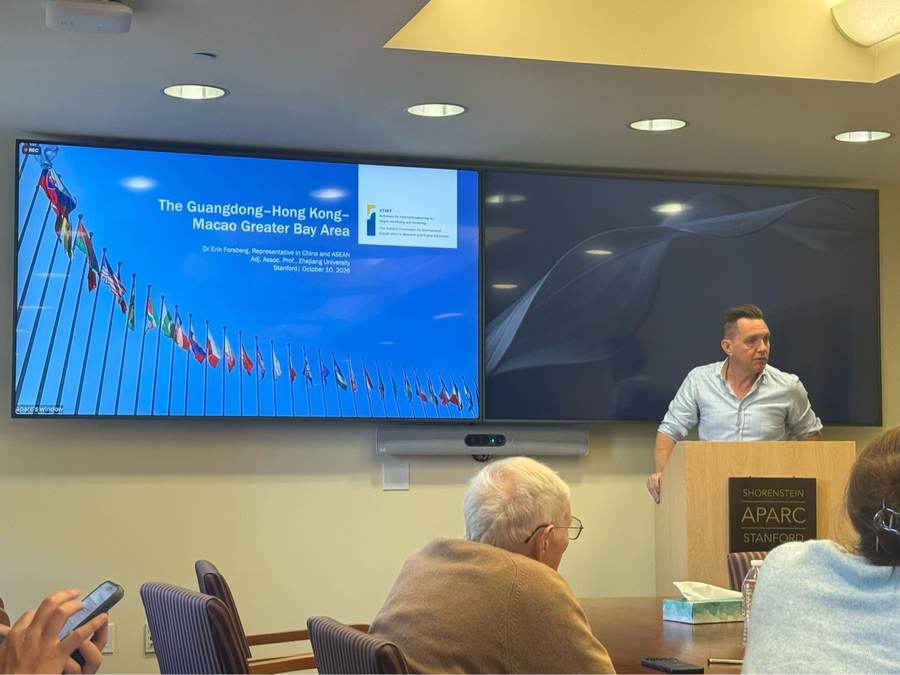
Stanford — Stanford University is located in Santa Clara County, California. On the afternoon of October 13, Stanford University's Shorenstein Asia-Pacific Research Center (APARC) hosted a seminar titled "Two Routes to Scale: Innovation Clusters in Tokyo-Yokohama and the Greater Bay Area" in the Okimoto Conference Room of Encina Hall. Three scholars from STINT, the Swedish Foundation for International Cooperation in Research and Higher Education, presented observations from the foundation's Science Intelligence program, examining the university research ecosystems and cross-border collaboration behind two of the world's leading innovation clusters.
Tokyo-Yokohama and Shenzhen-Hong Kong-Guangzhou in China's Greater Bay Area are the world's two top science and innovation clusters: in the World Intellectual Property Organization's (WIPO) Global Innovation Index 2025 cluster ranking, Shenzhen-Hong Kong-Guangzhou placed first globally and Tokyo-Yokohama second.
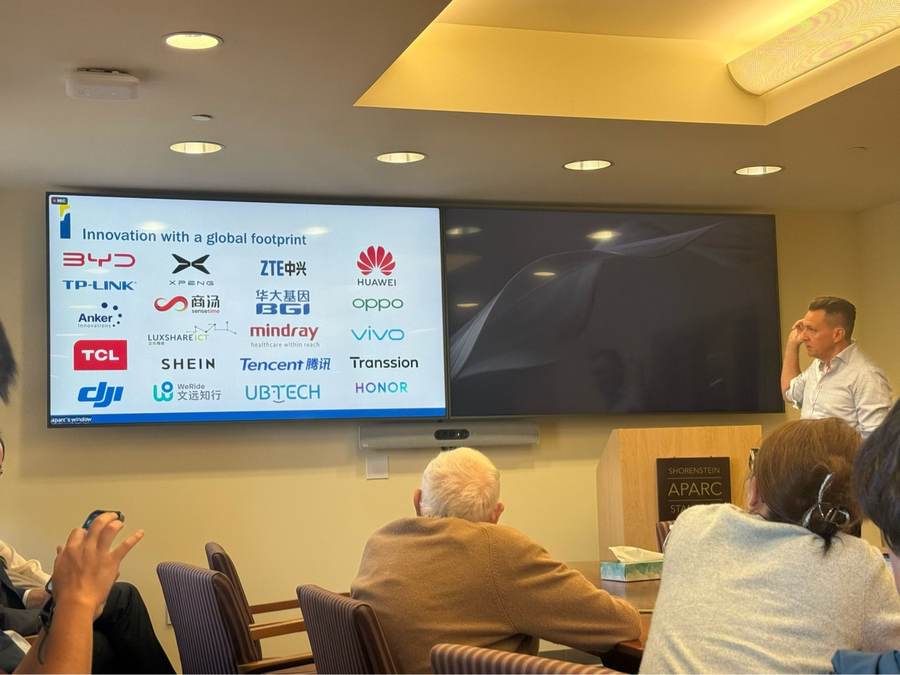
STINT Executive Director Dr. Andreas Göthenberg opened by sharing the foundation's perspectives on the global science and innovation landscape. Dr. Erik Forsberg, STINT's Representative in China and ASEAN, then presented on the Greater Bay Area. Forsberg has worked in China for more than 17 years and is currently an Adjunct Associate Professor at Zhejiang University. In a presentation titled "Innovation with a global footprint," he used a single slide listing nearly 20 Chinese technology companies with global operations — including BYD, Huawei, DJI, Tencent, XPeng, ZTE, SenseTime, BGI, Mindray, Anker, TCL and SHEIN — as background for the Bay Area's shift from a manufacturing base toward a source of original innovation.
A central theme of Forsberg's talk was the cross-border university cooperation behind the Greater Bay Area's branch campuses. He described two waves: a first wave beginning in the early 2000s, when leading universities from northern China — Tsinghua University, Peking University and Harbin Institute of Technology — set up graduate schools in Shenzhen; and a second wave from 2014, as Hong Kong universities moved north — the Chinese University of Hong Kong, Shenzhen (established 2014), the Hong Kong University of Science and Technology (Guangzhou) (opened 2022) and City University of Hong Kong (Dongguan) (completed 2024). Sun Yat-sen University also operates campuses in Zhuhai and Shenzhen, and the University of Macau's main campus is located on Hengqin Island in Zhuhai. For international partners, Forsberg noted, Hong Kong's institutional alignment and governance experience offer a distinctive bridge into the mainland.
Dr. Laura Barbieri, a STINT Science Fellow in Japan and South Korea based in Tokyo and a visiting scholar at the National Graduate Institute for Policy Studies (GRIPS), presented on the Tokyo-Yokohama cluster.
Sources: Stanford Shorenstein APARC event page; STINT official website; GSM on-site reporting.
Source: GSM · USA (original Chinese edition)
Photo: Forsberg 博士在斯坦福大学 APARC 研讨会上主讲粤港澳大湾区(GSM 记者现场拍摄,2026年10月13日)