
Legal Terms Explained: What "Tax Fraud" and "Asset Misappropriation" Actually Mean Under U.S. Law
"Tax fraud" and "asset misappropriation" are heavyweight terms often tossed around casually in community conversation. Under U.S. law, each has a strict definition and a defined set of elements, and whether either is established — and who gets to decide — follows a set process. This installment of Legal Terms Explained breaks down both terms element by element, based on current federal and California statutes, and closes with a checklist of other offenses that commonly trip people up in everyday life.
1. Tax Fraud
In plain terms: it is not "making a mistake on a tax return." It is knowingly owing tax and deliberately using deception or concealment to evade it — the core is willfulness and deceit.
Elements: The federal crime of tax evasion (26 U.S.C. § 7201) requires three things: a tax actually due and owing that was underpaid (a tax deficiency); an affirmative act of deception, such as concealing income or falsifying books; and willfulness — voluntarily violating a known legal duty (the standard set by the U.S. Supreme Court in Cheek v. United States). Willfully making a false statement in a return or document is separately punishable under § 7206. Section 7201 is a felony carrying up to five years' imprisonment; § 7206 up to three years. Where the conduct does not rise to the criminal level, the IRS may impose a civil fraud penalty of 75% of the portion of the underpayment attributable to fraud (§ 6663), and fraud must be proven by the IRS by clear and convincing evidence — the burden of proof is on the agency (§ 7491(c)). In California, the civil fraud penalty appears at Revenue and Taxation Code § 19164, and willfully filing a false return or making a false statement to evade tax is a misdemeanor under § 19705, punishable by fine and imprisonment.
Who decides: The IRS examines and investigates; criminal cases are referred to the U.S. Department of Justice; a prosecutor must bring charges and prove guilt beyond a reasonable doubt at trial, and the accused is presumed innocent until convicted. Until that process runs its course, no one can declare another person "a tax fraudster."
Three common misconceptions: First, an error is not fraud. Negligence — a careless mistake or a misunderstanding — results in back taxes plus a 20% accuracy-related penalty (§ 6662), not a crime. Second, filing status is a statutory choice: married filing separately, or filing as single or head of household after a divorce, are statuses the tax code itself provides — filing separately after separation or divorce is entirely lawful. Third, a person who fails to meet his or her own filing obligation bears the penalty personally; how liability for jointly filed years is allocated is decided on the records and through established procedures, not by anyone's accusation.
2. Asset Misappropriation (Conversion / Embezzlement)
In plain terms: the Chinese term "qinzhan" (侵占) maps onto two distinct concepts in U.S. law — conversion in civil law (wrongful dominion over another's property) and embezzlement in criminal law (fraudulent appropriation by a person in a position of trust). Both share one premise: the property must belong to someone else.
Elements: A civil conversion claim requires that the plaintiff own, or have the right to possess, the property; that the defendant, without authority, exercised dominion over it in a way that excluded the owner's rights — for example, disposing of it or refusing to return it; and that the plaintiff suffered resulting damages. Criminal embezzlement, under California Penal Code § 503, means property was first lawfully entrusted to the person and then fraudulently appropriated — "entrusted first, diverted second" — and the property is another's.
A key clarification — marital property follows different rules: California is a community-property state. Property acquired during marriage is presumed to be community property (Family Code § 760); during the marriage, both spouses have management and control rights over community property (§ 1100); and at divorce, the family court divides it according to law (§ 2550). Disputes over the use of jointly owned property — living in a jointly owned home, collecting rental income — are therefore matters of property division and expense accounting within the divorce proceeding: the court determines, item by item, when the property was acquired (before or during the marriage), under whose name it is titled, and whether it was commingled with separate property, and it credits occupancy and advances. Until a court finds that property is purely one spouse's separate property, calling the other spouse's use of shared property "misappropriation" has no legal footing.
3. Other Offenses That Commonly Trip People Up
The following offenses, which people run into most often in everyday life, are summarized in the same format. The penalties stated are general statutory ranges; actual outcomes depend on the circumstances, the person's record, and prosecutorial discretion. This section is based on California law, with federal provisions noted separately; offenses and penalties differ from state to state, and the law of the state where the conduct occurs controls.
1. DUI (Driving Under the Influence): Driving under the influence of alcohol or drugs violates Vehicle Code § 23152 and is generally a misdemeanor, rising to a felony where it causes serious injury or death, or on repeat offenses. The common trap is judging oneself "only had two drinks, perfectly sober" and driving anyway, or taking a chance driving home after a holiday gathering. Typical consequences are fines that, with penalty assessments, run to several thousand dollars, a driver's license suspension of about six months, and county jail time (often suspended for first offenders on probation), plus a criminal record.
2. Hit and Run: Leaving the scene of an accident without stopping and providing identification and insurance information violates Vehicle Code §§ 20001 and 20002; property-damage-only cases are misdemeanors, while cases involving injury or death are wobblers chargeable as either a misdemeanor or a felony. The common trap is scraping a parked car and driving off because "no one saw it," or leaving a minor collision without exchanging information. Consequences range from up to six months in county jail and fines for the misdemeanor, to two, three, or four years' imprisonment where someone is seriously injured or killed, plus license revocation and civil liability.
3. Shoplifting and Self-Checkout Skip-Scanning (Shoplifting / Theft): Entering an open commercial establishment with intent to steal property worth $950 or less is shoplifting under Penal Code § 459.5, a misdemeanor; deliberately failing to scan items at a self-checkout is theft under §§ 484 and 488. The common trap is treating "skipping just one or two small items" as no big deal, or concealing merchandise in a personal bag and walking out. Consequences include up to six months in county jail and a $1,000 fine, plus a theft record; since Proposition 36 took effect in 2024, repeat theft offenders can face felony charges, and non-citizens may also suffer immigration and naturalization consequences.
4. Domestic Violence: Inflicting physical violence on a spouse, cohabitant, or fellow parent of one's child is domestic battery under Penal Code § 243(e)(1), a misdemeanor; where it causes bodily injury, § 273.5 applies and may be charged as a misdemeanor or a felony. The common trap is pushing, grabbing, or hitting during an argument — even where the injury is slight and the other party later has second thoughts, police who respond commonly make an arrest, and the decision to prosecute rests with the prosecutor, not with either party. Consequences include up to one year in county jail for the misdemeanor, two, three, or four years for a § 273.5 felony, mandatory batterer-intervention programs and court protective orders, and for non-citizens, deportation and a lifetime firearms ban.
5. Leaving a Young Child Alone in a Car (Child Left Unattended in Vehicle / Child Endangerment): Vehicle Code § 15620 (known as "Kaitlyn's Law") prohibits leaving a child age six or younger alone in a vehicle without supervision by a person at least twelve years old — in particular where the engine is left running, the keys are in the ignition, or conditions present a significant risk to the child's health or safety; in serious cases, Penal Code § 273a child endangerment also applies, as a misdemeanor or a felony. The common trap is "just grabbing a coffee, back in five minutes," leaving a sleeping toddler in a parked car. Consequences are an infraction with a $100 fine under § 15620, but where a child is placed in circumstances likely to produce great bodily harm or death, a § 273a felony carries two, four, or six years.
6. Structuring: Banks must file a currency transaction report with the Treasury Department for cash transactions over $10,000; breaking cash into smaller deposits or transfers for the purpose of evading that reporting requirement is a standalone federal crime under 31 U.S.C. § 5324. The common trap is following advice to "deposit only nine thousand at a time, spread over several days" — even if the money is entirely legitimate, the act of splitting it is itself the crime. Consequences are a federal felony carrying up to five years' imprisonment, and up to ten years plus doubled fines where the pattern involves more than $100,000 in a twelve-month period.
7. Unreported Foreign Accounts and Foreign Income (FBAR / Unreported Foreign Income): U.S. tax residents whose foreign bank and financial accounts exceed $10,000 in aggregate at any point during the year must file an FBAR (FinCEN Form 114) annually; the United States also taxes worldwide income, so interest, rent, and business income from foreign accounts must be reported on the tax return. The common trap is assuming "the money is overseas, the U.S. can't see it," and going for years filing neither FBARs nor reporting the income, or omitting accounts one actually controls. Consequences include a maximum penalty of $10,000 per non-willful FBAR failure, while willful failures can be penalized at the greater of an inflation-adjusted $100,000 or 50% of the account balance, with criminal exposure as well, and unreported income is separately subject to back taxes and penalties under the tax-evasion rules.
8. Moving Money for Others (Money Laundering / Money Mule): Knowingly — or deliberately avoiding knowledge — using one's own account to receive and move funds from an improper source for others, taking a cut, can constitute federal money laundering (18 U.S.C. §§ 1956, 1957), and transmitting money for others without a license separately violates § 1960. The common trap is online gig offers like "receive and forward payments, earn commission for passing money through," or an acquaintance asking to "run one transfer through your account" for a fee. Consequences include up to twenty years' imprisonment and fines for laundering, and even those who claim ignorance commonly face frozen accounts, seized funds, and bank account closures first.
9. Unlicensed Business (Contracting, Massage, Food Service): In California, contracting for construction work of $500 or more (labor and materials combined) requires a contractor's license, and contracting without one violates Business and Professions Code § 7028; massage services must comply with California Massage Therapy Council (CAMTC) certification and local permit requirements; and operating a food business requires a food facility permit from the county health department first. The common traps are taking renovation jobs by word of mouth, running a massage studio out of a home, or selling home-cooked meals for delivery — all unlicensed operations. Consequences include, for a first unlicensed-contracting offense, a fine of up to $5,000 and up to six months in county jail, shutdown orders for the business, and the practical problem that amounts owed to an unlicensed operator are hard to recover in court.
10. Paying Wages in Cash to Evade Payroll Taxes (Payroll Tax Evasion): Employers must withhold and pay over employee income and payroll taxes and report wages to the state Employment Development Department (EDD); willfully failing to withhold or pay over is a felony under 26 U.S.C. § 7202. The common trap, especially in restaurants, construction, and retail, is paying all-cash "under the table" wages that are never booked or reported. Consequences include up to five years' imprisonment, plus back taxes, interest, and penalties, and at the state level, recovery of unemployment insurance contributions and fines, with business licenses at risk in serious cases.
11. Selling Counterfeit Goods: Manufacturing, selling, or possessing for sale goods bearing a counterfeit registered trademark violates California Penal Code § 350, and at the federal level, trademark counterfeiting under 18 U.S.C. § 2320. The common trap is selling "high-quality replica" brand-name bags, shoes, and watches at swap meets, online shops, or livestream sales — openly saying they are imitations is still unlawful. Consequences depend on quantity and value and may be charged as a misdemeanor or a felony, with fines, imprisonment, and seizure and destruction of the counterfeit goods, and trademark owners may also sue civilly.
12. Criminal Threats: Threatening, orally, in writing, or by electronic communication, to kill or seriously injure another person, in a way that puts the person in sustained fear, is a criminal threat under Penal Code § 422, chargeable as a misdemeanor or a felony and counted as a serious "strike" offense. The common trap is firing off angry texts or WeChat messages in a dispute — "I'll kill you," "your whole family will never know peace" — and later claiming they were empty words never meant to be carried out; charges may still be filed. Consequences include up to one year in county jail as a misdemeanor, state prison as a felony, and possible criminal protective orders.
13. False Statements to Law Enforcement: Making a materially false statement to federal law enforcement or investigators in a federal matter violates 18 U.S.C. § 1001; in California, providing a false name or other false identifying information to an officer separately violates Penal Code § 148.9. The common trap is making something up on the spot when questioned or interviewed — concealing one's identity, denying being present, or covering for someone else. Consequences include up to five years' imprisonment for the federal offense, and in practice, many people end up punished most heavily for this "lying offense" rather than for the matter originally under investigation.
(The Lying-and-False-Accusation Group)
14. False Report of a Crime: Knowingly reporting to police, prosecutors, or similar authorities that a felony or misdemeanor has been committed, when the report is false, violates Penal Code § 148.5 and is a misdemeanor. The common trap is calling the police during a dispute to gain leverage — claiming the other party "stole something" or "hit me," or exaggerating and fabricating facts to pressure them. Consequences include up to six months in county jail and a $1,000 fine, and where a false accusation leads to an arrest or a search, the accuser may also face a civil claim from the person accused.
15. Perjury: Willfully making a false statement on a material matter after taking an oath — including testimony in court, sworn declarations, deposition testimony, and documents signed under penalty of perjury — is perjury under Penal Code §§ 118 and 118a, a felony. The common trap is concealing assets or understating income in sworn filings in divorce, debt, or accident litigation, or testifying falsely on someone else's behalf. Consequences are two, three, or four years' imprisonment, and once convicted, a person's credibility as a witness will be questioned in every later case.
16. Malicious Prosecution: This is not a crime but a civil tort claim — a person who was subjected to a criminal prosecution (or similar proceeding) that was initiated or continued with malice and without probable cause, and that ended in that person's favor, may sue in return for damages. The common trap is using police reports and lawsuits as leverage — pushing proceedings one knows cannot stand, simply to wear the other side down. Consequences include liability for the other side's attorney's fees and reputational and emotional-distress damages, punitive damages in egregious cases, and professional discipline exposure for any attorney who participated.
4. Who Has the Power to "Convict"
In plain terms: no private individual has that power. In the United States, a criminal charge can only be brought by a prosecutor in court, proven at trial beyond a reasonable doubt, and decided by a judge or jury; criminal tax cases must first pass through IRS investigation. Before that, a public accusation in a WeChat group or online is, in law, merely an allegation, with no legal effect.
The accuser, by contrast, answers for his or her own words: under California Civil Code §§ 45 and 45a, publishing false statements in writing that harm another's reputation is libel; falsely accusing someone of a crime is libel per se, for which the person accused need not separately prove actual damages to recover. Someone who casually pronounces others guilty has put himself or herself next to the defendant's table.
5. General Self-Protection Points When Publicly Accused
First, do not argue or try to prove innocence in public: online sparring produces no legal benefit and can be quoted out of context; what matters is the record. Second, preserve complete records: save the time, platform, full text, and original screenshots of the other party's statements, including anything relayed by third parties. Third, respond only to formal documents: an attorney's letter, a court summons, or an official notice from a tax authority is what requires action — hand it to your own attorney immediately and act within the legal deadlines; online shouting is not a legal proceeding and needs no reply. Fourth, rely on original records: tax and property disputes ultimately turn on returns, contracts, transfers, and title documents — preserve those originals intact and unaltered.
Principal sources: 26 U.S.C. §§ 7201, 7206, 6662, 6663, 7491(c), 7202; 18 U.S.C. §§ 1001, 1956, 1957, 1960, 2320; 31 U.S.C. §§ 5321, 5324; IRS.gov and FinCEN FBAR guidance; California Revenue and Taxation Code §§ 19705, 19164; California Penal Code §§ 118, 118a, 148.5, 148.9, 243(e)(1), 273.5, 273a, 350, 422, 459.5, 503; Vehicle Code §§ 23152, 20001, 20002, 15620; Business and Professions Code § 7028; Family Code §§ 760, 1100, 2550; Civil Code §§ 45, 45a.
This article is general legal information, not legal advice. For a specific matter, consult a licensed attorney.
Published by GSM · USA (original Chinese edition)
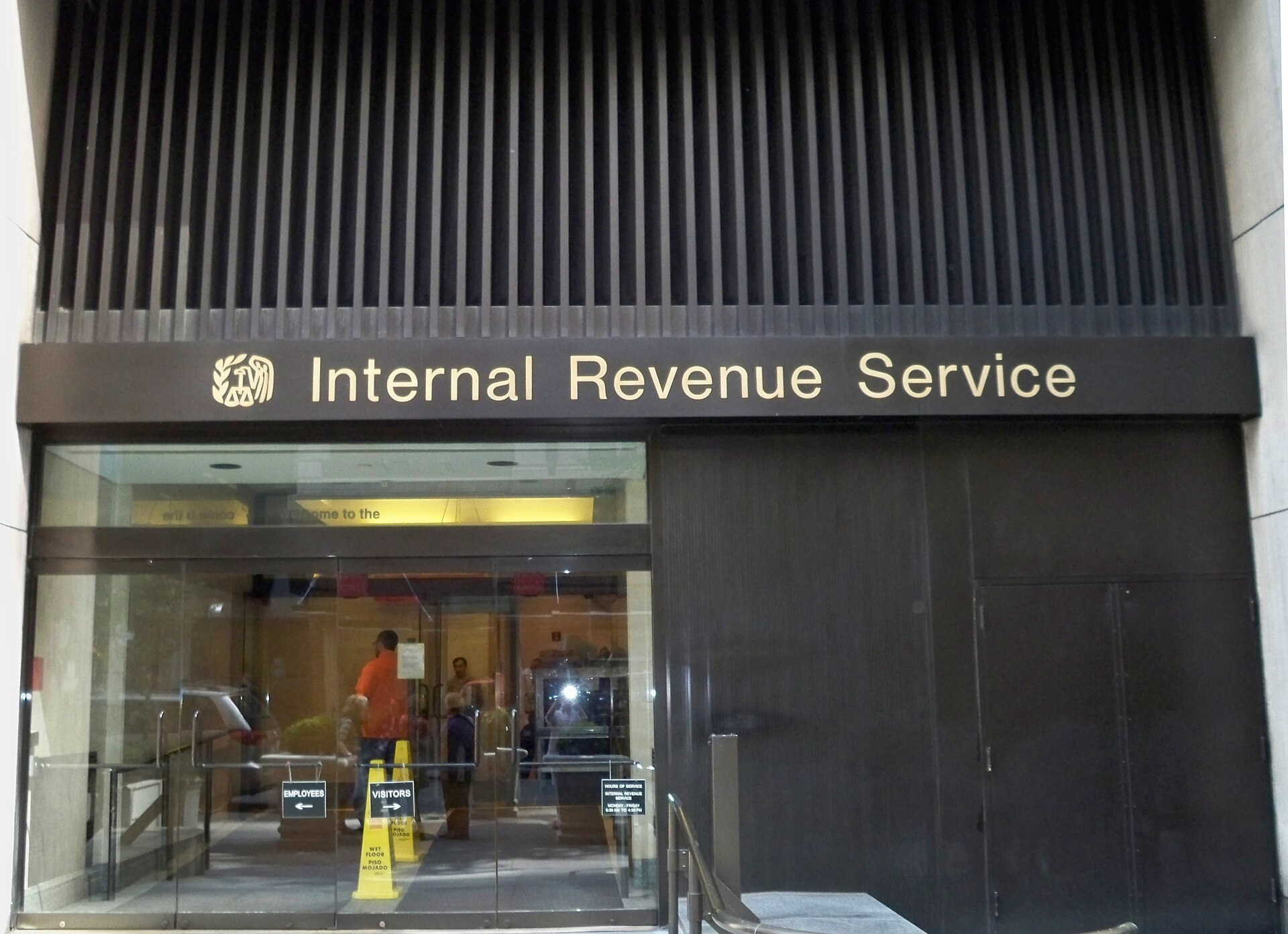
Photo: 美国国税局(IRS)纽约办公楼入口,MBisanz 摄,CC BY-SA(Wikimedia Commons)/ Entrance of an Internal Revenue Service office in New York, photo by MBisanz, CC BY-SA (Wikimedia Commons)