
Legal Terms Explained: Everyday Legal Terms for Life in the U.S.
Living in the United States means running into the law in ordinary moments: a patrol car lighting up behind you, a court envelope marked "Summons" in your mailbox, a lease full of words like "eviction" and "security deposit." Each of these terms is tied to deadlines, fines, or court dates, so meeting one for the first time can be stressful. This guide groups the legal words people encounter most often into four everyday scenes and explains each in plain language: what it means, where you will meet it, and the one thing most worth remembering. Definitions follow the official Glossary of Legal Terms published by the U.S. Courts (uscourts.gov) and the California Courts self-help pages; where specific deadlines or dollar figures are given, they reflect California rules, and other states differ.
1. On the Road and With Law Enforcement
Pull over. When a police car's lights or siren come on behind you, the officer is directing you to move safely to the side of the road and stop. It is the first step of most traffic enforcement. Scene: speeding, an unsafe lane change, or a broken light. Tip: signal right, slow down, stop in a safe spot, and keep both hands on the steering wheel while the officer approaches; at night, turn on the cabin light first so the officer can see inside.
Traffic stop. The whole encounter in which an officer lawfully stops a vehicle to investigate, from the pull-over through questions and a document check to a ticket or a release. Scene: every roadside stop is one. Tip: the officer will state the reason for the stop; if you disagree with the outcome, the proper channel is to contest it afterward through the ticket or court process, not to argue at the roadside.
Citation. The written notice an officer hands you after a stop, listing the violation and how and by when to pay or appear in court. Signing it is only an acknowledgment of receipt, not an admission of guilt. Scene: speeding, running a red light, or using a phone while driving — the paper you receive is a citation, often just called a ticket. Tip: do not toss it aside and miss the date; an ignored citation can mean added fines, a suspended license, and in serious cases a warrant. To fight it, appear by the date printed on it.
License and registration. The officer's usual first request: your driver's license and the vehicle's registration document. Scene: the standard opening of every traffic stop; for a rental car, the rental agreement serves as the registration paperwork. Tip: tell the officer where the documents are before reaching for them, and move slowly; keep the registration in a fixed place such as the glove box so you are not digging around.
DUI. Short for Driving Under the Influence — driving while impaired by alcohol or drugs, including cannabis and some prescription medications. It is a criminal offense, not a mere ticket. Scene: after a stop, if the officer suspects impairment, a DUI investigation begins. Tip: California and many states have "implied consent" laws — holding a license means you agreed in advance to chemical testing when lawfully arrested; refusing can cost your license and add penalties. Whether a DUI is proven depends on test results and legal standards through court proceedings, not on a roadside opinion.
Field sobriety test. A set of roadside coordination tasks — walking a straight line, standing on one foot, following a moving finger with your eyes — used to gauge impairment. Scene: the middle stage of a DUI investigation, after which the officer may ask for a breath or blood test. Tip: these roadside exercises involve an officer's judgment; the formal breath or blood numbers carry far more weight in court. The encounter is usually recorded by the patrol car's camera, so stay calm and steady.
Detain / Arrest. To detain is to hold someone briefly for questioning; to arrest is to take the person into custody and into the legal process. The two are very different in degree. Scene: being ordered to stop and answer questions is a detention; being handcuffed, told "you are under arrest," and taken to a station is an arrest, and it leaves a record. Tip: if you are unsure which one applies to you, ask, "Am I free to leave?" If the answer is yes, you may go; if no, you are being detained — do not walk away.
Miranda rights. From the U.S. Supreme Court's Miranda v. Arizona decision: before questioning a person in custody, police must advise them of the right to remain silent, that anything said can be used against them in court, and the right to an attorney. Scene: the famous warning heard in films appears at the custodial-interrogation stage, usually not during an ordinary traffic stop. Tip: you do not need to recite the words — but you do need to say yours out loud: "I wish to remain silent," or "I want a lawyer." Once clearly invoked, questioning should stop; merely staying quiet does not have the same effect.
Search warrant. A court order signed by a judge authorizing police to search a specific place for specific items; the address and the items sought are written on it. Scene: police coming to search a home or business generally need one; vehicle searches follow additional rules and are fact-specific. Tip: the Fourth Amendment protects against unreasonable searches. You may ask to see the warrant and check that the address is correct. If a search seems to go beyond the warrant, do not physically resist — say your objection out loud and tell your lawyer afterward, because it can affect whether evidence is admitted.
Consent (to a search). When officers have no warrant, they may simply ask, "Can I look in your trunk?" A yes is legally a voluntary consent search, and no warrant is then required. Scene: being asked to open a trunk, a bag, or a phone during a stop or encounter. Tip: consent must be voluntary, and you are allowed to say, "No, I do not consent." Refusing is not a crime and cannot by itself be treated as evidence of wrongdoing — take a breath before answering rather than nodding along under pressure.
2. In Court and in Lawsuits
Hearing. Most of what people call "going to court" is a hearing: a session before a judge where both sides are heard and a specific question is decided — bail, a motion, a custody schedule. A hearing is not a full trial. Scene: the court mails a notice stating the hearing's date, time, and courtroom. Tip: that date is a must-appear date. Missing it without excuse can mean losing by default or even a warrant; if you truly cannot attend, apply in writing to reschedule under the court's rules well in advance — not by phone on the day.
Arraignment. In a criminal case, the defendant's first formal court appearance, at which the charges are read, the defendant enters a plea, and bail is addressed (per the federal courts' glossary). Scene: after an arrest and release, or after receiving a criminal summons, this is the first proceeding you will see. Tip: an arraignment is not a trial — no one is found guilty or innocent that day. Pleading "not guilty" preserves every right and is the routine course; get a lawyer's advice before the date rather than explaining your case to the judge on the spot.
Summons / Subpoena. Both are court papers with legal force, but they do different jobs. A summons arrives with the complaint at the start of a civil lawsuit and tells the defendant, "You are being sued," together with the deadline to file a written answer (in California state court, generally 30 days after service). A subpoena is a court order commanding a person to appear and testify, or to produce documents — witnesses and uninvolved third parties, even banks and employers, can receive one. Scene: a packet of legal papers delivered to your door is usually a summons; being ordered to testify or turn over records in a case that is not yours is a subpoena. Tip: neither is junk mail and neither can be ignored. Miss the summons deadline and the other side can win a default judgment — the case is lost without your ever being heard. Ignore a subpoena and you risk contempt of court. If there is a genuine problem, have a lawyer raise it with the court; do not simply stay away.
Plaintiff / Defendant. The plaintiff is the party who files the lawsuit; the defendant is the party being sued. In criminal cases the plaintiff's role belongs to the government — the prosecuting side is styled "The People" or "the State" — and the person charged is still called the defendant. Scene: reading any court document or news report, sort out these two words first and you know who is suing whom. Tip: filing the suit is called filing a lawsuit (the document itself is the complaint). For a defendant, the answer clock starts running the day the papers are served: note the date first, call a lawyer second.
Plea. A criminal defendant's formal answer to the charges, with three choices: guilty, not guilty, or no contest (nolo contendere — neither admitting nor denying, but accepting punishment). Closely related is the plea bargain, a negotiated deal to plead in exchange for reduced charges or a lighter sentence. Scene: at arraignment the judge asks, "How do you plead?" Tip: a no-contest plea usually leads to the same sentencing outcome as guilty, the difference being that it generally cannot be used as an admission of fault in a later civil suit for damages. The choice has long consequences — make it on a lawyer's advice, not on instinct in the courtroom.
Bail. Money or other security given to the court to secure a criminal defendant's release while the case is pending, guaranteeing the defendant will appear as ordered (per the federal courts' glossary). Scene: after an arrest, the judge at arraignment weighs the charges and flight risk to set bail or order release on the defendant's own recognizance. Tip: if you go through a bail bondsman, the fee charged (commonly about ten percent of the bail amount) is generally not refundable. Bail posted directly with the court is returned when the case ends, provided the defendant appeared as required. Missing a court date can forfeit the money and trigger a warrant.
Court order. A judge-signed decision that parties are legally required to obey — to pay money, hand over a child, leave a home, or stop doing something. Divorce, custody, debt, and neighbor cases all end in one. Scene: announced in the courtroom at the end of a hearing, or arriving by mail as a stamped document. Tip: an order takes effect when served. "I didn't understand it" and "I don't agree" are not excuses for disobeying; the lawful route is to ask the court to modify it or to appeal. Ignoring it leads directly to the next term.
Restraining order. A court order directing a person not to contact, approach, or harass a protected person, common in civil harassment, stalking, and family disputes. In California, a civil harassment restraining order is issued under Code of Civil Procedure section 527.6: a temporary order may issue first, then, after a hearing, a longer order of up to five years, renewable. Scene: ongoing harassment, threats, or being followed by a former partner, a neighbor, or a stranger is the typical setting for an application. Tip: the order binds the restrained person, and under the statute's "directly or indirectly" language it also bars contact routed through third parties. Violating a restraining order is itself a crime (Penal Code section 273.6). The protected person should call the police and keep records rather than dealing with the restrained person directly.
Contempt of court. Willfully disobeying a court order, or disrupting the court, punishable by the judge within the same case by fines, community service, or jail — no separate lawsuit required. Scene: ignoring a subpoena, refusing to follow a court order, refusing court-ordered support or visitation, or outbursts at a hearing can all be handled as contempt. Tip: if you genuinely cannot comply with an order, apply in writing to modify it and explain why. Violating first and explaining later reads to the judge as exactly what the term says.
Settlement. An agreement resolving a lawsuit before the court decides it. Once signed, a settlement generally has the force of a contract and can be enforced by the court. Scene: car-accident claims, employment disputes, contract fights — when a lawyer says "the case was settled," it means the matter ended by agreement rather than judgment. Most civil cases in the U.S. end this way. Tip: before signing, read two things closely — the amount and payment terms, and any release clause giving up future claims over the same matter. A signed settlement is rarely undoable; for any significant sum, have a lawyer review it first.
Small claims court. A simplified court for small money disputes: low filing fees, plain procedures, and parties who usually appear without lawyers and speak for themselves (in California, an individual's claim is capped at $10,000). Scene: a landlord keeping a deposit, an acquaintance who will not repay a loan, minor property damage — amounts too small to justify a lawyer. Tip: small claims court can only award money; it cannot order someone to do or stop doing something. Send one written demand before filing and keep proof of mailing, and bring the contract, photos, messages, and payment records to the hearing — judges decide on the evidence in front of them.
3. Housing and Everyday Contracts
Lease. The rental contract between landlord and tenant: rent, term, deposit, who repairs what, whether subletting is allowed, and what breaking the lease early costs. Once signed, it is enforceable as a contract. Scene: the thick document signed for an apartment or a shop, usually for a one-year term. Tip: promises made out loud but not written into the lease are hard to enforce. Before signing, read three places closely: the early-termination penalty, how much notice is required before a rent increase, and how the deposit is returned.
Security deposit. Money paid to the landlord before move-in, held against unpaid rent or damage beyond ordinary wear, and settled by law when the tenant moves out (in California, residential deposits have been capped at one month's rent since July 2024). Scene: the check handed over together with the first month's rent when the lease is signed. Tip: photograph the unit's condition on move-in day and again on move-out day. In California the landlord has 21 days after move-out to return the deposit or provide an itemized list of deductions; late or unexplained deductions do not hold up — a deadline tenants use more than any other.
Eviction. The legal process by which a landlord recovers a property: written notice, then an unlawful detainer lawsuit in court, then a judgment, with removal carried out by county law enforcement. A landlord may not change the locks, cut off utilities, or throw a tenant's belongings out on his own. Scene: unpaid rent, a tenant who stays after the lease ends, or serious lease violations are what usually start one. Tip: receiving an eviction notice does not mean moving out that day; during the notice period (3, 30, or 60 days depending on the circumstances) there may still be room to cure the rent, negotiate, or contest the case. But court papers must never be ignored — staying away hands the landlord a win and leaves an eviction on your record.
Landlord / Tenant. The two parties to a lease: the landlord is the party renting out the property (not necessarily the owner — often a management company acting for the owner), and the tenant is the party renting it. Their rights come from the lease together with state landlord-tenant law. Scene: the two role words that appear in every rental ad, contract, repair request, and dispute. Tip: California law guarantees tenants basic habitability — heat, hot water, weatherproofing, working locks — maintained by the landlord, and a landlord generally must give 24 hours' written notice before entering the unit. These baseline rights cannot be signed away in a lease clause.
HOA. Short for Homeowners Association, the owners' organization in a subdivision or condominium complex that maintains common areas and enforces the community rules (the CC&Rs) on appearance, parking, and noise, funded by monthly HOA dues. Scene: unavoidable when buying a house or condo; tenants feel it too, when landlords pass the rules along. Tip: before buying, read the CC&Rs and the HOA's financial statements all the way through. Unpaid dues can become a lien against the home, and enough arrears can lead to foreclosure — that clause is not a bluff.
Notary public. A state-commissioned officer (appointed by the Secretary of State) whose job is to verify a signer's identity, witness the signature in person, and stamp the document — the act is called notarization. Scene: powers of attorney, real-estate documents, and affidavits (sworn statements) often state they must be notarized; bank branches and UPS stores commonly offer the service. Tip: an American notary certifies only that the signature is genuine and was made in their presence — unlike a Chinese notary office, they do not review whether the document's contents are lawful. Fees are capped by state law; if a price seems invented, try another location.
Power of attorney. A document granting another person legal authority to act for you in stated matters, abbreviated POA. A general POA is broad; a limited POA covers one or two specific tasks; a durable POA remains effective if you later become incapacitated. Medical decisions use a separate health-care directive. Scene: selling a home through a trusted relative while you are abroad, or arranging finances and care decisions in advance for an aging parent. Tip: a POA can confer enormous power, so choosing the agent matters more than the form. Most states require notarization or witnesses for it to be effective, and banks accept only documents that follow the state's format — give the agent a copy to keep once it is signed.
Co-sign. Signing together with a borrower or tenant as a guarantor: if the primary applicant stops paying, the creditor can collect the full amount from the co-signer, and the debt also appears on the co-signer's own credit report and counts against their borrowing capacity. Scene: students and new immigrants with thin credit files are routinely asked for a co-signer on apartment leases and car loans. Tip: co-signing is not "just helping with a signature" — it moves the entire default risk onto your name. Decide by the worst case, not the friendship; and if you cannot do it, saying so plainly is completely normal in the U.S.
4. Money and Liability
Liability. Who is legally responsible when something goes wrong, and how much they must pay — that allocation is liability. Liability insurance, the term seen most often on policies, covers what you owe others for harm you cause. Scene: after a car crash, the police report and the insurers' argument over "who was primarily at fault" is, in substance, an argument over liability. Tip: liability coverage pays for the other side's losses, not your own car or medical bills. State minimum limits are low and run out quickly in a serious crash; carrying adequate liability limits is among the cheapest protection a driver can buy.
Insurance claim. Formally asking your insurer to pay for a covered loss is filing a claim; the company then assigns a claims adjuster to investigate the facts and the damage and decide the payment. Scene: a collision, a burst pipe, lost luggage — the first step is always a report or case number, then the claim. Tip: claims have deadlines, so photograph everything and keep every receipt before reporting. When speaking to the other side's insurer, describe the facts and stop there — do not volunteer conclusions like "it was my fault," because claim conversations may be recorded and can shape how liability is split.
Deductible. The amount you pay out of pocket first in a claim, after which the insurer pays the rest: with a $500 deductible on auto insurance, a $2,000 repair means you pay $500 and the insurer pays $1,500. Scene: auto, home, and health insurance each carry their own deductible, always paired with the premium. Tip: never judge a policy by premium alone — cheap premiums usually hide high deductibles. Add up the yearly premium and the deductible to see what an accident would truly cost you; this matters most of all in health insurance.
Premium. The price of insurance coverage, paid monthly or by term, and the seesaw partner of the deductible: higher premiums generally buy lower deductibles, and money saved on premiums is paid back out of pocket when something happens. Scene: auto insurance every six months, homeowners insurance folded into the mortgage payment, health premiums taken out of every paycheck. Tip: miss payments and the policy lapses — no coverage at all for anything that happens in the gap, and reinstating may cost more. Moves, new cars, and big mileage changes should be reported to the insurer promptly to avoid disputes at claim time.
Will. The legal document stating how a person's property is to be distributed after death and who should raise minor children — full name, last will and testament. Dying without one is called dying intestate, and property then passes in the order fixed by state statute, which may not match the person's wishes. Scene: after buying a home and having children, it is the question lawyers and financial advisers ask most: "Do you have a will?" Tip: a will must meet your own state's formalities (signature, witnesses) to be valid, and a will made in China may not govern U.S. assets. For families with young children, naming a guardian in the will often matters more than the property split.
Probate. The court-supervised process after a death: confirming the will's validity, inventorying the property, paying the debts and taxes, and transferring what remains to the heirs (as described in the California Courts self-help materials). Scene: after a family member dies, a bank or the county recorder's office answers a request with "it has to go through probate" — this is the process they mean. Tip: probate commonly takes months and its costs and records are public. Assets arranged in advance through tools such as a living trust generally pass outside probate, which is why it is the most common estate plan for California homeowners; set it up with a lawyer rather than by copying a template found online.
Credit report. The record of a person's borrowing and repayment history, maintained by the three bureaus — Experian, Equifax, and TransUnion — and distilled into a credit score. Landlords, lenders, card issuers, and some employers all look at it. Scene: a rejected card application, or a landlord demanding a larger deposit, often traces back to something in the report that the person learns about last. Tip: federal law entitles everyone to see their own reports for free through the official site, AnnualCreditReport.com; sites charging for the same reports are not the government channel. If you find an account you do not recognize or an error, file a dispute with the bureau promptly — it can be the first sign of identity theft.
Identity theft. Using another person's name, Social Security number, date of birth, or other identifiers to open accounts, borrow money, claim refunds, or impersonate them — a crime under federal and state law. Scene: a bill arrives for a credit card you never applied for; or the tax authority tells you "a return has already been filed" in your name. Tip: start at IdentityTheft.gov, the Federal Trade Commission's site, which builds an official recovery plan; file a police report for the record as well. Then contact the three bureaus to place a fraud alert or, stronger, a credit freeze (free of charge), which blocks new accounts — including ones you open yourself — until you lift it with your PIN.
This article is general legal information, drawn from publicly available official glossaries and court self-help materials. It is not legal advice and is no substitute for a licensed attorney's judgment on a specific case. State law varies considerably; for a concrete dispute, consult an attorney licensed in your state.
Published by GSM · USA (original Chinese edition)
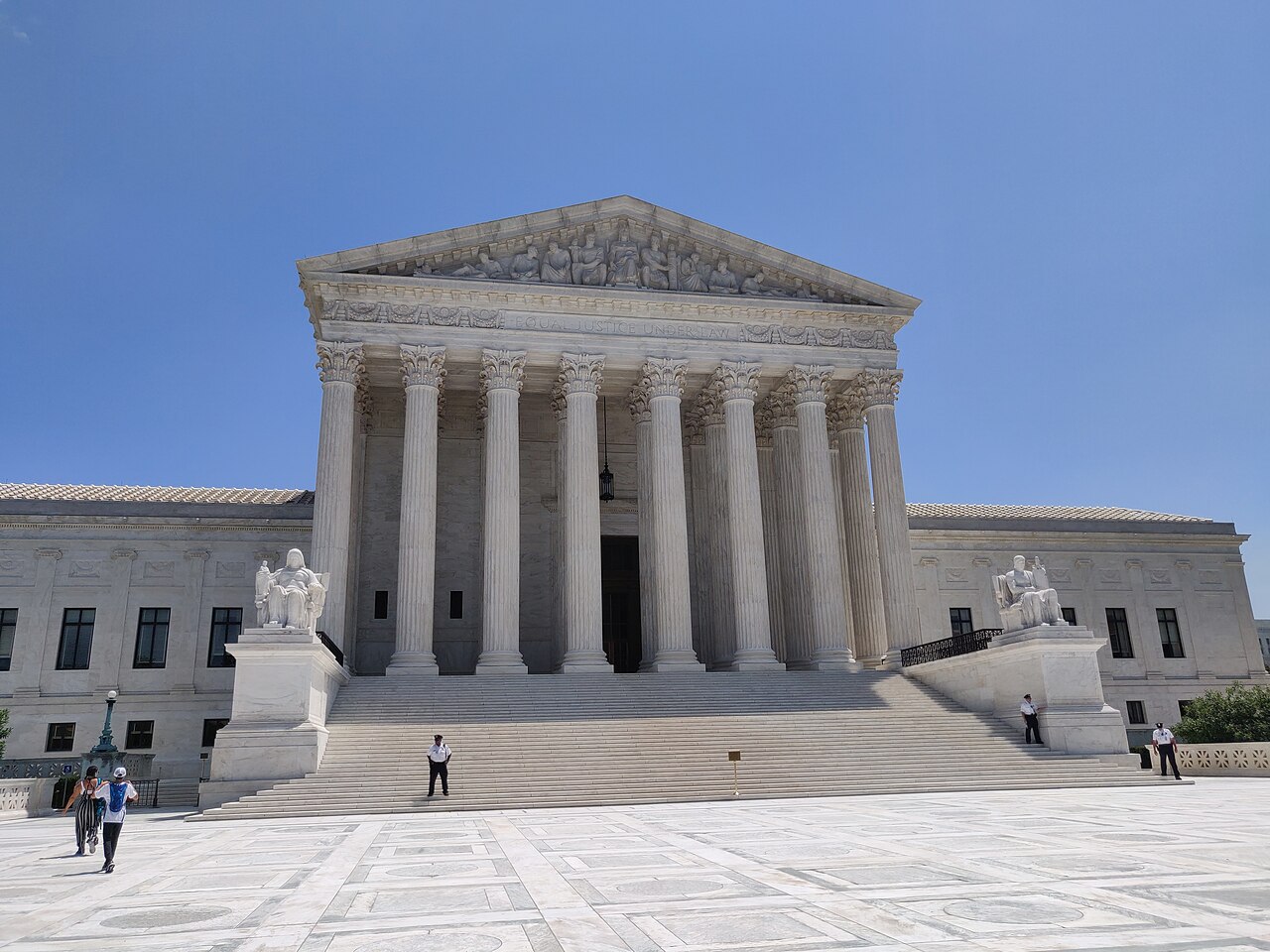
Photo: 图:美国联邦最高法院大楼(华盛顿)。图片来源:Kurt Kaiser 摄,CC0 公共领域贡献,维基共享资源。The U.S. Supreme Court building in Washington, D.C. Photo by Kurt Kaiser, CC0, via Wikimedia Commons.