Google's Willow Chip Demonstrates "Magic State Cultivation" for the First Time: 99.99% Logical Fidelity for T States, Errors Cut About 40-Fold
Google Quantum AI published a paper in Science on October 15, "Magic state cultivation on a superconducting quantum processor," demonstrating magic state cultivation in physical hardware for the first time on the company's Willow superconducting processor. According to Quantum Computing Report's summary of the paper, the experiment achieved a roughly 40-fold error reduction, producing T states with a logical fidelity of 99.99(1)% — an error rate of no more than 0.0001.
Magic states are the special quantum states required to run the error-corrected operations needed for universal, fault-tolerant quantum computing, and each can be used only once. Since 2004, researchers have foreseen their production cost as a core bottleneck: traditional distillation protocols were projected to consume 90% to 95% of a quantum computer's physical qubit footprint (Quantum Computing Report; Google's official blog puts the figure at up to 95% of total capacity). Cultivation, proposed in 2024 by Google researchers Craig Gidney, Noah Shutty and Cody Jones, grows the states in a small patch of the chip using small color codes, filters them through repeated measurements, and then grafts the purified states into surface codes; the new experiment grafted states from a distance-3 color code into a distance-5 surface code.
The limits were reported alongside the result: only about 8% of Willow's runs produced high-quality magic states usable downstream, with the rest discarded in quality screening, team member Rosenfeld told New Scientist, and the experiment used 54 of Willow's 105 physical qubits, according to Scientific American. Kenneth Brown, director of the Duke Quantum Center, who was not involved in the study, said the experiment shows the cultivation concept works in practice. Zhenyu Cai of Imperial College London told New Scientist it is a significant step, but that Willow's errors will need to be reduced further before it can tackle truly useful problems. Google said the technology still needs further validation at larger scale.
Published by GSM · USA (original Chinese edition)
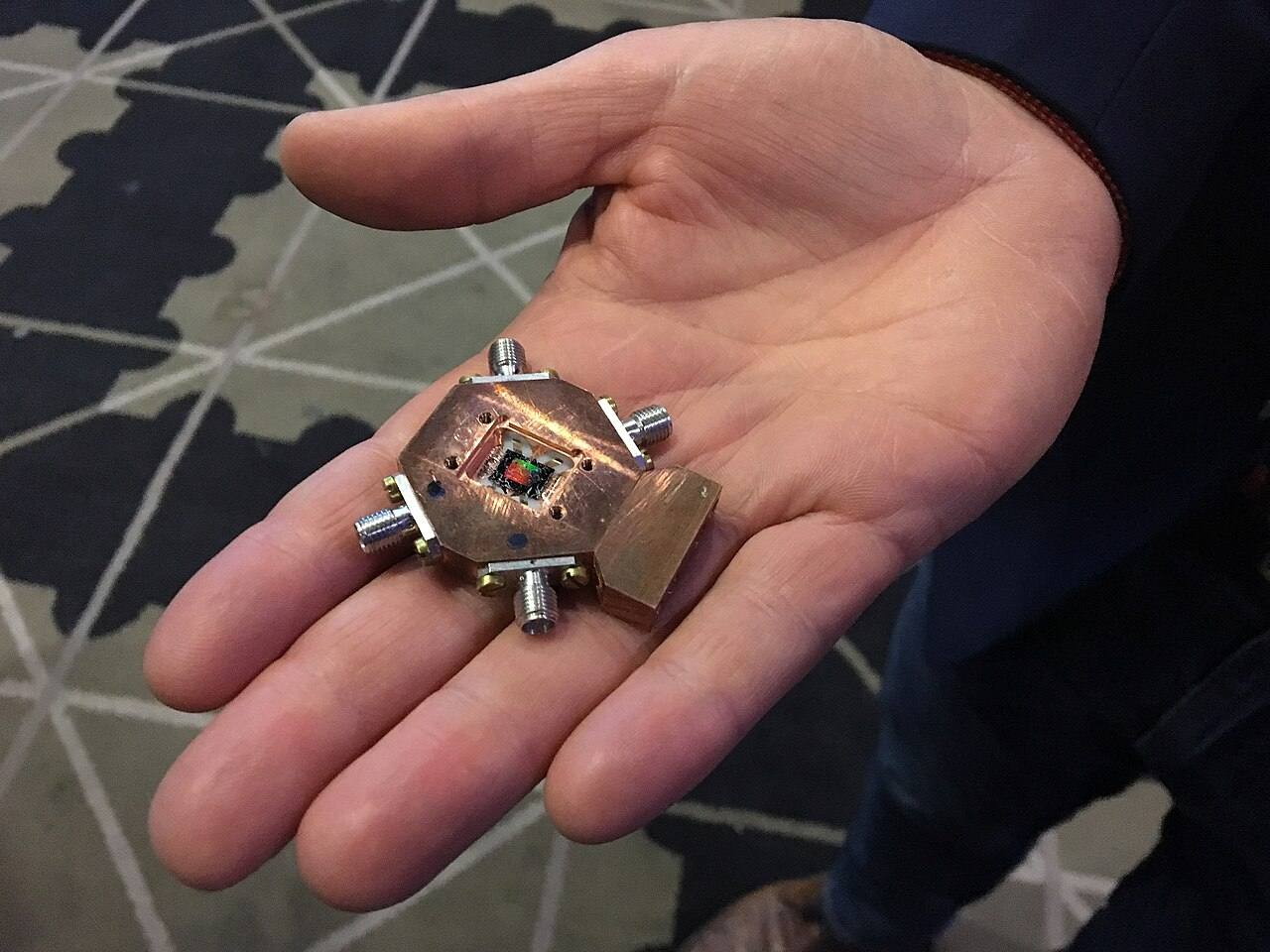
Photo: 图:量子处理器资料图(2017年摄于瑞典查尔姆斯理工大学纳米制造实验室,为三量子比特处理器,非Willow本体)。图片来源:Anita Fors (Chalmers),Wikimedia Commons,CC BY-SA 4.0。Photo: A quantum processor (three-qubit device, Chalmers University of Technology, 2017; file photo, not the Willow chip itself). Image: Anita Fors (Chalmers), via Wikimedia Commons, CC BY-SA 4.0.