Follow-Up: NASA's Roman Telescope Passes Key Stability Tests, Steady Enough to Hold a Laser on a Dime 240 Kilometers Away
WASHINGTON — NASA's Nancy Grace Roman Space Telescope has passed a key in-flight milestone: its fine-guidance system, which locks the observatory steadily onto its targets, cleared a series of tests from Sept. 15 to 21, holding the telescope's pointing stable to better than 1/100,000 of a degree. On Sept. 22, the telescope's Coronagraph Instrument then opened its eyes to cosmic light for the very first time. Roman launched on Aug. 30 and is traveling toward the Sun-Earth second Lagrange point (L2), about 1.5 million kilometers from Earth.
The tests showed Roman can hold that stability for half an hour at a time during Wide Field Instrument observations, and for eight hours at a time during the longer Coronagraph Instrument observations. NASA likens the steadiness to focusing a laser beam on a U.S. dime from about 150 miles (240 kilometers) away, and engineers plan to tune the guidance system further, which would stretch the analogy to about 230 miles (370 kilometers).
The system works in an unusual way. The spacecraft's attitude control system first points the observatory in the right direction, and the fine-guidance system then keeps it from drifting. The team assigned a small part of each of the 18 detectors in Roman's primary instrument, the Wide Field Instrument, to rapidly observe a separate guide star whose position is precisely known. The system reports the guide stars' positions to the attitude control system about four times each second, allowing tiny corrections as needed. "Every Roman observation relies on its ability to stay precisely pointed at the correct region of space long enough to collect an image, which can take from minutes to hours for a deep exposure," said Begoña Vila, Roman's guiding instrument systems lead at NASA's Goddard Space Flight Center in Greenbelt, Maryland. "Our tests confirmed that we are able to keep the observatory very stable for science operations."
Roman will also validate a guiding method that has never been attempted before. Unlike other space telescopes, Roman carries no separate guider instrument; instead, it will guide on stars' spectra — the detailed wavelength patterns in their light — using the same spectroscopic capability it already carries for science. The team looks forward to validating this spectral guiding mode in the coming weeks.
With stability confirmed, the Coronagraph Instrument took its turn. The instrument woke up on Sept. 1 and completed checks of its digital, electronic and mechanical systems mid-month. After engineers confirmed the fine-guidance system was holding it steady, scientists adjusted its focus. On Sept. 22 it captured a faint star in the Large Magellanic Cloud, a neighboring galaxy; the image carried noise because the detectors are being kept warmer than their final operating temperature so that contamination does not stick to them. On Sept. 27, with the detectors cooled for better sensitivity, the team observed a new location in the Large Magellanic Cloud and saw many stars in a single image, confirming the pointing. "This observation confirms that the instrument can produce a focused image," said Vanessa Bailey, a Roman Coronagraph Instrument scientist at NASA's Jet Propulsion Laboratory (JPL) in Southern California. "It's a very limited test that kicks off a methodical process of increasingly complex tasks that help us prepare for the instrument's future observations."
Designed and built by JPL, the coronagraph is a technology-demonstration instrument that will show how to block a star's glare so that the far fainter planets and dusty disks around nearby stars can be seen directly. It carries its own internal stability process, making it even more stable than the Wide Field Instrument, because even tiny vibrations or pointing errors could let starlight leak through and wash out the faint planets scientists hope to see. The technology is considered a pathfinder for future missions that would image Earth-like planets directly.
Named for NASA's first chief astronomer, Nancy Grace Roman, the telescope carries a 2.4-meter primary mirror and a 300-megapixel Wide Field Instrument whose field of view is far larger than the Hubble Space Telescope's. Roman will conduct sweeping surveys of dark matter, dark energy and exoplanets. The coronagraph's first light is only the start of commissioning, with a methodical sequence of increasingly demanding tests still ahead. (GSM, based on NASA reporting)
Published by GSM · USA (original Chinese edition)
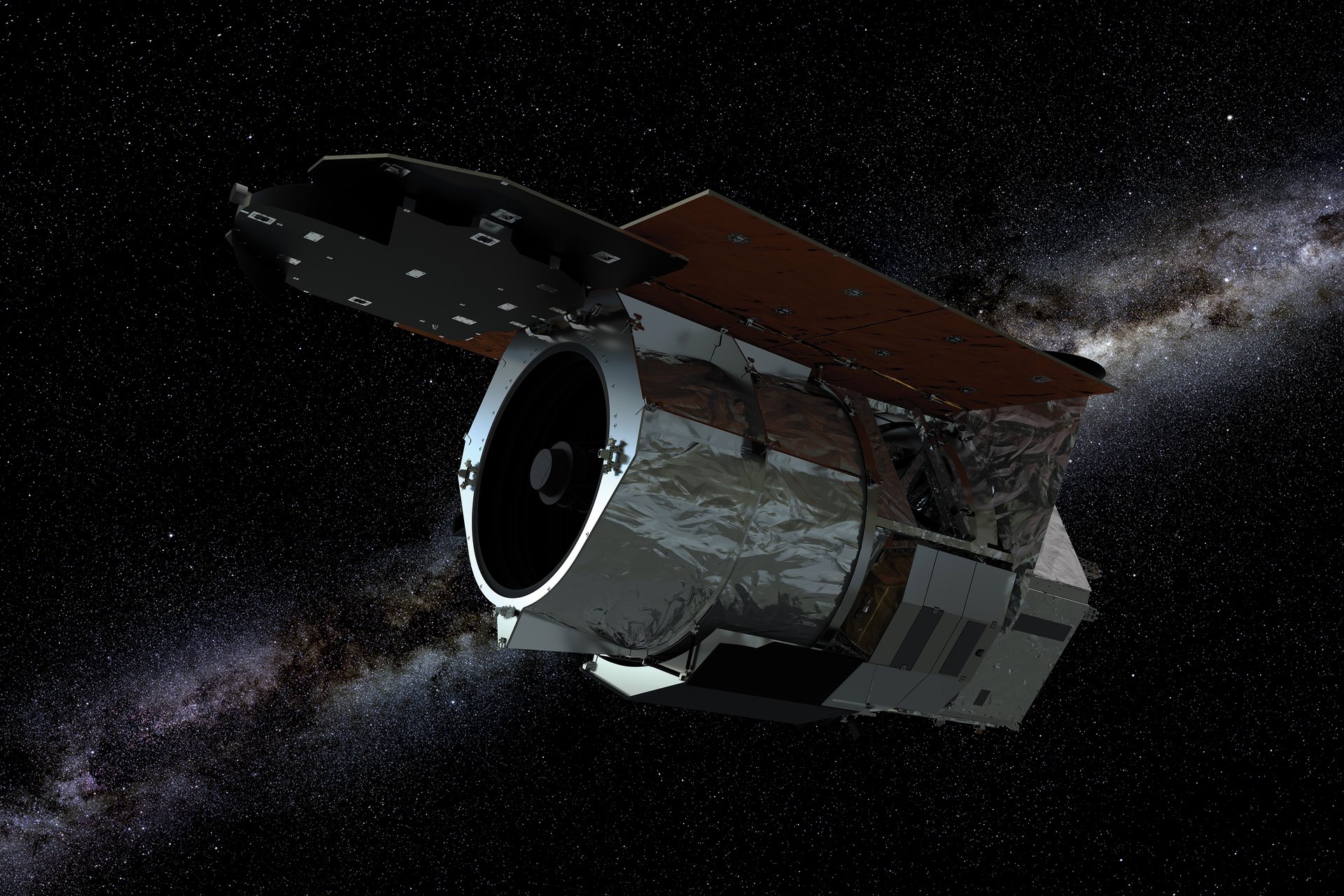
Photo: 图:南希·格雷斯·罗曼太空望远镜在轨飞行示意图。美国国家航空航天局 NASA 官方发布,公共领域。Image: Artist's concept of NASA's Nancy Grace Roman Space Telescope in orbit. Credit: NASA (public domain).
- 2026-08-25[Video] NASA's Roman Space Telescope Set to Launch, Opening a New View of the Universe
- 2026-08-30[Video] NASA Successfully Launches Roman Space Telescope
- 2026-10-17Follow-Up: NASA's Roman Telescope Passes Key Stability Tests, Steady Enough to Hold a Laser on a Dime 240 Kilometers AwayThis story