Terry Tao Says He Is 'on a War Footing' as OpenAI's SI Proof Release Roils Mathematics
LOS ANGELES — Mathematician Terence Tao told a two-day workshop at UCLA that he is doing very little math these days and is instead 'on a war footing,' The New York Times reported on October 16. The workshop, on partial differential equations in the age of super intelligence, was dominated by discussion of SI's impact on the field. Tao, 51, is a UCLA professor who won the Fields Medal in 2006.
Days earlier, OpenAI announced it had solved the Navier–Stokes problem, one of the seven Millennium Prize problems — a company claim that remains unverified by the mathematics community. 'There are no rules any more,' Tao said. He described OpenAI's Navier–Stokes proof as technically readable, but said no expert he had spoken to had understood the whole argument.
On October 6, OpenAI released more than 350 findings spanning nearly every subfield of mathematics, according to the Times. A separate count by files is larger: the Association for Human Mathematics said OpenAI had released 'over 700 files at once,' a body of material grouped into roughly 372 result families. The two figures measure different units — findings versus files. Tao said much of his time now goes to what he calls 'community organizing': convening mathematicians, responding to media and advising colleagues. Of OpenAI, he said: 'They used math for what they needed, which was to evaluate their models,' and 'At this point, I don't see a way to constructively engage.' An OpenAI spokesperson said the company values its engagement with Tao and the wider community. The public call for mathematicians to discontinue work with OpenAI came from the Association for Human Mathematics, in a statement published as a guest post on Tao's blog — not from Tao himself.
Related:
Published by GSM · USA (original Chinese edition)
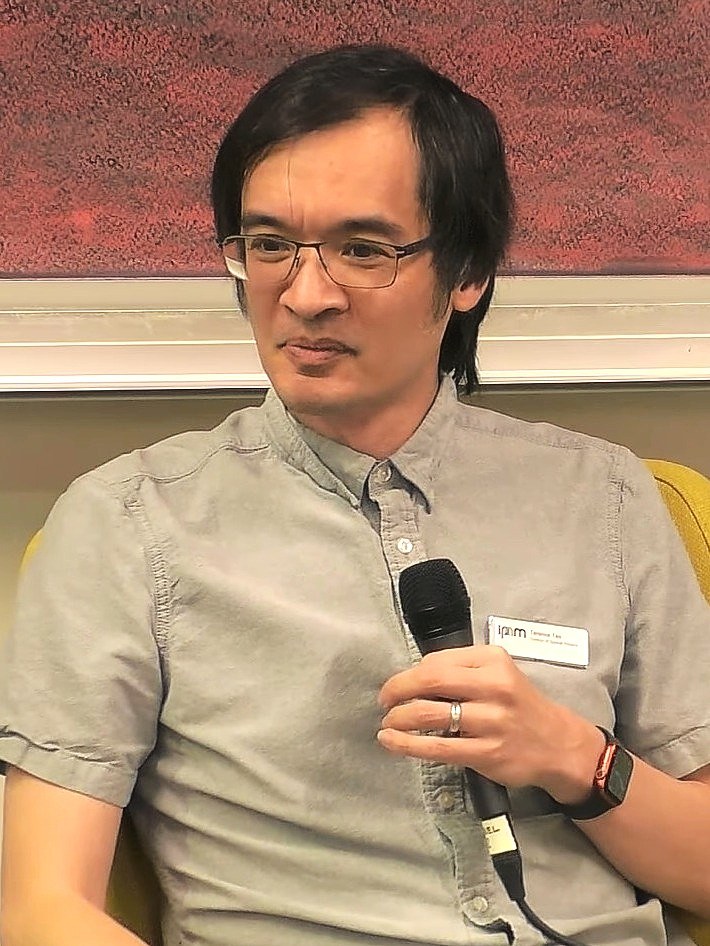
Photo: 图:陶哲轩2026年在加州大学洛杉矶分校纯粹与应用数学研究所(IPAM)炉边谈话上发言。图片来源:IPAM,CC BY 4.0,经维基共享资源。Photo: Terence Tao speaking at an IPAM Fireside Chat at UCLA in 2026. Source: IPAM, CC BY 4.0, via Wikimedia Commons.