Feature | Bruce Lee's American Years: Seattle, Oakland and Hollywood
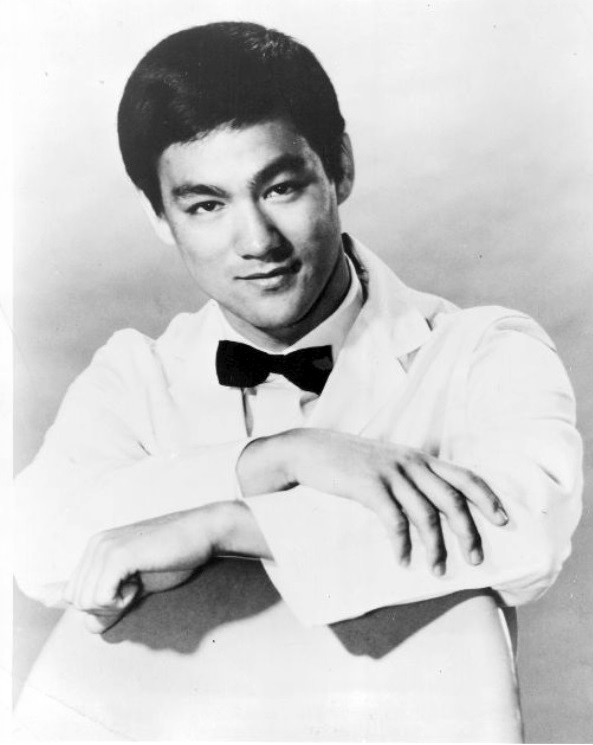
SEATTLE — On October 16, at the corner of South King Street and Maynard Avenue South in Seattle's Chinatown-International District, a new street sign was unveiled to the sound of lion dances: "Bruce Lee Way." The city proclaimed the day "Bruce Lee Way Day." Shannon Lee, Bruce Lee's daughter and chair of the Bruce Lee Foundation, came for the ceremony; the sign itself exists because of years of effort by his former student Abe Santos, whose crowdfunding campaign raised the $7,000 needed to fabricate and install it. At the unveiling, Deputy Mayor Brian Surratt offered a line that has since traveled widely online: "Many think San Francisco is Bruce Lee's place, but I have to say — no. Bruce Lee belongs to Seattle. Seattle is Bruce Lee!"
There is substance behind the claim. Lee was born in San Francisco in 1940 and died in Hong Kong in 1973, but the years in which America was his home ground add up to fourteen: in 1959, aged 18, he returned to the country of his birth, waiting tables, studying, opening a school and starting a family in Seattle; in 1964 he moved down to California, fighting his way from an Oakland kung fu school to the soundstages of Hollywood; in 1971 he took a martial art formed in America back to Hong Kong and became a sensation across Asia, only to die suddenly at the height of his fame. His American years began in Seattle, and they ended there too — the grave at Lake View Cemetery lies only a few miles from the street that now bears his name.
Bruce Lee was born on November 27, 1940, at Chinese Hospital in San Francisco's Chinatown — in the lunar Year of the Dragon, and, by family reckoning, in the hour of the dragon as well. His father, Lee Hoi-chuen, was a leading Cantonese opera performer then touring the United States with a troupe; his mother, Grace Ho, traveling with him, named the boy Jun-fan. According to HistoryLink, the Washington state history encyclopedia, the English name "Bruce" was suggested by the nurse who delivered him. While still an infant he "appeared" on screen, carried by his father in the film Golden Gate Girl (released 1941). Before he was five months old, the family returned to Hong Kong.
His eighteen Hong Kong years are background here: a child actor in more than twenty films, known for pictures such as The Kid (1950); a teenager drawn to street fighting who, from age 13, studied Wing Chun under Ip Man; a schoolboy boxing champion in 1958 who was also an accomplished cha-cha dancer. In 1959, worried that he would keep getting into trouble, his parents sent the newly 18-year-old back to the United States. Family accounts and biographers record that he set out with $100 to his name.
After a few months at his sister's home in San Francisco, he headed north to Seattle. Ruby Chow, a Chinese community leader and a friend of his father's, ran a restaurant near Chinatown; Lee waited tables there and slept in a small room above the restaurant while finishing his schooling at Edison Technical School, graduating in 1960. In March 1961 he enrolled at the University of Washington (UW); the university's alumni magazine later established that his official major was drama, though he read widely in philosophy and psychology. In his spare time he taught kung fu on campus lawns, in parks and in students' homes. At a time when Chinese martial arts schools commonly taught only Chinese students, he taught anyone willing to learn; among his first students was Taky Kimura, a Japanese American who became his closest assistant and lifelong friend.
In 1963 he published his first book, Chinese Gung Fu: The Philosophical Art of Self-Defense. That same year his Jun Fan Gung Fu Institute took formal shape, first in a Chinatown basement and, in the fall, at 4750 University Way near the university — a studio of nearly 3,000 square feet with his living quarters behind it. Linda Emery had seen him demonstrate kung fu at Garfield High School; she became his student, then a UW freshman. On August 17, 1964, they married in Seattle, with Taky Kimura as best man.
In 1964 Lee left the university and opened a second Jun Fan Gung Fu Institute in Oakland, California, with the veteran martial artist James Yimm Lee. On February 1, 1965, his son Brandon Lee was born in Oakland. The Oakland years also produced the most mythologized episode of his life: a fight, at the end of 1964, with Wong Jack Man, a martial artist newly arrived from Hong Kong. The two camps' accounts of who won, how long it lasted and what exactly happened have never agreed, and the embellished versions far outnumber the documented ones. What is consistently recorded is that Lee was dissatisfied with his own performance — the set forms of traditional Wing Chun had felt cumbersome in a real fight — and that the bout pushed him to remake his art. In August that year, at Ed Parker's Long Beach International Karate Championships, he demonstrated the one-inch punch and two-finger push-ups that stunned the American martial arts world; footage of the demonstration eventually reached television producer William Dozier and earned him a screen test.
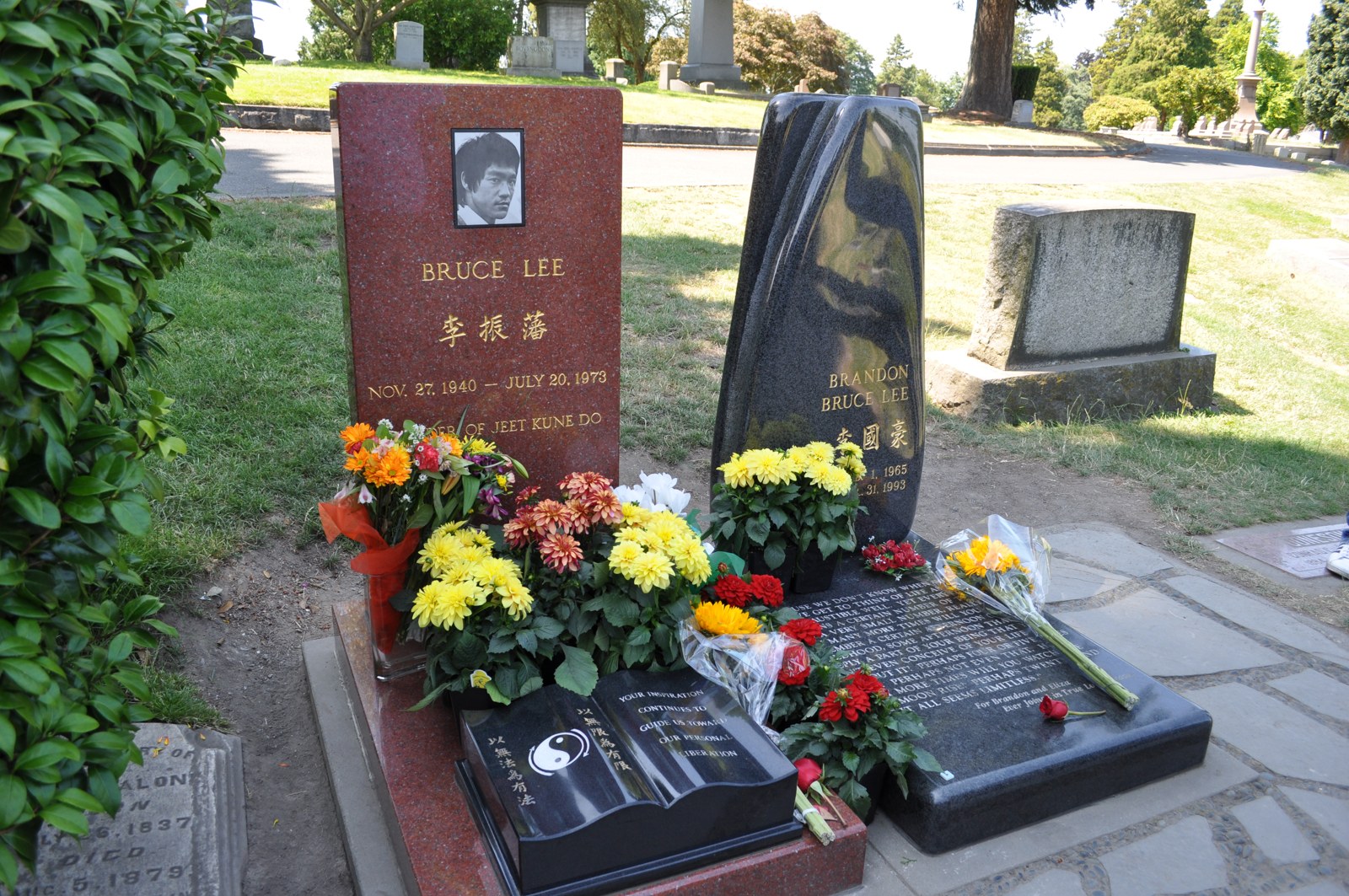
In 1966 Lee moved his family to Los Angeles to play Kato, the hero's aide and chauffeur, in the American Broadcasting Company (ABC) series The Green Hornet (1966–67, 26 episodes). Britannica records that his kicks were too fast for the cameras of the day, and that he was asked to slow them down. The show was cancelled after one season. Hollywood offered Asian actors almost nothing, and Lee made his standing instead in private lessons: Steve McQueen and James Coburn were among his students, and basketball star Kareem Abdul-Jabbar trained with him for years. In 1967 he opened a third Jun Fan Gung Fu Institute, in Los Angeles's Chinatown, and formally named his system Jeet Kune Do — "the way of the intercepting fist." Its guiding line, "using no way as way, having no limitation as limitation," is now carved on the stone book at his grave.
The Los Angeles years were lean ones. In 1969 he drew notice for a scene in the film Marlowe in which he demolishes an office with his feet; that year his daughter, Shannon Lee, was born in Los Angeles. In 1970 a weightlifting injury to his back put him in bed for months; in enforced idleness he organized years of martial arts notes — the manuscripts that became the posthumously published Tao of Jeet Kune Do (1975). In 1971 he appeared in the series Longstreet as Li Tsung, a martial arts instructor, and contributed to the writing, folding Jeet Kune Do philosophy into the dialogue. That year, in a television interview with Canadian journalist Pierre Berton, he gave the answer for which he is still quoted: "Empty your mind, be formless, shapeless, like water... Be water, my friend."
Hollywood's door stayed shut, but opportunity arrived from across the Pacific: The Green Hornet had been a hit in Hong Kong, where audiences came for Kato and nicknamed it "the Kato show." In 1971 Lee took his family back to Hong Kong. The Big Boss (1971) and Fist of Fury (1972) broke Hong Kong box-office records in succession. The Way of the Dragon (1972), which he wrote, directed and starred in, closed with a duel against Chuck Norris in the Roman Colosseum that became one of the most famous fight scenes ever filmed. With producer Raymond Chow he co-founded Concord Production Company; Enter the Dragon (1973) was the first co-production between Hong Kong and an American studio, Warner Bros. On July 20, 1973, resting at the Kowloon Tong home of actress Betty Ting Pei, he fell into a coma and could not be revived; he was 32, and Enter the Dragon was six days from its Hong Kong premiere. A coroner's inquest returned a verdict of death by misadventure: cerebral edema, linked to a sensitivity to an ingredient in a painkiller he had taken. Half a century of speculation about his death has produced no evidence to displace that finding.
After memorial services in Hong Kong, his family brought him home to Seattle. The funeral was held on July 31, 1973, with Steve McQueen and James Coburn among the pallbearers. He lies at Lake View Cemetery on Capitol Hill, under a red granite stone carved with his Chinese name, Jun-fan Lee, and the words "Founder of Jeet Kune Do." In 1993 his son Brandon was shot and killed on the set of The Crow at 28, and was buried beside him; the two graves remain a place of pilgrimage for fans from around the world.
His reputation kept growing after his death. In 1999, Time magazine named him among the hundred most influential people of the twentieth century. In 2002 his widow, Linda Lee Cadwell, and his daughter Shannon founded the Bruce Lee Foundation to preserve his writings and teachings. The Wing Luke Museum in the Chinatown-International District maintains a permanent exhibition titled for his most famous line, "Be Water, My Friend." In 2013, a bronze statue of Lee — the first in the United States — was unveiled in Los Angeles's Chinatown Central Plaza.
Sixty-two years separate the basement school on University Way from the street sign on South King Street. What Seattle remembers is not only the screen fighter whose punches were too fast to film, but the young man who waited tables, taught on a university lawn, and wrote "be like water" in his notebooks. This city gave his American years their first chapter; he left the last page here.
Related:
Source: GSM · USA (original Chinese edition)
Photo: 图:李小龙在美国广播公司(ABC)剧集《青蜂侠》(The Green Hornet,1966–1967)中饰演 Kato,1967 年宣传照。ABC 发布,公共领域,经 Wikimedia Commons 发布。Photo: Bruce Lee as Kato in ABC's The Green Hornet (1966–67), a 1967 publicity photo released by ABC. Public domain, via Wikimedia Commons.