Weighing Just 1 Gram: Chinese Scientists Build the World's Lightest Wireless Mesoscope, Recording over 8,500 Neurons in a Single Mouse; Published in Nature
Chinese scientists have developed the world's lightest wireless mesoscope, weighing just 1 gram, Xinhua reported on October 19. The device can record neural activity in the mouse cerebral cortex at single-cell resolution across a 6-millimetre field of view, capturing more than 8,500 neurons in a single mouse at the same time — 25 times the capacity of existing devices of its type. The results were published online in Nature on October 19.
Xinhua said that making a microscope that can simultaneously "see wide, see clearly, be light to wear and be free of cables" is a major challenge in neuroscience: microscopes that can resolve individual neurons usually require the mouse's head to be fixed under the instrument or tethered by cables, making it hard to study complex natural behaviour, while head-mounted miniature microscopes need no cables but typically have a field of view of less than 1 millimetre. Covering a larger area of cortex at higher resolution has required heavier, more power-hungry instruments.
To address this, a team led by Dai Qionghai, a professor at Tsinghua University and an academician of the Chinese Academy of Engineering, working with a team led by Dai Pu of the Chinese PLA General Hospital, built the ultra-light wireless mesoscope, named Airscope, through integrated design and systematic optimisation. Using just four aspheric lenses, it achieves single-cell resolution (4 to 6 micrometres) across a 6-millimetre field of view. Wu Jiamin, an associate professor in Tsinghua's Department of Automation, said wireless operation, light weight, a wide field of view and high throughput are Airscope's defining features: conventional head-mounted miniature microscopes usually weigh more than 3 grams and affect the mouse's free movement, while Airscope removes the cable constraint and uses a 2-megapixel image sensor with on-device compression to transmit megapixel-level images wirelessly.
Using the wearable device, the team carried out experiments that cable or weight constraints previously made difficult, such as recording cortical activity in several mice exploring simultaneously in a 5-square-metre natural habitat, and tracking mice over long periods as they freely explored a large maze with 32 end points. Dai Qionghai said the new microscope provides a new tool for understanding the neural basis of intelligence, will push optical brain-computer interfaces toward more precise neural detection, and could in future extend from neuroscience to fields such as immunology and oncology, enabling complete tracking of disease processes. (GSM, via Xinhua)
Source: GSM · USA (original Chinese edition)
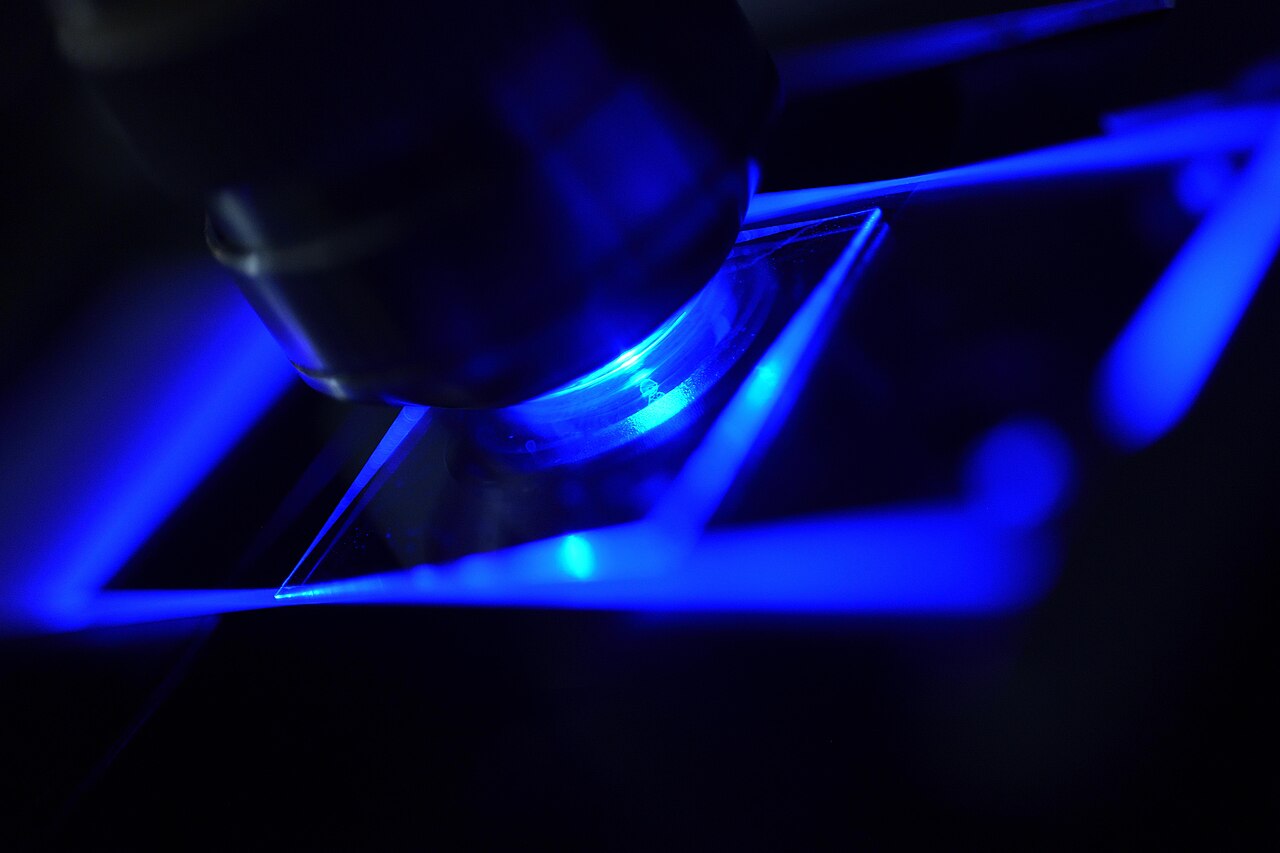
Photo: 图:荧光显微成像特写。中国科学家研制的无线介观显微镜Airscope重仅1克,可在小鼠自由活动时记录其大脑皮层神经活动。(供稿图)