A New Chinatown Rises in San Francisco's Bayview and Portola: Chinese Residents Reach 27% and 46% as San Bruno Avenue Fills With Chinese Businesses
San Francisco is a city in San Francisco County, California (a consolidated city-county). San Francisco's southeastern Bayview-Hunters Point and Portola neighborhoods are gradually becoming a "new Chinatown," the San Francisco Chronicle reported on October 19: along San Bruno Avenue, Chinese bakeries, Cantonese barbecue shops, bubble-tea stores and herbal-medicine shops line the street, and more and more Chinese families are settling and doing business there.
U.S. Census data show that between 2020 and 2024, Chinese residents made up about 27 percent of Bayview's population and nearly 46 percent of Portola's. Citywide, San Francisco's Chinese share has held just above 20 percent for two decades, but the Chinese population of the traditional enclaves — Chinatown, the Richmond and the Sunset — has declined; as housing costs rose there, more families have turned to the southeast for relatively affordable homes. In 1990, Chinese residents were 10 percent of Bayview and 20 percent of Portola. Bayview home prices rose 146 percent between 2010 and 2024, among the fastest increases of any San Francisco neighborhood; Black residents now make up about a quarter of Bayview and Asian residents about 40 percent.
Chinese commerce on the street began in 1991, when Phong Duc Yen, an ethnic Chinese from Vietnam, opened a Chinese grocery on San Bruno Avenue and later, with his wife Lien, an herbal shop and the area's first Chinese restaurant. His daughter Elaine Chan recalled that her father saw the area's potential early. Earlier still, in 1980, Hong Kong immigrant Gordon Gee bought a house in Bayview for $42,000; he had lived in a cramped Chinatown rental and worked as a restaurant server for $1 an hour before studying electrical engineering in San Jose. When he moved in, Black residents were more than 70 percent of the neighborhood and his was one of only two Chinese families on the street. Susan Liang, who immigrated from Guangzhou with her family in 1992 at age nine, bought a townhouse with her husband in 2018 in a new development near the old naval shipyard; she said San Bruno Avenue now reminds her of the Chinatown of her childhood. Danli Xu, who came to the United States in 2016, bought in Bayview two years ago for a little over $1 million — about a third cheaper than a similar house in the Sunset or Richmond.
The demographic shift has also brought friction: during San Francisco's 2022 redistricting, some Black residents opposed placing the largely Asian and white Portola in the same district as Bayview. Russell Jeung, a professor of Asian American studies at San Francisco State University, said sociologists call this "ethnic competition," as different groups contend over limited resources; he added that Asian Americans moving into new neighborhoods also often face exclusion.
The community is also working to bridge divides: since 2010, local nonprofits have held an annual celebration combining Lunar New Year and Black History Month, with lion dances alongside traditional African music, and the roughly one-acre Florence Fang Community Farm, founded in 2014 by the late Chinese American businesswoman Teddy Fang, brings Chinese immigrants and Black residents together to grow vegetables. On the other hand, the Imperial Garden Seafood Restaurant, run for 31 years by Elaine Chan's father, will close this December despite its legacy-business status, as margins have thinned.
Published by GSM · USA (original Chinese edition)
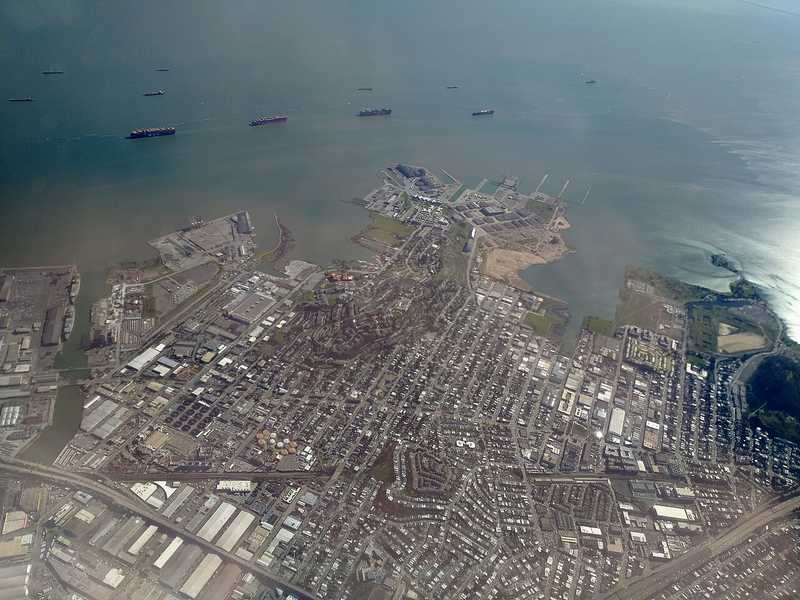
Photo: 图:旧金山湾景区、亨特斯角与烛台角鸟瞰。(Firstcultural/CC0,Wikimedia Commons)