Follow-Up: Dallas Revises Trash-Truck Camera Enforcement: Full-Body Blurring, 'Blight Score' Dropped, Courtesy Notices to Be Rewritten
Dallas, in Dallas County, Texas: The City of Dallas is revising its program that uses artificial-intelligence cameras mounted on garbage trucks to assist property code enforcement. At a briefing of the City Council's Quality of Life Committee, the city's Code Compliance Department and its contractor, City Detect, said images captured by the cameras will now blur people's bodies as well as their faces, that the 'courtesy notices' sent to homeowners will be rewritten, and that the internal term 'blight score' has been dropped in favor of 'image index.'
Background: As GSM reported on October 19, the City Detect system, mounted on 50 sanitation trucks and in use since April, has flagged potential violations at more than 20,000 properties; the city has sent about 3,700 courtesy notices seeking voluntary compliance and opened about 300 enforcement cases, while the Dallas Tomorrow Fund, which helped low-income homeowners pay for repairs, has made no grants since 2024, raising privacy and equity concerns among council members and residents.
The revisions have three parts. First, stronger blurring: City Detect CEO Gavin Baum-Blake said the enhanced blurring obscures a person's appearance, though clothing may still be visible; the images also record the date, time and location they were taken. Second, rewritten notices: the city will revise the courtesy notices sent to more than 3,000 homeowners whose properties were flagged. Code Compliance Director Christopher Christian said the revised notice will carry a QR code linking to city information on housing assistance and home repair programs, and will make clear that the notice itself is not a citation and will not trigger enforcement; the original version had told recipients to make repairs to avoid enforcement action, and some residents have received citations instead. The city's grant program for low-income homeowners needing help with code-related repairs has been paused for about two years, and officials suggested residents could be directed to nonprofit assistance. Third, terminology: the 'blight score,' which ranked flagged properties from 1 to 4 and was used internally to prioritize locations for human review, has been replaced by 'image index'; Baum-Blake acknowledged the former term was loaded.
On oversight, Councilmember Chad West questioned what checks and balances govern the program, and Councilmember Bill Roth called for stronger protections for people captured in the images; committee members said they would work on a plan for more regular oversight, audits and briefings. Councilmember Adam Bazaldua urged the city to address violations on its own properties, including abandoned homes and lots where trash has been dumped, before intensifying enforcement against residents. 'We've rolled out a program that is greatly enhancing code's reach and nothing to sort of mitigate that,' West said. (GSM, based on reporting by Dallas Focal)
Published by GSM · USA (original Chinese edition)
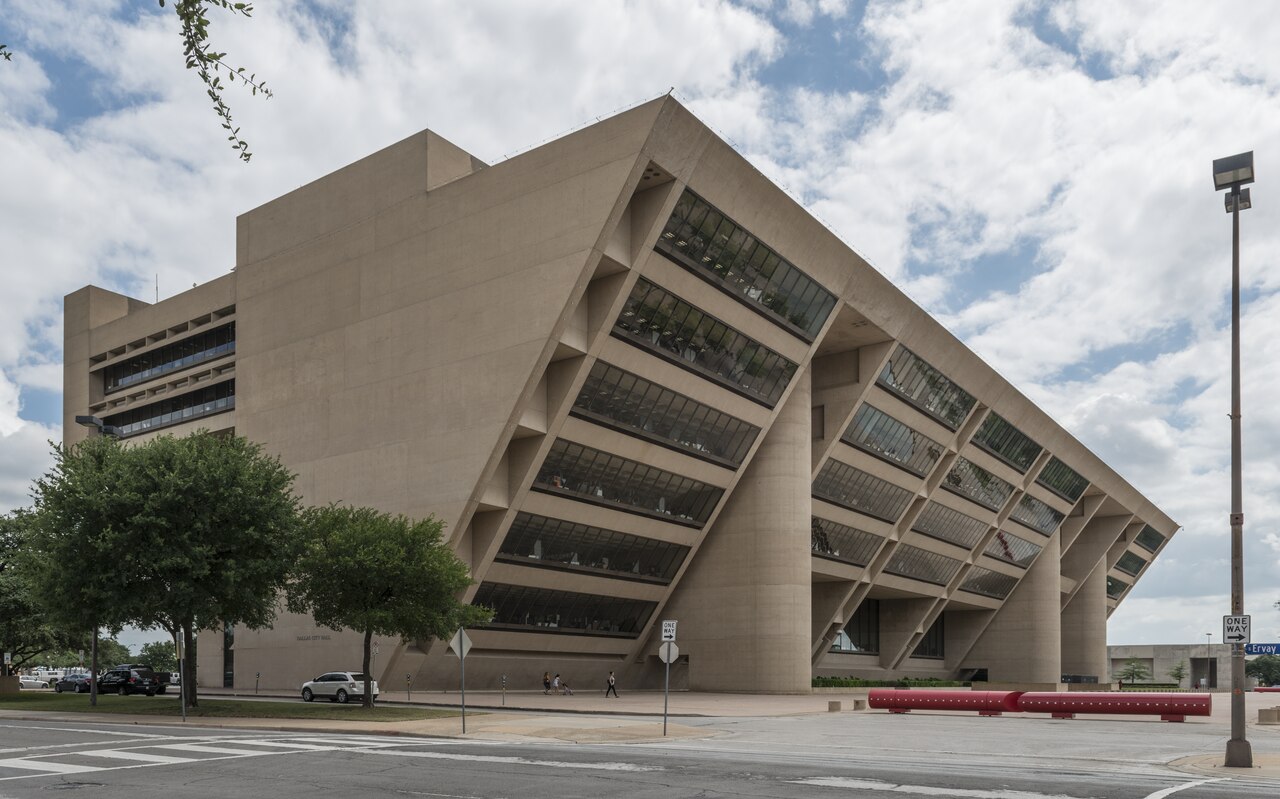
Photo: 图:Dallas 市政厅(1500 Marilla Street),由建筑师贝聿铭设计、1978年建成。Carol M. Highsmith 摄,美国国会图书馆藏品,经 Wikimedia Commons 发布,公共领域。Photo: Dallas City Hall (1500 Marilla Street), designed by I. M. Pei and completed in 1978. By Carol M. Highsmith, Library of Congress collection, via Wikimedia Commons, public domain.
- 2026-10-19Dallas Trash-Truck SI Cameras Flag More Than 20,000 Potential Violations as Repair Grant Fund Sits Paused Since 2024
- 2026-10-20Follow-Up: Dallas Revises Trash-Truck Camera Enforcement: Full-Body Blurring, 'Blight Score' Dropped, Courtesy Notices to Be RewrittenThis story