America's Electoral System (7): Counting, Certification, and a Path into Public Office
[Key points]
The winners 'called' on election night are media projections, not official results; results become official only through county and state canvasses and certification
States count at different speeds mainly because their rules on processing mail ballots differ - not because something has gone wrong
Chinese-American civic participation is a ladder: naturalize, register, vote, serve as a poll worker, then run for local office
1. Election night: why some states finish fast and others take days
California counties begin releasing results after polls close at 8 p.m. on November 3 and update them every few hours until the count is complete. Across the country, though, some states are settled within the evening while others take days. The differences are mostly written into law:
Mail voting volume differs widely by state, and mail ballots are labor-intensive: envelopes must be opened, signatures verified, ballots flattened and scanned.
When processing may start differs too. Florida and several states let officials open, verify and scan mail ballots weeks before Election Day (results, of course, remain secret until polls close). Pennsylvania and Wisconsin, by law, do not allow processing to begin until Election Day morning, so stacks of mail ballots queue behind in-person votes.
Receipt deadlines differ. California counts ballots postmarked by Election Day that arrive by November 10; some states require arrival by election night. A later receipt deadline means a later finish. Add time zones, and most election-night 'slowness' is simply how the rules were designed.
When television networks and wire services 'call' a race, they are publishing a statistical projection from partial counts; close races can stay uncalled for days. A call is not an official result and has no legal force.
2. From counting to certification: how results become final
Election-night numbers are preliminary. Counties then conduct the official canvass: every mail ballot, provisional ballot, and military and overseas ballot is accounted for; signatures are cured where the law allows; audits sample the count; and the county formally adopts its results.
California's 2026 timetable (Secretary of State): counties must certify their results by December 3, and on December 11 the Secretary of State certifies the statewide Statement of Vote - the official record. In very close races, a candidate or voters may request a recount under state law, and disputes go to court; the Florida recount fight of 2000 ended only with a Supreme Court ruling.
The federal handoff follows. The new Congress is seated at noon on January 3, 2027: the House elects its Speaker and new senators are sworn in. In a presidential cycle there is one more loop - states issue certificates of ascertainment, electors meet in December, and Congress counts the electoral votes on January 6 (the Electoral Count Reform Act of 2022 made the vice president's role purely ceremonial and raised the threshold for objections) - before the inauguration on January 20. Every step of the transfer of power has a date, an office responsible, and a paper trail.
3. Chinese Americans in the system: from one ballot to a seat at the table
The institutions give every citizen the same doors; Chinese-American participation has climbed them one rung at a time.
The first rung is naturalization and registration. Beyond voting, county elections offices continually recruit bilingual poll workers - in much of California, Chinese-language service at voting sites is a legal requirement - and serving as a poll worker is many Chinese Americans' first look inside the machinery: trained, paid, and strictly nonpartisan.
The second rung is showing up, election after election, and organizing. Local races draw low turnout, so an organized community carries real weight in school board and city council contests. Nonprofit community groups may lawfully run nonpartisan voter education and registration drives - they may not support or oppose candidates - and many Chinese-American organizations do exactly this.
The third rung is running. The path usually starts locally - school board, city council, community college board, water district - with the requirements printed in plain sight: be a registered voter, meet residency and age rules, file candidacy papers with the county by the deadline, pay a filing fee or gather signatures, and report campaign finances under disclosure law (the FEC for federal races; California's Fair Political Practices Commission for state and local ones). Chinese-American officeholders now serve at every level from school boards to Congress - each step of that ladder is the system described in this series, working as designed.
Seven chapters later, the long American ballot makes sense: it is long because it staffs three levels of government, and it is slow because every vote must be verifiable. For immigrants, learning the rules is how living in a place becomes taking part in it.
(The series concludes. Thank you for reading.)
Related: America's Electoral System (1): The Big Picture: What U.S. Elections Actually Decide
Related: America's Electoral System (6): How Voters Cast Ballots: California in 2026 as an Example
Source: GSM · USA (original Chinese edition)
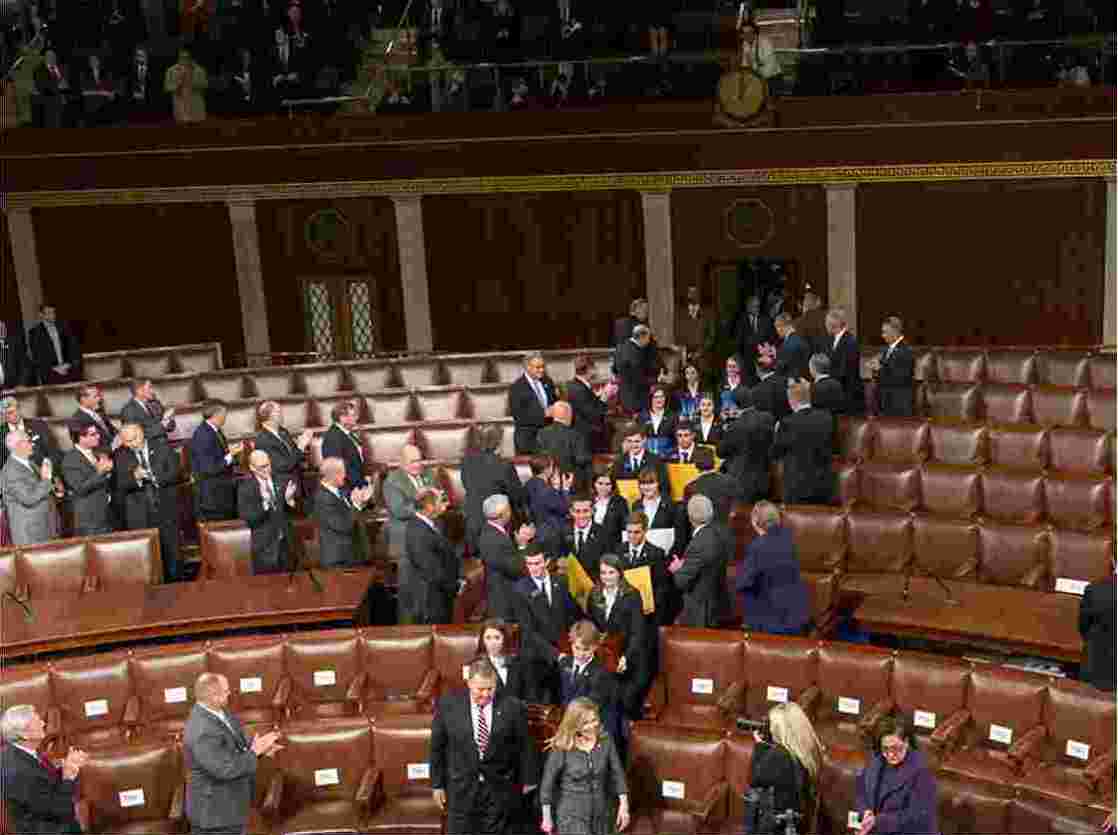
Photo: 图:国会联席会议清点各州选举人票(2017年1月)。图片来源:Wikimedia Commons(公共领域)
- 2026-10-20America's Electoral System (1): The Big Picture: What U.S. Elections Actually Decide
- 2026-10-20America's Electoral System (2): How the President Is Elected: The Electoral College and the Road to 270
- 2026-10-20America's Electoral System (3): How Congress Is Elected: Senate, House and Redistricting
- 2026-10-20America's Electoral System (4): The Midterms: What Is on the Ballot on November 3, 2026
- 2026-10-20America's Electoral System (5): Primaries and Nominations: How Candidates Are Chosen
- 2026-10-20America's Electoral System (6): How Voters Cast Ballots: California in 2026 as an Example
- 2026-10-20America's Electoral System (7): Counting, Certification, and a Path into Public OfficeThis story