Eight Foreign Ministers Meet in Istanbul to Oppose New Strike on Iran as Trump Says U.S. May Launch 'Another Little Epic Fury'
ISTANBUL — Foreign ministers from eight European and Middle Eastern countries met in Istanbul on October 23 and agreed to oppose a new U.S. and Israeli military strike on Iran, calling for the Strait of Hormuz to be reopened immediately, attacks on Saudi Arabia to stop, and safe navigation in the Black Sea to be protected. The eight countries were Türkiye, Egypt, Pakistan, Saudi Arabia, Britain, France, Germany and Italy. The meeting began with the four Middle Eastern ministers discussing regional tensions and the blocked Strait of Hormuz, and was then joined by the four European ministers for talks on Hormuz, Black Sea navigation and the Russia-Ukraine conflict.
Turkish Foreign Minister Hakan Fidan said after the meeting that military intervention against Iran was "by no means a solution" and that all participants agreed a new round of strikes would spread war and conflict across the region; risks to the Strait of Hormuz, the Bab el-Mandeb Strait and the Black Sea were adding to pressure on the global economy. He said the countries wanted neither the Gulf conflict nor the Russia-Ukraine conflict to spread further, and that diplomacy and dialogue were the only way forward. French Foreign Minister Jean-Noël Barrot said another U.S.-Iran war would be a disaster for both sides and would only push oil prices higher; oil prices have already reached their highest since May. British Foreign Secretary Ed Miliband urged both sides to pursue diplomacy. Italian Foreign Minister Antonio Tajani said the meeting aimed at de-escalation and freedom of navigation, that military means alone could not solve the problem, and that reopening Hormuz required dialogue. German Foreign Minister Johann Wadephul said deadlocked conflicts were hitting economies and security, accused the Houthis and Iran of coercing global trade and choking energy and fertilizer supplies, and said the consequences of shipping attacks were already visible in petrol-station and supermarket prices.
The same day, statements from the U.S. side contrasted with the ministers' appeal. Tom Barrack, the U.S. ambassador to Türkiye and special envoy for Syria, said on October 23 that a U.S. strike on Iran this weekend was "absolutely" possible, while adding that President Donald Trump remained open to a diplomatic deal. Trump told a rally in Florida on October 23: "We may do another little Epic Fury, or they'll agree." He added that if Iran were smart, it would say, "Let's get down to business," but he doubted it would. Trump also said the U.S. had destroyed Iran's uranium-enrichment capacity and that Washington could end the war quickly, but was weighing whether to finish it immediately or let it wind
down. "Epic Fury" is the U.S. military's name for its campaign against Iran, which began on February 28. Earlier this month Trump said the U.S. would not strike Iran before the November 3 midterm elections. His remarks were rally remarks; he gave no details of any operation's scale, targets or timing.
(GSM, from The Guardian, Xinhua, Al Jazeera, Agence France-Presse and Reuters)
Source: GSM · USA (original Chinese edition)
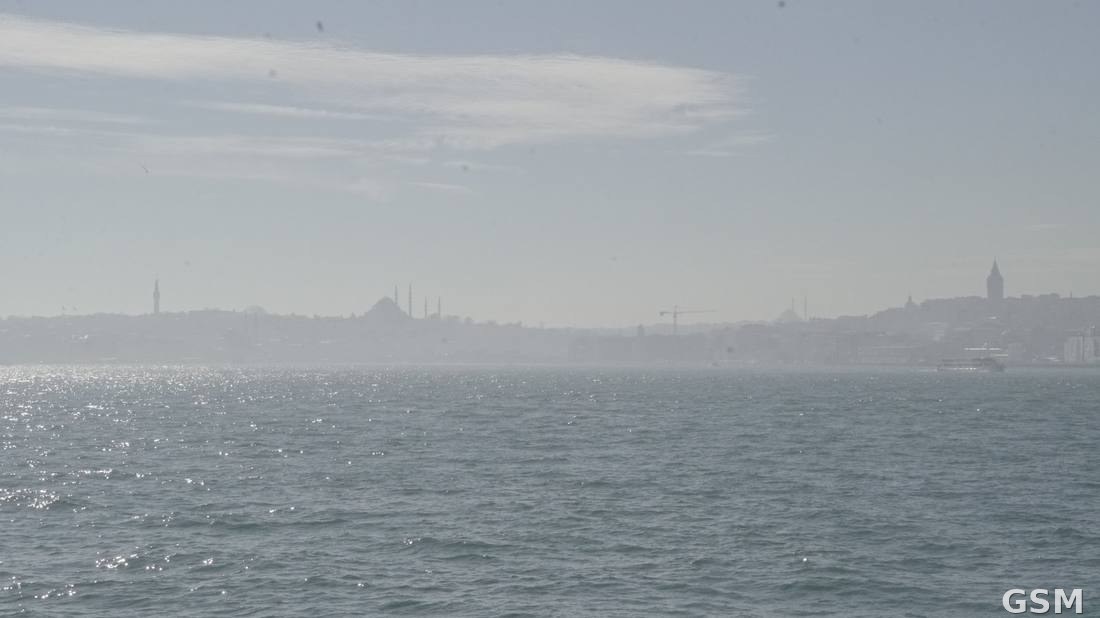
Photo: 图:伊斯坦布尔博斯普鲁斯海峡天际线,资料图。照片:Jwslubbock,CC BY-SA 3.0,经Wikimedia Commons。 / The Bosphorus skyline, Istanbul (file photo). Photo: Jwslubbock, CC BY-SA 3.0, via Wikimedia Commons.
- 2026-10-24Turkish, Egyptian, Pakistani and Saudi Foreign Ministers Issue Joint Istanbul Statement: Israeli Occupation Is the Root Cause of Regional Instability, Two-State Solution Must Come Soon
- 2026-10-24Eight Foreign Ministers Meet in Istanbul to Oppose New Strike on Iran as Trump Says U.S. May Launch 'Another Little Epic Fury'This story