California's Second Methane Satellite Tanager-2 Launches: Satellite Program Has Now Helped Fix 50 Major Leaks, Oil and Gas Repairs Equal to 42,000 Cars Off the Road for a Year
California Governor Gavin Newsom announced in Sacramento on October 27 that Tanager-2, the state's second methane-detecting satellite, has recently launched, and that California's Satellite Methane Program (CalSMP) has now helped resolve 50 major methane leaks statewide — 20 at oil and gas facilities and 30 at landfills — with the oil and gas repairs alone preventing planet-warming pollution equivalent to taking 42,000 gasoline-powered vehicles off the road for a year.
The Governor's Office said the tally stood at 10 leaks last November, when Newsom announced the program's first six months of results using data from the Tanager-1 satellite. Tanager-2 will double the project's coverage; the satellites pass over California four to five times a week, can spot major methane releases more quickly and recheck whether operators have fixed them, and additional satellites are expected to launch in 2027 and beyond.
Newsom said California is doubling down on methane-detecting technology to find leaks and push polluters to clean them up even as the Trump administration makes it easier to pollute, adding that the second satellite means more eyes in the sky to help stop pollution on the ground and protect California workers, families and children.
The announcement came as the Trump administration signaled plans the same day to eliminate federal protections requiring oil and gas companies to investigate major methane leaks detected through satellites and other monitoring technologies, the Governor's Office said. The U.S. Environmental Protection Agency's plans are expected to include eliminating the federal "super-emitter" program, which uses satellite, aircraft and certified third-party observations to identify major methane releases and requires operators to investigate EPA notifications; EPA also plans to revise requirements for low-producing wells and reconsider how companies handle natural gas produced at oil wells, including flaring. When EPA adopted the prior standards, it projected the full rules would prevent 58 million tons of methane, 16 million tons of smog-forming pollution and 590,000 tons of toxic air pollutants, including benzene, from 2024 through 2038. Last year EPA also proposed ending long-standing greenhouse gas reporting requirements for power plants, oil refineries, chemical factories, landfills and many other industries, and letting most oil and gas operations stop reporting greenhouse gas emissions until 2034.
California Environmental Protection Agency Secretary Yana Garcia said the federal rollback rewards polluters at the expense of public health, and that California refuses to go backward and will keep using science-based action and cutting-edge technology to identify and address methane leaks. California Air Resources Board (CARB) Chair Lauren Sanchez said reckless federal rollbacks do not change California law, that the state's methane regulations remain in place, and that the satellite project has already helped stop 50 major leaks at oil and gas facilities and landfills statewide.
As an example of the program in action, the Governor's Office said that in late August California used satellite data to identify a large methane plume linked to oil and gas equipment in the Midway-Sunset oil field, southwest of Bakersfield; after CARB was notified, the operator located the source at a flange on top of a storage tank and completed repairs the same day.
The methane detection technology was developed by NASA's Jet Propulsion Laboratory in Pasadena, and CalSMP is the first major initiative to use it in a real-world, non-research setting; CARB maintains a public dashboard tracking leak locations and progress toward stopping them. Methane is the second-largest source of human-caused greenhouse gas emissions, with a warming impact up to 80 times greater than carbon dioxide, and remains in the atmosphere for about a decade. California's Oil and Gas Methane Regulation requires operators to inspect their systems every quarter and repair above-ground leaks, and its Landfill Methane Regulation requires large landfills to monitor and capture methane emissions. Through the Subnational Methane Action Coalition (SMAC), launched by California at COP28, CARB is also exploring pilot projects with partners in other jurisdictions.
Source: GSM · USA (original Chinese edition)
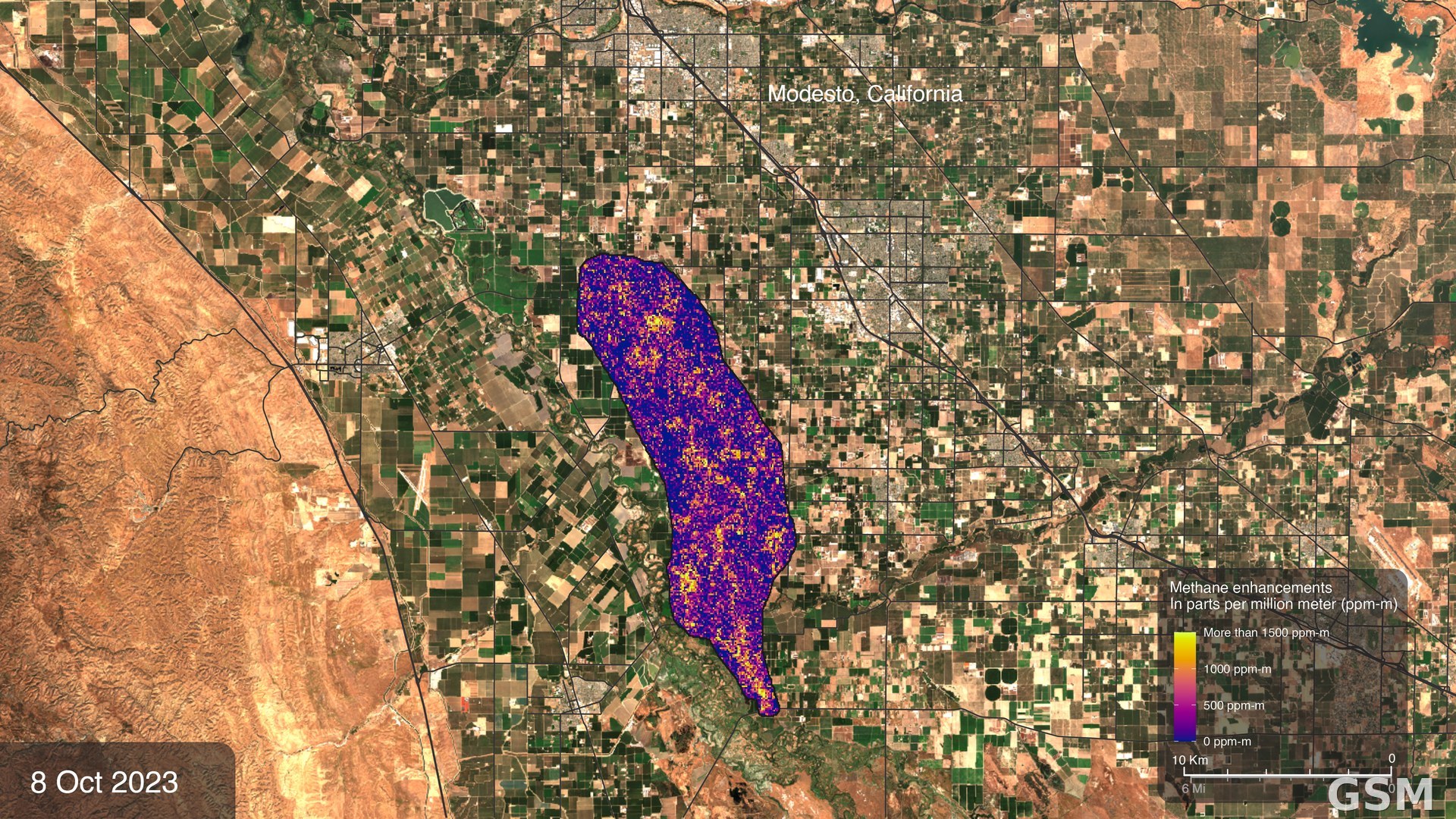
Photo: 图:卫星探测到的加州 Modesto 一带甲烷浓度增强(2023年10月8日,NASA EMIT任务资料图,与本稿卫星监测同类技术)。NASA科学可视化工作室(SVS)发布,公共领域,来源:Wikimedia Commons / Photo: Methane enhancements near Modesto, California, detected by NASA's EMIT mission on Oct. 8, 2023 (illustrative; same class of satellite monitoring as this story). By NASA Scientific Visualization Studio, public domain, via Wikimedia Commons