Stanford KIPAC Astrophysics Colloquium Dec. 3: NASA Goddard Scientist Zorawar Wadiasingh at SLAC, Free
The Astrophysics Colloquium series of Stanford's Kavli Institute for Particle Astrophysics and Cosmology (KIPAC) continues on Thursday, December 3, 2026, at 11 a.m. at SLAC National Accelerator Laboratory in Menlo Park, San Mateo County, California. Zorawar Wadiasingh of NASA's Goddard Space Flight Center and the University of Maryland, College Park, will speak in the third-floor conference room of SLAC's Fred Kavli Building; the talk ends at noon.
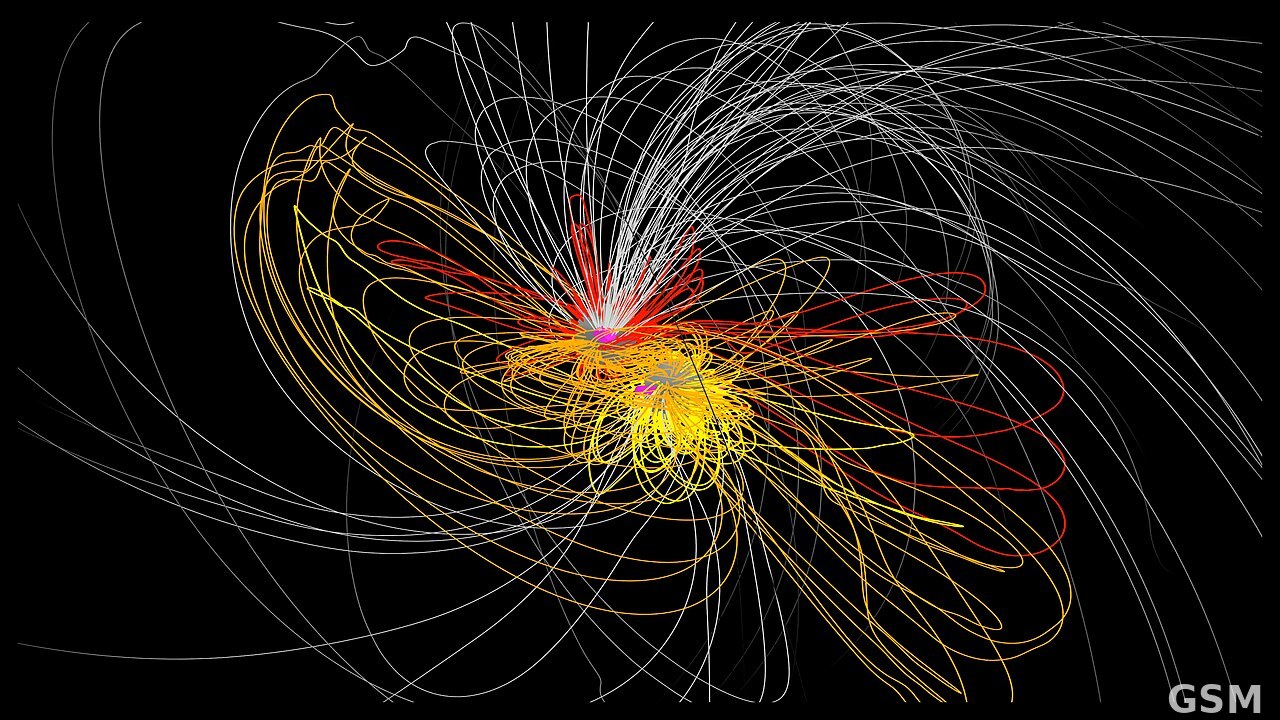
Wadiasingh studies the high-energy physics of neutron stars, magnetars and other compact objects. In a NASA study he co-authored, researchers ran more than 100 supercomputer simulations tracking how the magnetospheres of two neutron stars, each 1.4 solar masses, tangle, break and reconnect in the final milliseconds before merger. The light from such systems varies greatly in brightness and depends on the stars' relative magnetic orientations, and those signatures could be imprinted on gravitational-wave signals detectable by next-generation facilities. KIPAC has not yet posted the specific title of this talk; it will be updated on the institute's website.
The KIPAC Astrophysics Colloquium meets Thursdays at 11 a.m. during academic quarters and is free and open to the public, with no registration required. Details: kipac.stanford.edu.
Source: GSM · USA (original Chinese edition)
Photo: 图:美国宇航局(NASA)超级计算机模拟两颗中子星并合前磁层缠绕的科学可视化图,Wadiasingh 参与了这项研究。公共领域图片,美国宇航局科学可视化工作室(NASA Scientific Visualization Studio),来源:Wikimedia Commons / Photo: NASA supercomputer visualization of the tangled magnetospheres of two merging neutron stars, from a study co-authored by Wadiasingh. Public domain, NASA Scientific Visualization Studio, via Wikimedia Commons.