How China and the U.S. Handle Homelessness: America Counts People on One Night, China Counts Relief Visits: Different Yardsticks, No Direct Comparison
A note on measurement first. The United States counts homeless people on a single night each year, including people in shelters and people sleeping on streets, in cars and in encampments. China counts the number of relief visits at its aid stations over a year and does not publish a street headcount. The two sides do not count the same thing, so the headcounts cannot be compared directly. What follows compares the two systems and their practices; figures are scale references only, not a verdict on either system.
The American approach: one count a year, federal money, local delivery.
The U.S. Department of Housing and Urban Development conducts a Point-in-Time Count each January, tallying how many people are homeless on a single night. The January 2024 count found 771,480 people, up 18.1% from 653,104 in 2023 and the highest since the count began in 2007; California led all states with 187,084, followed by New York with 158,019; veterans were the only group whose numbers fell, down 8%.
The January 2025 count found 745,652 people, including 266,320 unsheltered, down 3.3% from 2024 — the first national decline since 2016, but still 27% above 2013. The decline was driven by families with children (down 11%), unaccompanied youth (down 7.9%), unsheltered people (down 2.9%) and veterans (down 1.2%); California fell 2.8% and New York 7.9%. But single adults (515,286) and people experiencing chronic homelessness (155,750) both hit record highs, and the National Alliance to End Homelessness noted that about 17,500 people a week entered homeless systems for the first time during 2024.
Federal money flows through local Continuums of Care, run by local governments and service providers. Since the 2000s, federal programs have used a "Housing First" approach: provide stable housing first, then address treatment and employment. On June 28, 2024, the U.S. Supreme Court ruled 6–3 in City of Grants Pass v. Johnson that cities may enforce camping bans even when no shelter beds are available, overturning lower-court protections for people sleeping outdoors; Grants Pass fines camping starting at $250, with jail time for repeat offenses.
On July 24, 2025, the president signed the executive order "Ending Crime and Disorder on America's Streets," directing federal grants to give priority to jurisdictions that enforce prohibitions on open drug use, urban camping, loitering and squatting, and moving people into treatment — a shift from "Housing First" toward treatment and self-sufficiency. Supporters said the approach balances public safety with access to services; critics, including the National Homelessness Law Center, said it criminalizes homelessness and that forced treatment is unethical and ineffective. Both positions are on the record.
Local execution varies. In Los Angeles, Mayor Karen Bass's Inside Safe teams had brought more than 6,200 people indoors as of early October, yet the county's 2026 count showed 73,040 people countywide and 45,194 in the city, rising after two years of declines, with the city's unsheltered population up to 29,115; the city and county were still disputing who controls the data system and housing matching, with the County Board of Supervisors voting on October 27 to sign an agreement.
The Chinese approach: aid stations, voluntary and free.
China runs an aid-station system for urban vagrants and beggars with no means of livelihood. In 2003, after the Sun Zhigang case drew widespread public attention, the State Council adopted the Regulations on Aid and Management for Urban Vagrants and Beggars with No Means of Livelihood on June 18, effective August 1, abolishing the 1982 measures on shelter and repatriation; the Ministry of Civil Affairs issued implementation rules on July 21, 2003. The system changed from compulsory shelter and repatriation to voluntary, free relief.
The regulations define the target group precisely: people who cannot secure food and lodging on their own, have no relatives or friends to turn to, do not receive urban minimum living allowances or rural five-guarantee support, and are currently living as vagrants and beggars in cities. Relief is temporary social assistance, delivered by aid stations established by city governments at county level and above and run by civil affairs departments. Stations may not detain or disguised-detain recipients, beat, abuse or punish them, extort or seize their property, withhold their living supplies, or hold back their documents; they must provide food and lodging meeting basic health and safety needs, send the sick for medical treatment, contact families and the governments of recipients' registered or actual residences, help them return home, and arrange placement for disabled people, minors and elderly people who genuinely have no home.
On scale, Ministry of Civil Affairs figures for 2004 showed 977 stations and 45,000 beds nationwide, with 820,000 person-times of relief provided to urban vagrants and beggars with no means of livelihood. The caseload has changed in recent years: the ministry said in June 2025 that traditional vagrants and beggars were gradually declining and that people in temporary difficulty had become the main service population; over the past year, civil affairs departments and aid stations assisted 709,000 person-times of people in temporary difficulty, and helped 4,051 lost people return to their families in 2024. Data released by the ministry on December 31, 2025, put the year's relief for vagrants, beggars and others with no means of livelihood at 625,000 person-times.
The terminology is changing too. A spokesperson for the Legislative Affairs Commission of the National People's Congress Standing Committee said that as the number of vagrants and beggars declined year by year, the people served were mainly those stranded away from home after getting lost or running into difficulty while working away — "people in temporary difficulty." The Social Assistance Law, effective July 1, 2026, replaced the term "vagrants and beggars" with "people adrift," described as more accurate, neutral and concise, without changing the content of the relief system.
The broader safety net is the backdrop. Ministry figures show that as of the first half of 2026, China had 39.354 million urban and rural minimum living allowance recipients and 4.937 million people receiving special hardship support; during the 14th Five-Year Plan period, cumulative basic livelihood assistance spending exceeded 1.38 trillion yuan, and average minimum living allowance standards rose 22.8% in urban areas and 25% in rural areas. These are basic livelihood protections for the whole disadvantaged population, not vagrancy-specific counts.
The two measurement yardsticks differ: the United States counts people on one night; China counts relief visits over a year. The U.S. count covers shelters and streets; China's relief target is limited to people unable to secure food and lodging, with no family support and no minimum allowance or five-guarantee support, currently living as vagrants and beggars in cities. The institutional designs also differ: the United States funds through the federal government, delivers through local Continuums of Care, and lets courts set the boundary for camping enforcement; China delivers temporary relief through civil affairs aid stations, helps people return home or find placement, and backs the system with a broader social assistance net.
Related: More Homeless People Near My Home — After 26 Years in America, One Corner of the Country I See
Source: GSM · USA (original Chinese edition)
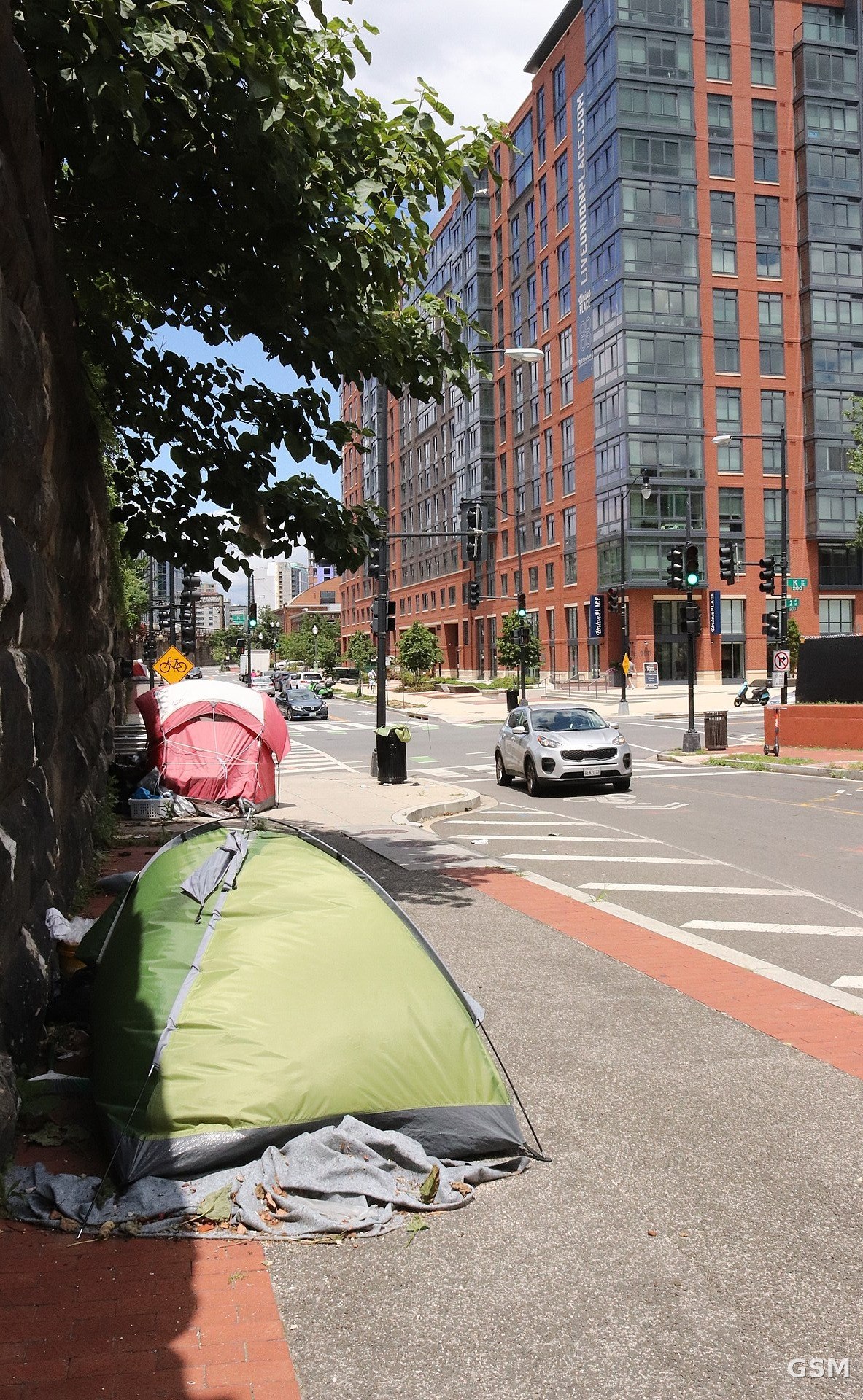
Photo: 美国华盛顿特区街头无家可归者营地的帐篷(资料图)。照片:Elvert Barnes,CC BY-SA 2.0,经维基共享资源。 / Tents at a homeless encampment in Washington, D.C. (file photo). Photo: Elvert Barnes, CC BY-SA 2.0, via Wikimedia Commons.