SLAC on Tap Brings a Night of the Dark Matter to Menlo Park on October 28: Four SLAC Scientists Explain the LZ and SuperCDMS Hunts, Free to Attend
SLAC National Accelerator Laboratory, in the city of Menlo Park, San Mateo County, California, will host "SLAC on Tap: Night of the Dark Matter" on Wednesday, October 28, from 5:30 to 7:00 p.m. at The Dutch Goose restaurant, 3567 Alameda de las Pulgas, Menlo Park, CA 94025. Four SLAC scientists — Dan Akerib, Tom Shutt, Kelly Stifter and Ann Wang — will explain how researchers hunt for dark matter in a moderated panel followed by an audience Q&A. The event is free, with registration through Eventbrite. This Halloween edition also features a costume competition: attendees are invited to come dressed as their favorite dark matter candidate particle.
Dark matter makes up most of the matter in the universe, yet it continues to slip through our grasp. According to SLAC, the LUX-ZEPLIN (LZ) experiment recently made headlines after researchers spotted a mysterious particle interaction that they cannot easily explain — one that could potentially have been caused by dark matter. Meanwhile, SuperCDMS has started its hunt for lighter dark matter particles with detectors sensitive enough to pick up their faintest traces. The panel will take the audience deep underground, where experiments like LZ and SuperCDMS have set traps for one of the universe's sneakiest substances, and explore what could be hiding in the dark, how scientists are trying to catch it, and what it would take to finally unmask dark matter.
All four speakers work on the front lines of the dark matter search. Dan Akerib and Tom Shutt, both professors of particle physics and astrophysics at SLAC, have worked together in the search for dark matter for most of the last 30 years, starting with the CDMS program and continuing through the development of liquid-xenon detectors including LUX and LZ; they relocated from Case Western Reserve University to SLAC in 2014. Kelly Stifter, their first graduate student from the Stanford Physics Department, now develops new detectors, including quantum sensors, to extend dark matter searches to lower masses, and is a member of the SuperCDMS collaboration. Ann Wang joined the LZ group as a KIPAC fellow, working on the search for dark matter with liquid xenon and on technologies for future detectors. Both Stifter and Wang later became Panofsky Fellows at SLAC.
How to attend: The event is free and registration is through Eventbrite. As of publication, the Eventbrite registration page shows this session as fully booked; those interested can watch the SLAC events page and the registration page for any waitlist openings or future sessions. The event is held in person only, with no livestream.
Source: GSM · USA (original Chinese edition)
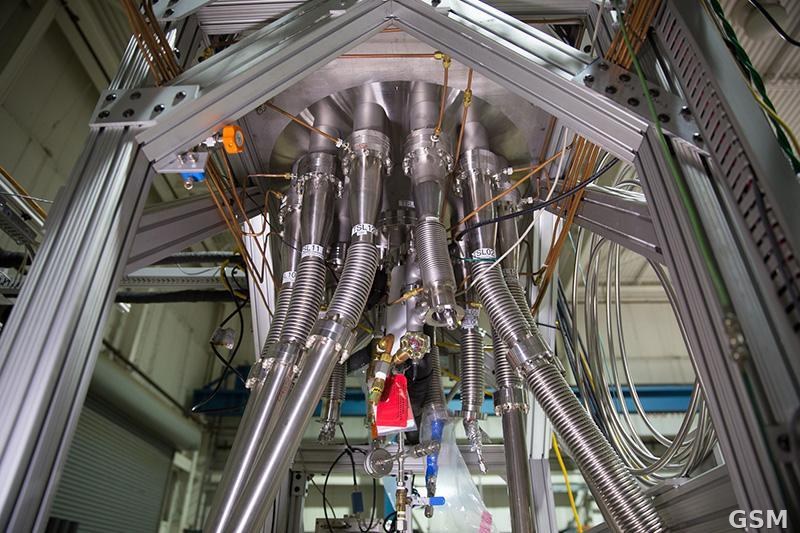
Photo: 图:位于SLAC国家加速器实验室的LZ(LUX-ZEPLIN)暗物质实验系统测试平台,SLAC科学家正是在这类探测器上搜寻暗物质粒子。图片来源:SLAC国家加速器实验室(SLAC/LZ实验官网图库)。Photo: The LZ (LUX-ZEPLIN) dark matter experiment's system test platform at SLAC National Accelerator Laboratory. Credit: SLAC National Accelerator Laboratory.