UN Security Council Debates Iran Nuclear Programme: Grossi Says Nuclear Material Still Unverified, 400 kg of Highly Enriched Uranium Unaccounted For
The UN Security Council held its 10253rd meeting in New York on 27 October to take up non-proliferation and the Iranian nuclear issue. Rafael Grossi, Director General of the International Atomic Energy Agency (IAEA), told the Council that Iran has not provided the information and access needed for verification, and that the Agency cannot verify Iran's previously declared nuclear material. The meeting took no substantive decision, as speakers remained divided over whether sanctions on Iran are back in force.
The meeting opened with a procedural vote requested by the Russian Federation. By 11 votes in favour to 2 against, with 2 abstentions, the Council adopted its provisional agenda; the Russian Federation and China voted against, while Somalia and Pakistan abstained. Before the vote, the representatives of the Russian Federation and China asserted that on 18 October 2025 the Council had concluded its consideration of the Iranian nuclear issue and terminated the "non-proliferation" agenda item, citing paragraph 8 of resolution 2231 (2015). The representatives of France, the United Kingdom and the United States countered that Iran's non-compliance with its safeguards obligations meant that resolution 2231 (2015) remained in force, with the United States rejecting the opposing claims as "baseless, self-serving counterfactual" statements.
Grossi said Iran "has not provided the requested information and access so that the IAEA can verify previously declared nuclear material at Iran's facilities under safeguards, both those that have been affected by military attacks and those that have not". He noted that Agency inspectors had spent more than 14,000 calendar days conducting verification activities in more than 1,400 facilities and locations, but were compelled to withdraw for safety reasons after the commencement of military attacks in June 2025. "Legal obligations in this regard cannot be unilaterally suspended under any circumstances," he said, citing resolution GOV/2026/61, adopted by the IAEA Board of Governors on 9 September 2026, and he encouraged Iran to clarify outstanding safeguards questions and give the IAEA the information and access it requires so it can verify all relevant facilities and material, as is Iran's legal obligation. Such gradual, technical, incremental steps, he added, could pave the way to normal safeguards implementation in Iran while contributing to a confidence-building atmosphere conducive to a wider agreement.
Iran's enriched uranium stockpile drew alarm from several speakers. The United Kingdom's representative expressed concern over a stockpile of more than 400 kilograms of uranium enriched to 60 per cent, making Iran the only State without nuclear weapons to enrich to this level, "for which there is no credible civilian justification". She said the stockpile has remained unaccounted for for more than a year and called on Iran to allow the return of IAEA inspectors to all nuclear sites. France's delegate warned that such a quantity of material would potentially be enough for around 10 explosive nuclear devices, and said the Council must fulfil its role in responding to the proliferation crisis and demand that Iran immediately comply with its international obligations and urgently resume effective cooperation with the Agency. Germany's representative said the issue at stake is the integrity and credibility of the global nuclear non-proliferation regime, and that the rights and obligations of the Non-Proliferation Treaty must be upheld. Denmark's representative said the snapback mechanism had been activated in full accordance with resolution 2231 (2015) and the sanctions against Iran remain in force. Latvia's delegate said that if Iran is serious about a peaceful long-term solution and the eventual lifting of sanctions, it must fully cooperate with the Agency.
The United States representative rebuked Iran for its continued non-compliance with its obligations, adding that "all who value the NPT should be deeply concerned by this". She said the United States will work with other Council members to advance an independent multilateral mechanism to monitor and report on global implementation of the 1737 sanctions regime, and urged Council and General Assembly representatives to support "this architecture of accountability".
The Russian Federation's delegate said claims that there are no IAEA verification activities in Iran were another round of "fabrications", noting that even after the first series of strikes by the United States and Israel against Iran's peaceful nuclear infrastructure in June 2025, Iran continued to engage with the Agency, including inspections at facilities not affected by the strikes. Creating an "alternative reality" around the Iranian issue does not help the Council's work, he said, calling on Council members to stop using the Council and the IAEA "to settle political scores with Tehran", and adding that there can be no alternative to a political and diplomatic settlement. China's representative concurred that political and diplomatic means are the only solution, saying the root causes of the current predicament are the United States' withdrawal from the nuclear agreement, its resumption and continuous intensification of unilateral sanctions and its "maximum pressure" policy. Military strikes carried out twice by Israel and the United States on Iran's IAEA-safeguarded nuclear facilities are the direct cause of the IAEA's inability to carry out safeguards at relevant sites, he said, calling on the United States to cease using force against Iran.
Iran's delegate stressed that "Iran is a victim of war, not the aggressor", taking issue with the Council's "inexcusable inaction" in the face of aggression by two nuclear-weapon possessors against his country 18 months ago. He decried 11 repeated attacks against Iran's nuclear facilities under IAEA safeguards, in violation of Council resolution 487 (1981), saying such strikes create a grave risk of radiation release with potentially devastating consequences. Assailing what he called double standards, he said those with genuine non-proliferation concerns should look to Israel, which he said possesses 200 nuclear warheads, remains outside IAEA safeguards and is party to none of the disarmament conventions.
Bahrain's delegate said diplomacy and dialogue remain the best path to address the Iranian nuclear file. Pakistan's delegate urged all sides to exercise restraint and break the deadlock towards a negotiated settlement, pointing to the Islamabad Memorandum of Understanding reached in June, which he said demonstrates that progress is possible.
By way of background, the Council in 2015 endorsed the Joint Comprehensive Plan of Action, under which Iran received sanctions relief in exchange for limits on its nuclear programme and a 10-year monitoring framework; the agreement included a "snapback" mechanism under which sanctions would be reinstated if Tehran failed to fulfil its obligations. After the United States withdrew from the agreement in May 2018, Iran reduced its commitments. In September 2025, France, Germany and the United Kingdom argued that the snapback mechanism had been triggered by Tehran's alleged violations, reinstating the sanctions and the 1737 Committee, established in 2006 to report on Iran's nuclear programme. The Russian Federation and China contended that, the United States having withdrawn from the plan, the mechanism had lapsed. Because of the impasse, the Council has been unable to agree on whether the 1737 Committee's mandate is valid, has not elected a Chair for the Committee and has been unable to appoint a Panel of Experts to monitor the implementation of sanctions. Tensions worsened after the United States and Israel launched military strikes on Iran in February and Iran launched counterattacks against its neighbours.
Source: GSM · USA (original Chinese edition)
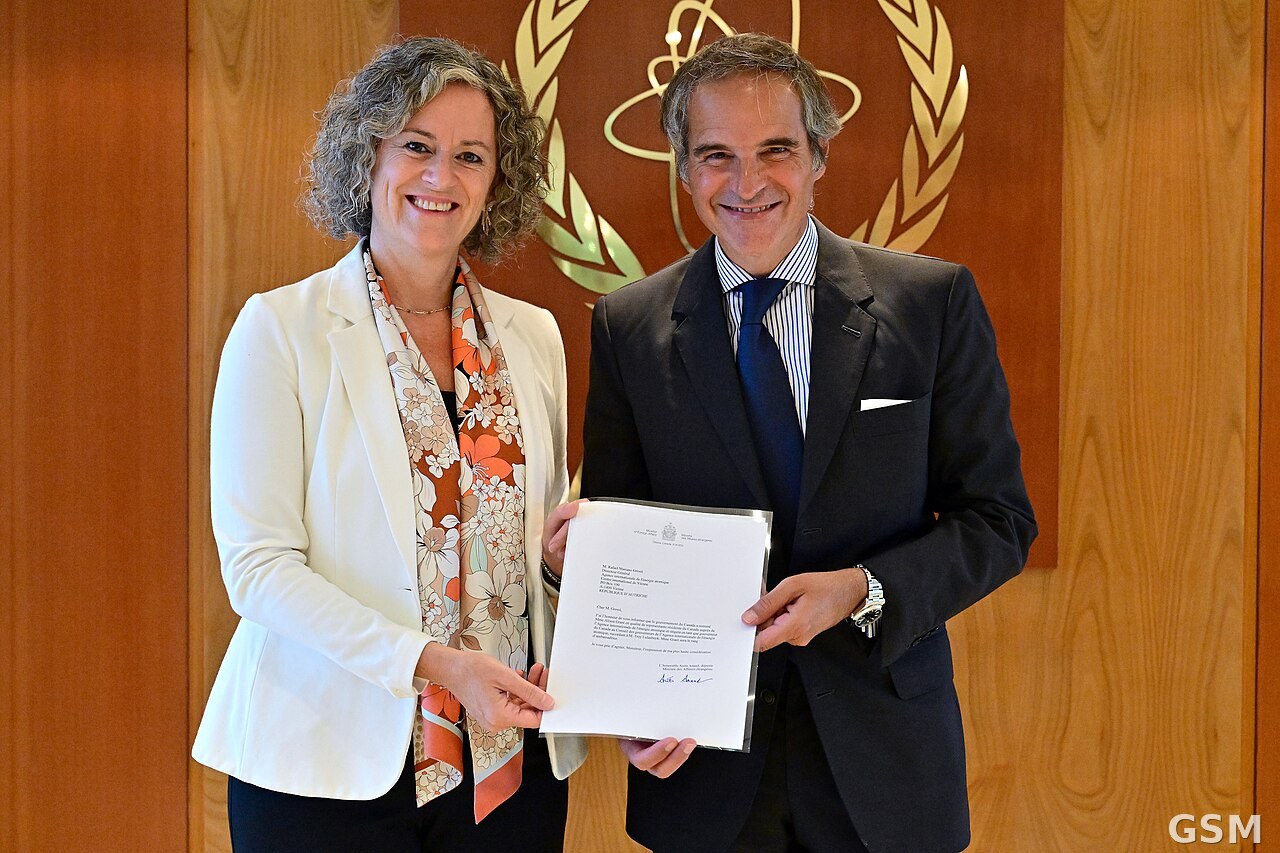
Photo: 国际原子能机构(IAEA)总干事格罗西(右),2025年8月摄于维也纳IAEA总部。照片:IAEA Imagebank / Dean Calma,CC BY 2.0,经 Wikimedia Commons