California AG Rob Bonta Joins Coalition of 19 Attorneys General in Supreme Court Brief Backing Connecticut and Cook County Assault Rifle Bans
The California Attorney General's Office announced in Oakland on October 28 that Attorney General Rob Bonta, as part of a coalition of 19 attorneys general, filed an amicus brief in the U.S. Supreme Court supporting laws enacted in Connecticut and Cook County, Illinois, that restrict the sale, manufacture, and possession of certain assault rifles. The brief, filed in Viramontes v. County of Cook, urges the Supreme Court to uphold appellate court rulings that found the challenged assault weapon laws consistent with the Second Amendment and the nation's strong historical tradition of regulating uniquely dangerous weapons.
"The California Department of Justice will continue to aggressively defend life-saving safety measures and support local leaders with the tools necessary to keep people safe. Assault weapon laws restrict a small and uniquely dangerous category of weapons that have proven to be mass shooters' weapon of choice for a reason," Bonta said in the statement. He said California enacted the nation's first state-level assault weapons restriction almost four decades ago to protect residents from weapons with battlefield features that facilitate indiscriminate mass killing, and that the Supreme Court has the opportunity to affirm what many appellate courts have already found: that these protections are reasonable and constitutional. He also noted that a mass shooter with an assault weapon can inflict more deaths and injuries than those using other weapons, and that three-quarters of mass shootings with 10 or more victims from 2012 to 2022 involved an assault weapon.
The coalition's brief argues that the AR-15 platform and similar semiautomatic rifles are uniquely dangerous because their features facilitate assaultive mass killing and are poorly designed for self-defense, and that the United States has a long historical tradition of regulating uniquely dangerous weapons. It also urges the Court to reject the petitioners' argument that the Second Amendment prohibits laws restricting any weapon once it reaches an arbitrary popularity threshold, arguing that outcome would be dangerous, illogical, and ahistorical, contrary to the Court's Second Amendment caselaw, and would encourage manufacturers to flood communities with new dangerous weapons before legislatures can act.
According to the Attorney General's Office, California has been a leader among states with effective firearm safety laws. Republican Governor George Deukmejian signed California's initial bipartisan assault weapons restriction in 1989, after a hate-motivated shooting at Cleveland Elementary School in Stockton, where a gunman wielding an AK-47-style semiautomatic assault rifle with detachable 30-round and 75-round large-capacity magazines fired over 100 times in about three minutes, murdering five young children and injuring 30 other students and a teacher. A 2026 report from the California Department of Justice's Office of Gun Violence Prevention showed California's mass shooting victimization rate for 2023-2025 fell to 38% below the rate for the rest of the United States on average. Today, 10 other states and several cities generally restrict the sale, manufacture, and possession of assault rifles, including the AK-47 and AR-15.
Connecticut enacted its initial assault weapons law in 1993 and expanded it in 2013 following the December 2012 Sandy Hook elementary school shooting, in which a gunman armed with an AR-15-style rifle and large-capacity magazines fired over 150 rounds and murdered 20 children and six educators in under five minutes.
Bonta was joined in filing the brief by the attorneys general of Arizona, Colorado, Delaware, the District of Columbia, Hawaii, Illinois, Maine, Maryland, Massachusetts, Michigan, Minnesota, New Jersey, New Mexico, New York, Oregon, Rhode Island, Vermont, and Washington. The Supreme Court has consolidated Viramontes with Grant v. Higgins, the challenge to Connecticut's law, and has scheduled oral argument for December 2.
Source: GSM · USA (original Chinese edition)
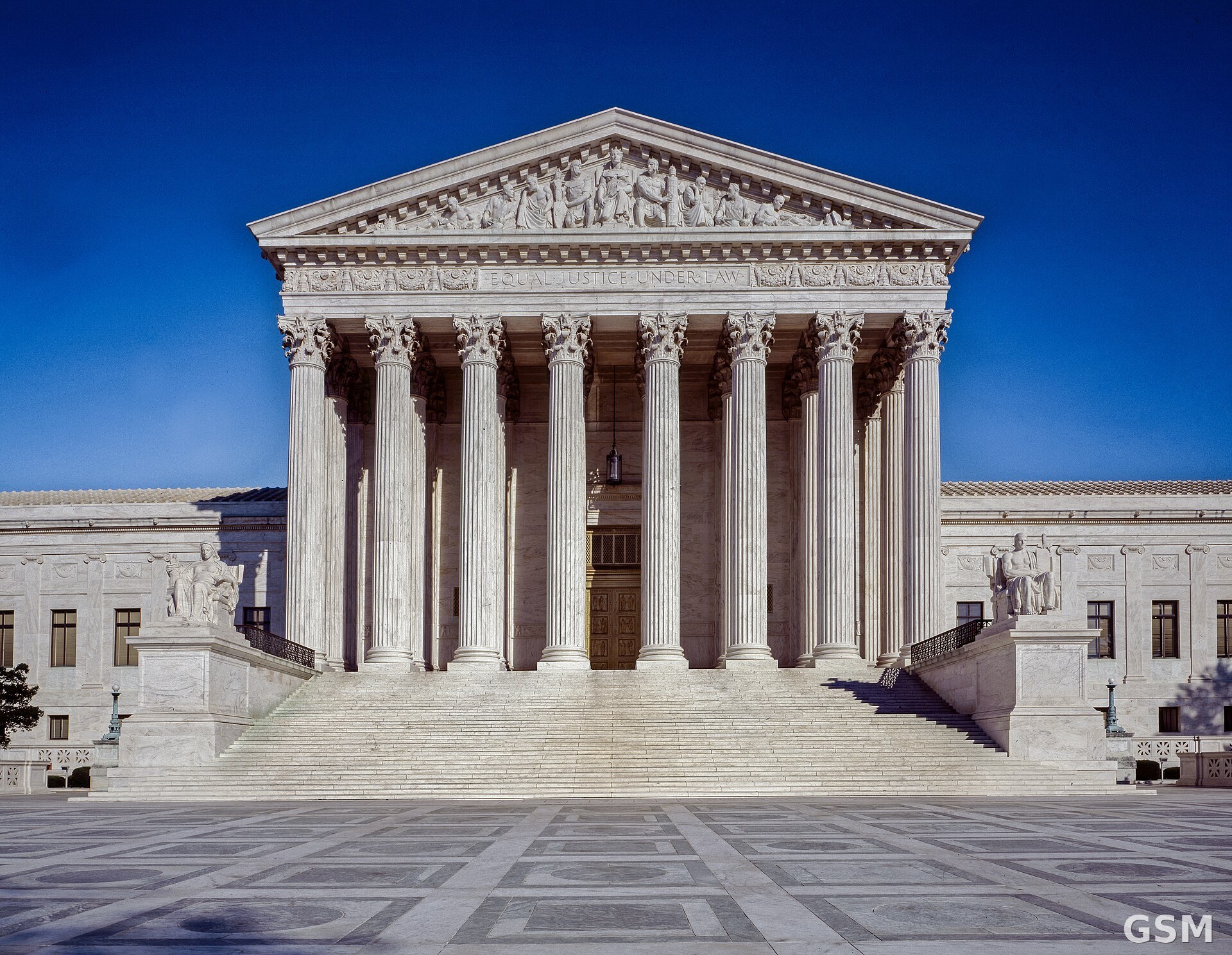
Photo: 图:位于华盛顿的美国最高法院大楼正立面。摄影:Carol M. Highsmith,美国国会图书馆藏,无已知出版限制,经 Wikimedia Commons。 / Photo: The front facade of the U.S. Supreme Court building in Washington, D.C. Photo by Carol M. Highsmith, Library of Congress, no known restrictions on publication, via Wikimedia Commons.