Dolores Huerta: From a Stockton Classroom to the Presidential Medal of Freedom — The Life of a Farmworker Movement Leader
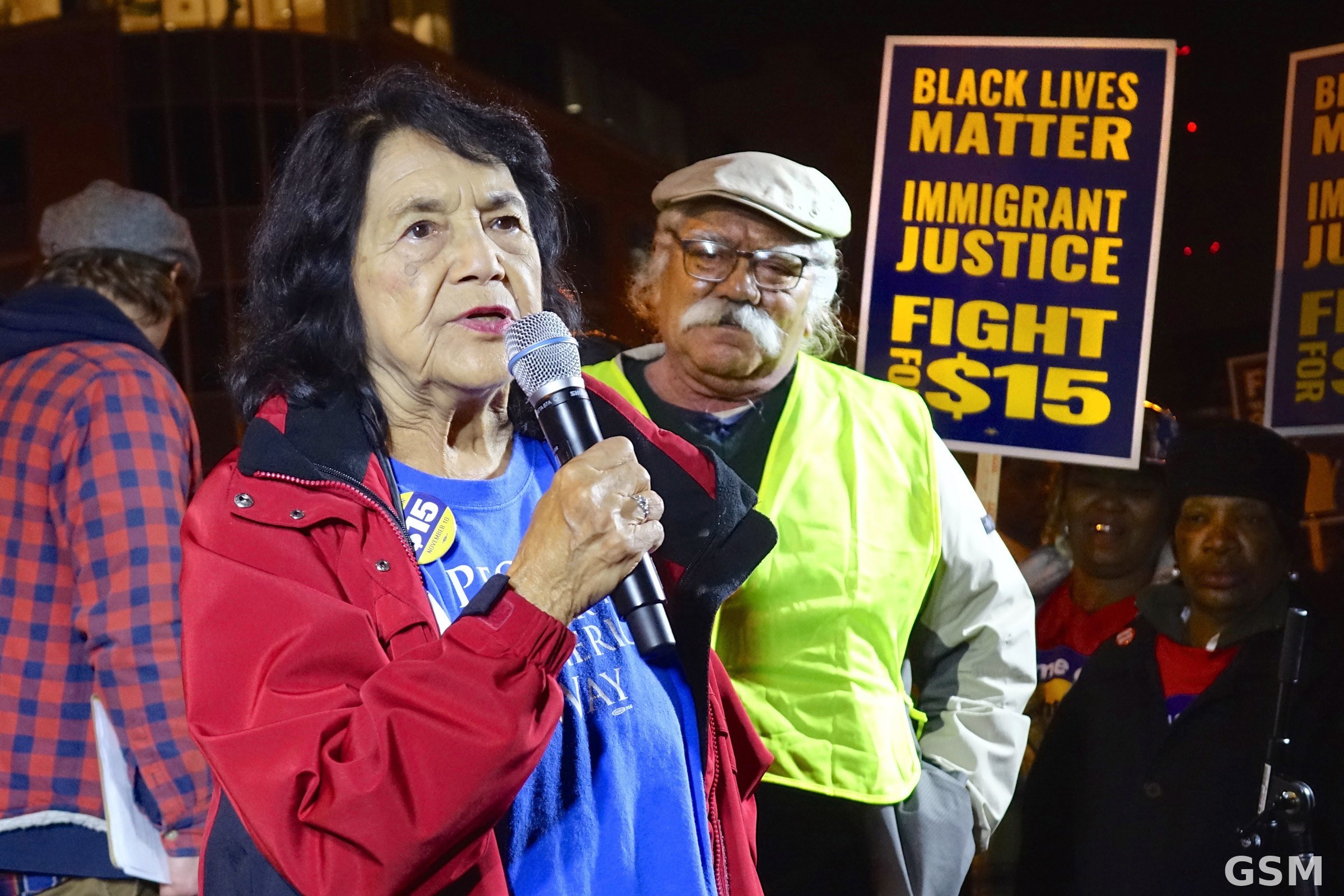
Dolores Huerta died on October 28, 2026, at her home in Bakersfield, California. She was 96. Governor Gavin Newsom and First Partner Jennifer Siebel Newsom issued a statement in her memory and ordered flags across California flown at half-staff. From a teacher of farmworkers' children to co-founder — with César Chávez — of the United Farm Workers, lead negotiator of the first collective bargaining agreement in American agriculture, and recipient of the Presidential Medal of Freedom, her life traces the history of the farmworker movement itself.
FROM DAWSON TO STOCKTON. Huerta was born on April 10, 1930, in Dawson, a mining town in New Mexico. Her parents divorced when she was three, and she moved with her mother to Stockton, California, where she grew up in a farmworker community; her mother ran a restaurant there and was known for extending help to working families. Huerta earned a teaching credential at Delta College of the University of the Pacific in Stockton and went into the classroom, teaching the children of farmworkers. Watching her students arrive hungry and barefoot, she concluded that education alone could not change their families' circumstances, and she left teaching to organize workers instead.
CO-FOUNDING THE UNION. In 1955, Huerta helped found the Stockton chapter of the Community Service Organization (CSO), running voter registration drives and pressing for better conditions in Latino neighborhoods, and there she met César Chávez, a fellow organizer. The two shared a conviction that farmworkers needed their own union. In 1962, in California, they co-founded the National Farm Workers Association (NFWA), the organization that became the United Farm Workers (UFW). Huerta served as the union's vice president until 1999.
DELANO, THE BOYCOTT AND THE LAW. In 1965, grape workers struck in Delano; the Filipino workers' organization and the NFWA joined forces, and the two streams later merged into the UFW, with Huerta among its organizers and leaders. In the late 1960s she directed the nationwide table grape boycott and served as the union's lead negotiator: the boycott ended with union contracts in 1970, and she negotiated the first-ever collective bargaining agreement with an agricultural business, securing better wages and working conditions. She was also influential in winning passage of California's Agricultural Labor Relations Act of 1975 — the first law in the nation recognizing farmworker unions' right to bargain collectively — and helped secure disability insurance for California farmworkers.
"SÍ, SE PUEDE." In 1972, during an action in Arizona supporting Chávez's fast, Huerta answered the doubters' "no se puede" — it can't be done — with "Sí, se puede": yes, it can be done. The phrase became the rallying cry of the farmworker movement and of labor and civil rights campaigns across the United States; Barack Obama's 2008 campaign slogan "Yes We Can" traces back to it.
THE COST. The road was not an easy one. In 1988, during a protest in San Francisco, Huerta was beaten by police with batons, suffering broken ribs and a ruptured spleen that had to be removed. She did not stop; after recovering, she went on negotiating, lobbying and organizing. As the U.S. Department of Labor puts it in its biography of her, in the struggle her bones were broken, but never her spirit.
HONORS AND LATER YEARS. In 1993, Huerta became the first Latina inducted into the National Women's Hall of Fame; in 1998, President Bill Clinton awarded her the Eleanor Roosevelt Award for Human Rights. In 2002 she founded the Dolores Huerta Foundation, dedicated to developing community organizers and leaders. In 2012, President Barack Obama awarded her the Presidential Medal of Freedom, the nation's highest civilian honor, for her lifetime of advocacy on behalf of the underserved. She is a member of the California Hall of Fame, and in 2018 California designated her birthday, April 10, as Dolores Huerta Day. The mother of 11 children, she remained a fixture at rallies and picket lines well into her nineties.
"Dolores represented the best of us," Governor Newsom said in his statement. "California — and the United States — would not be what we are today without her resolute spirit, her passion for justice and fairness, and her commitment to those overlooked and forgotten."
Source: GSM · USA (original Chinese edition)
Photo: Dolores Huerta 在一场集会上发言(资料图)。Susan Ruggles 摄,CC BY 2.0,经 Wikimedia Commons。 / Dolores Huerta speaking at a rally (file photo). Photo by Susan Ruggles, CC BY 2.0, via Wikimedia Commons.