The Night $6.3 Billion Was Stolen: Cryptocurrency and Binance Explained, Why the World's Largest Exchange Has Never Gone Public
On the evening of October 29, Binance, the world's largest cryptocurrency exchange, suffered the biggest theft in the industry's history: the company estimates that about $6.3 billion in assets was affected, roughly $3 billion has been frozen, and Binance says users will be reimbursed in full. Overnight, three questions reached every corner of the Chinese-speaking internet: What exactly is cryptocurrency? What is Binance? And is money kept on an exchange safe? This feature answers them in plain language — and maps the company, its founder Changpeng Zhao, and the people around tonight's story.
1. What is cryptocurrency?
A cryptocurrency is a form of digital money that exists only online and is issued by no central bank. Its ledger is not kept on one bank's server; it is a public record maintained simultaneously by thousands of computers around the world — the "blockchain." To rewrite history, an attacker would have to overpower most of those computers at once.
The first cryptocurrency was Bitcoin, launched in 2009 by a person or group using the name Satoshi Nakamoto, with a hard cap of 21 million coins. New bitcoins are created through "mining," a race among computers to solve mathematical puzzles for the right to record transactions. Ethereum, launched in 2015, is the second-largest network; its token is ether, and its "smart contracts" — programs that execute automatically — underpin most crypto applications today.
Ownership comes down to a "private key," a string of characters that works like an unchangeable password. Whoever holds the key owns the coins; lose it, and no institution on earth can recover the funds — the starkest difference from a bank deposit. In practice, most people do not hold their own keys. They keep money on exchanges such as Binance or Coinbase, which act as broker and vault in one: matching trades and custodying assets. That is precisely why an exchange hack, like tonight's, hits users first.
A third category matters for tonight's story: stablecoins such as USDT and USDC are pegged one-to-one to the U.S. dollar and backed by cash and short-term Treasury bills — the industry's internal "cash." The GENIUS Act, signed in July 2025, wrote reserve rules for them into U.S. law.
Prices swing violently because crypto trades around the clock with no circuit breakers, heavy leverage, and sentiment-driven flows; double-digit moves in a day are unremarkable. The risks are equally concrete. Theft: tonight's Binance breach is the latest example. Fraud: the FBI counted $5.8 billion in reported losses from crypto investment fraud alone in 2024. Platform failure: when the exchange FTX collapsed in 2022, about $8 billion in customer money had been misused. U.S. regulators, including the Securities and Exchange Commission (SEC), have long warned that crypto assets are highly speculative and that "guaranteed profit" pitches on social media should be treated with suspicion.
2. What is Binance?
Binance was founded in Shanghai in July 2017 by Changpeng Zhao and Yi He, raising about $15 million by issuing its BNB token. Its matching engine was fast, its listings numerous and its fees low; within roughly 180 days it was the world's largest exchange by trading volume, a position it still holds.
In September 2017, China banned domestic crypto trading platforms. Binance moved its operations out of China, passing through Japan and Malta, and for years described itself as having no headquarters: its parent company is registered in the Cayman Islands, with staff scattered across many countries. That stateless structure helped it outrun regulators — and planted the seeds of its American troubles. In 2019 it launched Binance.US, a separate platform run by a U.S. company for American customers.
The reckoning came on November 21, 2023. The U.S. Department of Justice announced that Binance had pleaded guilty to violating the Bank Secrecy Act, operating an unlicensed money-transmitting business and breaching sanctions rules, agreeing to roughly $4.3 billion in fines and forfeiture — among the largest corporate criminal resolutions in U.S. history. Zhao pleaded guilty personally, resigned as CEO and paid a $50 million fine. He was succeeded by Richard Teng, a career regulator who spent more than a decade at the Monetary Authority of Singapore and ran the financial regulator of Abu Dhabi Global Market (ADGM). The SEC dismissed its civil case against Binance in May 2025. In December 2025, co-founder Yi He became co-CEO alongside Teng, and Binance's global platform won full authorization from ADGM; since January 2026 it has operated under the Abu Dhabi framework. According to Bloomberg, Binance's registered accounts passed 320 million as of June 2026.
Tonight's breach is the largest security crisis in the company's history. Binance estimates about $6.3 billion was affected and says roughly $3 billion has been frozen. Yi He said user funds are safe and that Binance will bear all losses; Zhao, posting as a shareholder, said he expects all user funds to be covered. The company says it has found no evidence of private-key leakage, has paused deposits and withdrawals pending security scans, and notes that the independently operated Binance.US is unaffected. Several blockchain intelligence firms have attributed the attack to hackers linked to North Korea; Binance has not confirmed the attacker's identity. The previous industry record was the roughly $1.5 billion theft from the exchange Bybit in February 2025 — tonight's figure is about four times that.
3. The founder: Changpeng Zhao
Zhao was born in 1977 in Lianyungang, Jiangsu, into a family of schoolteachers. In 1989, at age twelve, he emigrated with his family to Vancouver, Canada, working jobs at McDonald's and a gas station as a teenager. After studying computer science at McGill University, he built trade-matching software for a Tokyo Stock Exchange subcontractor, then spent four years developing futures-trading software at Bloomberg Tradebook in New York, before returning to Shanghai in 2005 to build high-frequency trading systems.
In 2013, over a poker game, fellow entrepreneur Bobby Lee told him about Bitcoin. Zhao sold his Shanghai apartment and put everything he had into it, joined the wallet company Blockchain.info, and later became chief technology officer of the exchange OKCoin. In 2017, he and Yi He founded Binance.
In November 2023, Zhao pleaded guilty in the United States to causing Binance to fail to maintain an effective anti-money laundering program and stepped down as CEO. In April 2024 he was sentenced to four months in prison; he was released that September. In October 2025, President Donald Trump signed a full pardon for him. Zhao now lives in the United Arab Emirates, investing through YZi Labs and backing Giggle Academy, a free education project. Under his plea arrangement he cannot return to manage Binance, but he remains its controlling shareholder.
His fortune is itself a matter of dispute. Forbes, in its 2026 billionaires ranking, estimated his net worth at about $110 billion — 17th in the world — almost all of it from an estimated 90 percent stake in Binance. Zhao himself recently put his wealth at only $10 billion to $30 billion. The gap exists precisely because Binance is not a public company: with no share price, there is no agreed number.
4. What year did Binance go public? It never did.
It is one of the most common questions about the company, and the answer is short: Binance has never listed on any stock exchange, and it has never publicly filed to do so. There is no listing year. It is a private company that publishes neither a full shareholder register nor audited financial statements, and its shares cannot be bought in any brokerage account.
Everything known about its ownership comes from financial-press reporting, and it is estimation, not disclosure. Forbes and Bloomberg estimate that Zhao holds about 90 percent of Binance, making him the controlling shareholder. The Wall Street Journal reported in 2023 that co-founder Yi He owns at least 10 percent of the Cayman Islands parent company. In March 2025, Abu Dhabi investment firm MGX bought a minority stake for $2 billion — Binance's first-ever institutional investment — without disclosing the percentage; The New York Times reported the deal valued Binance at about $75 billion. Binance has never officially confirmed a complete ownership breakdown.
The contrast is Coinbase, which took the opposite path: on April 14, 2021, it listed directly on Nasdaq under the ticker COIN, becoming the first major U.S. crypto company to go public, with its ownership, finances and risks laid out in public filings for anyone to read.
5. Which crypto companies are listed?
Binance is the exception. The year 2025 became the industry's great IPO wave. Among exchanges and platforms: Coinbase (Nasdaq: COIN, listed 2021, the sector's leader); online broker eToro (Nasdaq: ETOR, May 2025); Circle, issuer of the USDC stablecoin (NYSE: CRCL, June 2025); the exchange Bullish (NYSE: BLSH, August 2025); Gemini, founded by the Winklevoss brothers (Nasdaq: GEMI, September 2025); blockchain lender Figure (Nasdaq: FIGR, September 2025); custodian BitGo (NYSE: BTGO, January 2026 — the only crypto IPO completed so far in 2026); and digital-asset conglomerate Galaxy Digital (Nasdaq: GLXY).
A second group holds crypto as a corporate treasury: Strategy (Nasdaq: MSTR, formerly MicroStrategy) has made buying bitcoin its corporate strategy and is the largest corporate holder of bitcoin; BitMine (BMNR) is built around an ether treasury, as is SharpLink (SBET). A third group, the bitcoin miners — Marathon Digital (MARA), Riot Platforms (RIOT) and CleanSpark (CLSK) — has traded on Nasdaq for years.
Another big exchange, Kraken, got halfway: it filed confidentially for a listing in November 2025, then paused the process in March 2026 as markets weakened, possibly until 2027. Binance, by contrast, has never filed at all. And according to market-data firms including Kaiko and Cleasky, the class of 2025 has given back much of its debut gains in 2026 as bitcoin retreated from its record high.
6. The people web behind tonight's story
Yi He, Binance's co-founder and co-CEO. She built Binance with Zhao in 2017, long ran its marketing and customer operations, and heads its investment arm, YZi Labs; she is reported to own at least 10 percent of the parent company. When tonight's breach broke, hers was the first voice promising that users would be made whole.
Richard Teng, Binance's co-CEO. A Singaporean career regulator, Teng joined Binance in 2021 and took over as CEO when Zhao resigned in November 2023, focusing on compliance and licensing — a deliberate pairing with He's product and user base.
Justin Sun, the Chinese entrepreneur who founded the TRON blockchain in 2017 and remains one of crypto's most visible Chinese figures. In March 2023 the SEC sued him and his companies over the unregistered offer and sale of the TRX and BTT tokens. In November 2024 he paid about $6.2 million for the banana artwork "Comedian" and ate the banana at a Hong Kong press event; in August 2025 he flew to the edge of space aboard Blue Origin. TRON is among the major blockchains traded on Binance. His connection to tonight's news cycle runs through the entertainment pages: a court has accepted his lawsuit against actress Jing Tian and her parents over a betrothal gift of more than RMB 30 million, reported separately by GSM.
Sam Bankman-Fried, known as SBF, founded the exchange FTX in 2019 and became Binance's biggest rival. Binance had been an early FTX investor and received a large amount of FTX's own FTT token when it exited. On November 6, 2022, Zhao announced Binance would sell its FTT; the run that followed bankrupted FTX within five days. Prosecutors later proved that Bankman-Fried had misused about $8 billion of customer money. A jury convicted him on all seven fraud and conspiracy counts in November 2023; he was sentenced to 25 years in March 2024, and a federal appeals court upheld the conviction in June 2026.
Vitalik Buterin, the Russian-born Canadian programmer who wrote the Ethereum white paper in 2013 and launched the network in 2015. Ether is the world's second-largest cryptocurrency, and Buterin remains the industry's most influential technologist.
Brian Armstrong co-founded Coinbase with Fred Ehrsam in 2012 and has been its CEO ever since, taking it public on Nasdaq in 2021. U.S.-based, listed and compliance-forward, Coinbase is Binance's principal global competitor — the opposite corporate model in almost every respect.
From a $4.3 billion settlement to tonight's $6.3 billion theft, Binance and the web of people around it amount to a compressed history of cryptocurrency itself. Binance says deposits and withdrawals will resume once its security review is complete and that it will publish a detailed technical report; GSM will follow the reimbursement and recovery effort as it develops.
Related: Coinbase Posts $719 Million Third-Quarter Net Income as Total Revenue Falls 35% to $1.22 Billion
Source: GSM America
Source: GSM · USA (original Chinese edition)
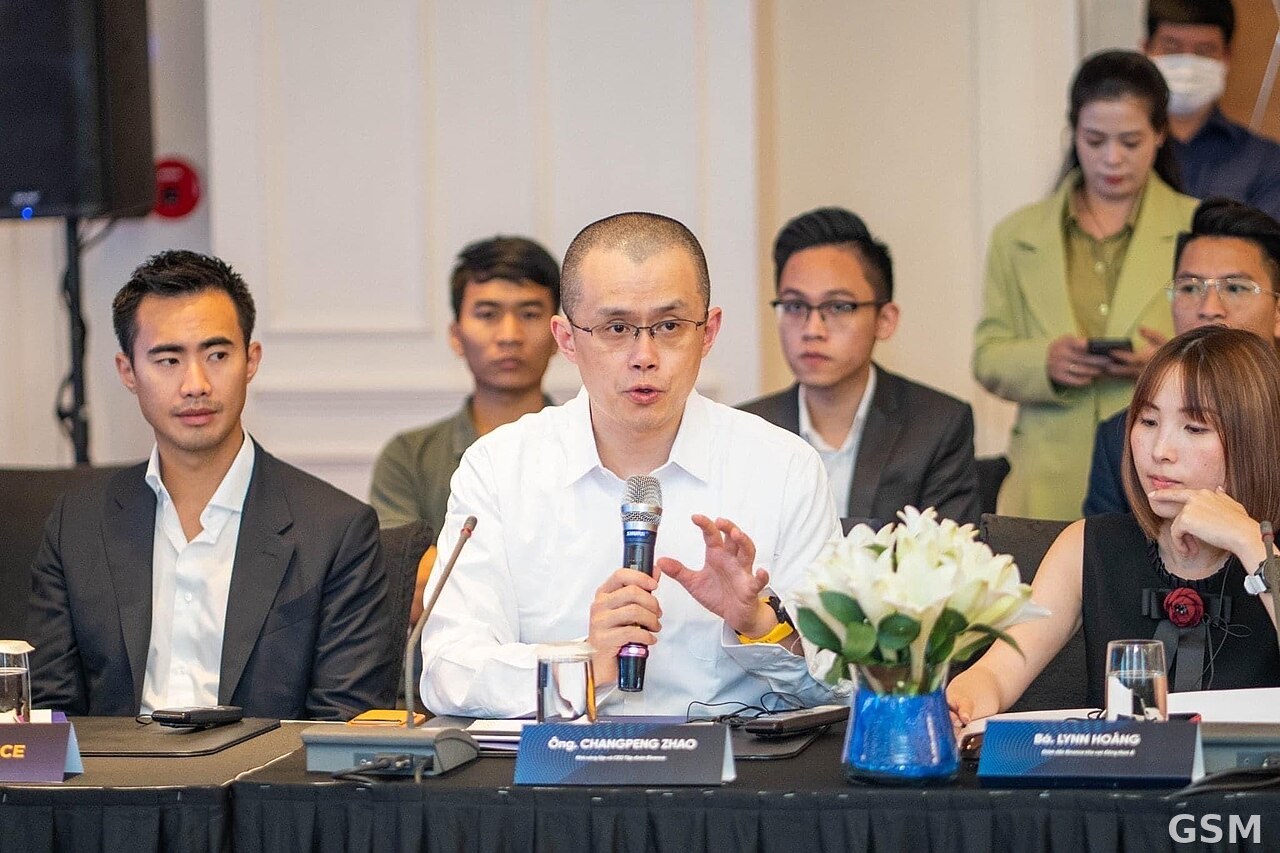
Photo: 图:币安联合创始人赵长鹏2022年在越南NFT峰会上发言。图片:Aevozer/Wikimedia Commons(CC BY-SA 4.0)。 / Binance co-founder Changpeng Zhao speaks at the Vietnam NFT Summit in 2022. Photo: Aevozer via Wikimedia Commons (CC BY-SA 4.0).