NASA's Twin TRACERS Satellites Deliver First Results on Magnetic Reconnection
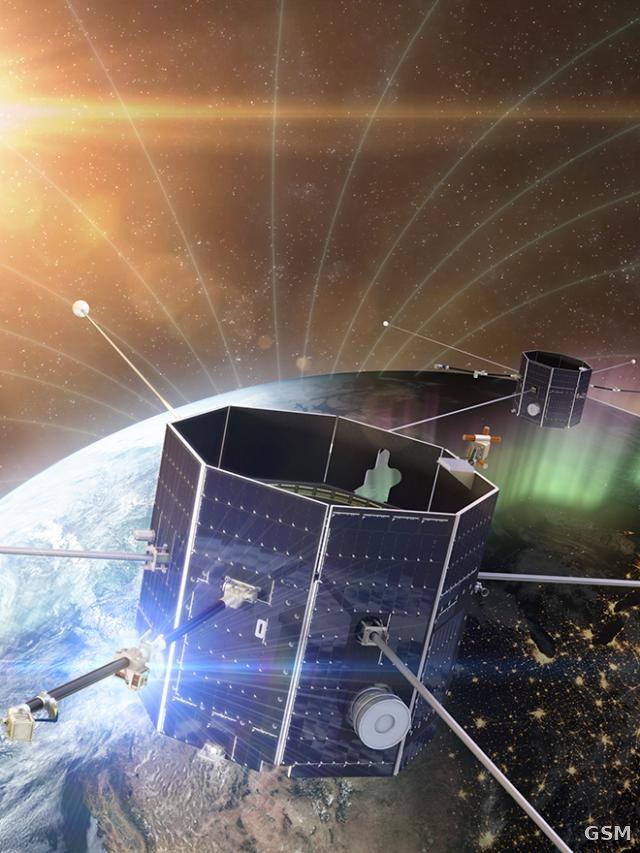
NASA announced on October 29 that its TRACERS mission — the Tandem Reconnection and Cusp Electrodynamics Reconnaissance Satellites — has gathered its first clues to how space weather affects Earth's magnetic field. In a new paper published in the Journal of Geophysical Research: Space Physics, researchers break down the interactions after analyzing initial observations from the first year of the mission.
The two TRACERS spacecraft, launched last year, fly one behind the other in a Sun-synchronous orbit, passing through the polar cusps — funnel-shaped regions over the north and south magnetic poles where Earth's magnetic field converges — to study magnetic reconnection, the explosive process in which the Sun's magnetic field, embedded in the solar wind, collides with Earth's magnetic shield and flings nearby particles into the atmosphere at high speeds.
A critical question is what primarily drives the process: whether the location of reconnection events influences the magnetopause reaction more than the rate of reconnection. Data from the Analyzers for Cusp Ions instruments show that magnetic reconnection is largely a spatial process, meaning where reconnection is occurring is moving, rather than changing in time. Future measurements will help confirm the results.
"Analyzing the data TRACERS collected gave our team a clearer view of solar wind particle behavior and how it connects to reconnection events," said Stephen Fuselier, TRACERS deputy principal investigator and instrument lead at the Southwest Research Institute in San Antonio. Principal Investigator David Miles of the University of Iowa said he is excited to see what future measurements reveal.
After a setback with one of the satellites shortly after launch, the team re-established contact and routine data collection; the spacecraft now observe the southern cusp routinely several times a day. In September, NASA approved a prime mission extension for the spacecraft to continue studying reconnection events into spring 2027.
Understanding how magnetic reconnection varies helps scientists better predict geomagnetic storms that can affect the safety of astronauts near Earth, as well as the power grids and communication systems people rely on. The mission is led by David Miles at the University of Iowa with support from the Southwest Research Institute, and is managed for NASA's Heliophysics Division by the agency's Goddard Space Flight Center.
Source: GSM · USA (original Chinese edition)
Photo: 图:TRACERS 双星在地球上空飞行的艺术概念图。图片来源:美国国家航空航天局(NASA),公共领域,经 Wikimedia Commons。 / Artist's view of the twin TRACERS satellites above Earth. Source: NASA, public domain, via Wikimedia Commons.