France GDP Shrinks 0.1% in Third Quarter as Exports Slump: Investment Falls Again and Carry-Over Growth Stands at Just 0.2%
France's National Institute of Statistics and Economic Studies (INSEE) published its preliminary estimate for third-quarter gross domestic product (GDP) on October 30: GDP, adjusted for seasonal and working-day effects, fell 0.1% from the previous quarter, missing economists' expectations of a 0.1% increase. Growth in the second quarter was revised to zero and GDP had contracted 0.2% in the first quarter, making this the second quarter of negative growth in France this year.
Foreign trade was the main drag. Exports fell 1.7% in the third quarter after rising 2.8% in the second, with exports of transport equipment plunging 9.1% and aerospace products the main negative driver, while imports edged up 0.1%. Foreign trade subtracted 0.6 percentage points from quarterly growth.
Investment weakened further: gross fixed capital formation fell 0.6%, a second consecutive quarterly decline after a 0.5% drop in the second quarter, as household investment fell 1.7%, government investment 0.5% and non-financial corporate investment 0.3%, with construction and transport equipment the weakest areas.
Domestic demand was not without bright spots. Household consumption rose 0.4%, accelerating from 0.2% in the second quarter, as purchases of electric vehicles lifted transport-equipment spending and higher electricity spending pushed energy consumption up 1.2%; government consumption rose 0.3%. Final domestic demand excluding inventories contributed a positive 0.1 percentage points to growth and inventory changes a further positive 0.4 points, not enough to offset the trade drag.
INSEE also gave the key full-year figure: at the end of the third quarter, France's acquired growth for 2026 — the annual rate that would result if GDP were flat in the fourth quarter — stood at just 0.2%, and reaching the Finance Ministry's 0.5% full-year target would require fourth-quarter growth of about 0.9%.
According to Reuters, Economy Minister Roland Lescure said the French economy was at a standstill because of an unprecedented combination of external and internal shocks; flash inflation for October, released the same day, accelerated to 3.4%, the highest since December 2023, leaving the euro area's second-largest economy facing stalled growth and rising prices at once. Revised figures are due at the end of November. The full release is available from INSEE, preliminary estimate of GDP, third quarter 2026.
Related: Euro Area GDP Grows 0.4% in Third Quarter, Beating Forecasts
Related: France Flash Inflation Rises to 3.4% in October
Related: Italy GDP Flat in Third Quarter: Annual Growth Slows to 0.8%
Related: Spain GDP Grows 0.6% in Third Quarter: Annual Rate Rises to 2.7%
Source: GSM · USA (original Chinese edition)
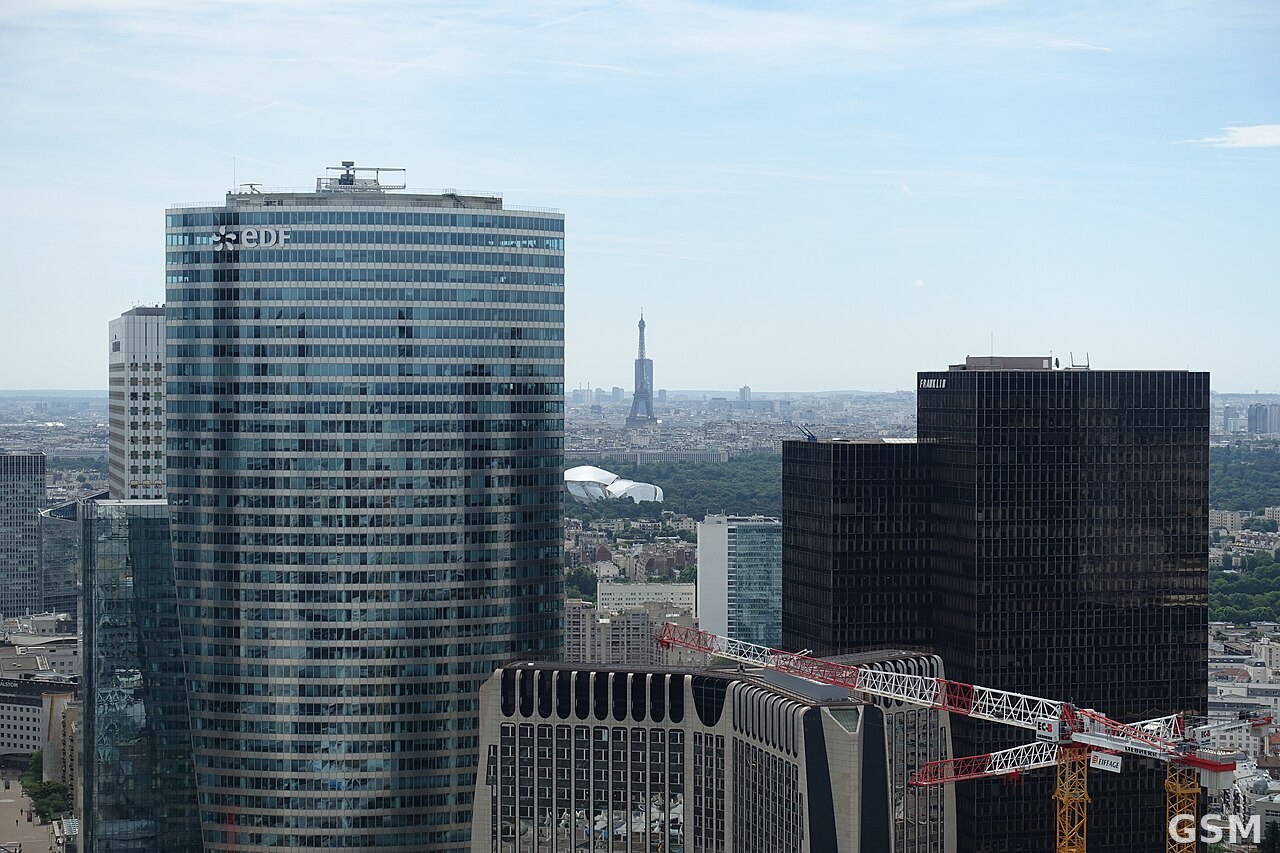
Photo: 图:法国 Paris 的 La Défense 商务区高楼与远处的 Eiffel Tower(资料图)。Guilhem Vellut 摄,CC BY 2.0,经 Wikimedia Commons。 / The La Défense business district towers in Paris, France, with the Eiffel Tower in the distance (file photo). Photo by Guilhem Vellut, CC BY 2.0, via Wikimedia Commons.