Polling Places Move onto Campus: Nearly 50 Million Young Voters Face the Midterms as AAPI Youth Registration Jumps 19%
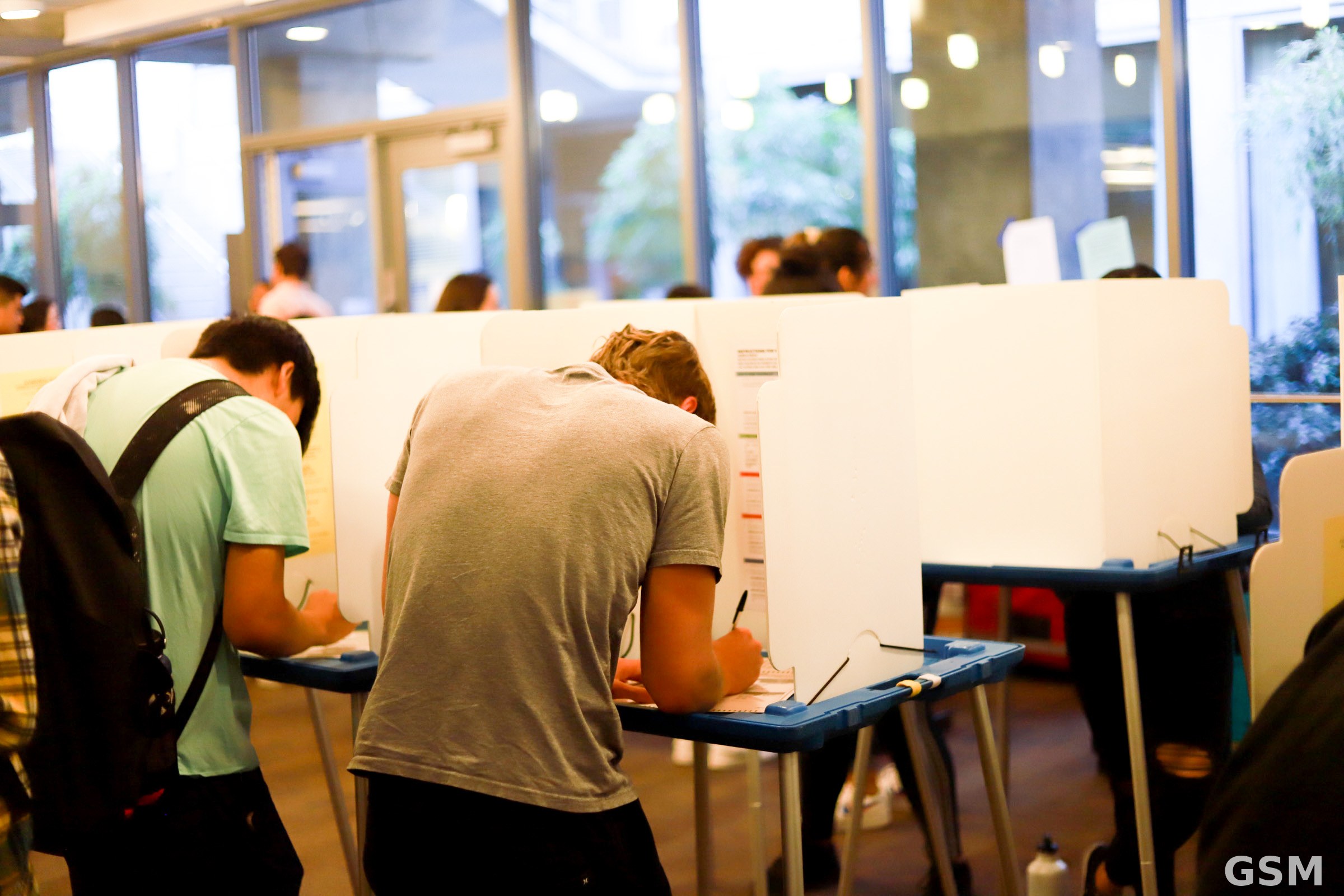
WASHINGTON, November 3 — November 3 is Election Day in the 2026 U.S. midterm elections. From Virginia to Florida, universities have turned student unions and campus buildings into polling places, where students carrying backpacks walk in between classes, mark a ballot, and hurry off to their next lecture. According to CIRCLE, the Center for Information & Research on Civic Learning and Engagement at Tufts University, nearly 50 million Americans ages 18 to 29 are eligible to vote this year, and about 8.5 million of them have become eligible for the first time since the 2024 presidential election. By November 1, more than 57.5 million Americans had already cast early ballots, according to the University of Florida Election Lab.
At Liberty University in Lynchburg, Virginia, the city voting precinct located on campus opened at 6 a.m. and closes at 7 p.m., in the Alumni Ballroom of the Montview Student Union. A precinct has operated on the campus on every Election Day since 2012. Virginia allows same-day registration on Election Day: students who live on campus can register and vote using a provisional ballot, with staff from the university's Registrar's Office and the local electoral board on hand to help. As the university's news release put it, students living on campus can "make their voices heard" there.
During early voting, campus voting sites were already setting records. According to the Leon County Supervisor of Elections, the early voting site at the Florida State University student union received 5,535 ballots during the early voting period, and Florida A&M University received 2,541. In the 2022 midterms, those numbers were just 1,985 and 507. Joseph Rodriguez, a clerk at the Florida State early voting site, said many students wrongly believed that if they were not registered locally they could not vote there, when in fact registration could be completed on the spot. He said the campus site was the third-busiest early voting location in the county, and probably the busiest college campus early voting site in Florida.
But whether a campus has a voting site at all can make a large difference. Data from the North Carolina State Board of Elections show that as of October 28, more than 187,000 North Carolinians ages 18 to 29 had voted early, making up 9% of all early voters, up from 7% in 2022. Yet North Carolina A&T State University and the University of North Carolina at Greensboro have no on-campus early voting sites this year — early voting plans are drawn up by county boards of elections. Both universities had on-campus sites during the 2024 presidential election, but not for this midterm.
Whether young people will actually walk into a polling place is a question on which pre-election surveys disagree. CIRCLE's registration analysis, released October 27 and based on voter files as of October 19 covering 42 states, found 3% more young voters registered than at the same point before the 2022 midterms, with registrations among newly eligible 18- and 19-year-olds up 8%. In CIRCLE's survey earlier this year, 89% of young respondents said they were willing to vote. But registration and willingness are not turnout: in the 2022 midterms, only 23% of eligible young people actually voted. The Harvard Youth Poll released in October by the Institute of Politics at Harvard Kennedy School (2,024 Americans ages 18 to 29, interviewed September 30 to October 7) found that only 33% of young people said they would definitely vote, down from 40% before both the 2018 and 2022 midterms. The generation's final turnout rate will only be estimated after the election, by CIRCLE and the Census Bureau.
What they care about most is money. In the survey CIRCLE conducted with When We All Vote among 5,549 Americans ages 18 to 29 between January 26 and February 12 (released April 23), 65% named the cost of living and inflation as their top issue, followed by health care and housing costs; about 60% said they sometimes or often have trouble meeting basic financial needs. The Harvard Youth Poll likewise describes a generation heading to the polls under financial pressure. For students, these issues have concrete shapes: next semester's tuition, the starting salary of a first job after graduation, the rent on a shared apartment, and the balance on a student loan.
For Chinese American readers, this Election Day carries an additional layer. The 2026 AAPI Voter Survey, released in August by AAPI Data and APIAVote, estimates 16 million eligible Asian American and Pacific Islander voters nationwide — the nation's fastest-growing voter bloc — including 1.6 million who became eligible after 2022. Among young people, CIRCLE's registration analysis shows AAPI youth registrations up 19%, the largest increase of any racial or ethnic group of youth, compared with 8% for Latino youth, 2% for white youth, and an 8% decrease for Black youth. AAPI turnout has been climbing as well: Asian American midterm turnout rose from 27% in 2014 to 40% in both 2018 and 2022. The same survey found that 52% of AAPI voters ages 18 to 34 called jobs extremely important and 51% said the same of education, far above the 34% and 36% among voters 65 and older — the young generation's ballot is written in the language of work and schooling.
In immigrant families, voting is often a three-generation relay. Many in the grandparents' and parents' generations were born outside the United States; they first had to take the oath of naturalization before they could register to vote. Their U.S.-born children are different: they hold the right to vote from birth, and exercise it at 18. Among the 8.5 million young people who became eligible this cycle, many are the children of immigrants — a parent may still struggle with an English-language ballot while their child casts a first-ever vote at a campus polling place. The AAPI survey found that family and friends are the most trusted messengers for AAPI voters (62%), and 75% of AAPI adults discussed politics with family or friends in the past year. In many immigrant families, voting has never been a one-person affair.
The system leaves room for that relay. Under Section 203 of the federal Voting Rights Act and the Census Bureau's coverage determinations, counties with large Chinese-speaking citizen populations must provide Chinese-language ballots, voter materials, and interpretation assistance. The covered jurisdictions include Los Angeles, Orange, San Diego, San Francisco, Santa Clara, and Sacramento counties in California; Cook County, home to Chicago; Queens, Brooklyn, and Manhattan in New York City; and King County, home to Seattle. On Election Day, the national multilingual voter hotline, 1-888-API-VOTE, offers help in languages including Mandarin and Cantonese. Community organizations matter as well: the AAPI survey found that about 58% of AAPI adults had been contacted by a community organization, a reach comparable to that of the Democratic Party.
Yet there is another group of young people on campus who can only watch today, not vote. Federal law provides that only U.S. citizens may vote in federal elections, and voting by a noncitizen in a federal election is a federal crime. International students on student visas are not citizens; neither are green-card holders, who are lawful permanent residents. They can discuss the election in class and walk a roommate to the polling place door, but the ballot itself is not theirs. Understanding that line is both respect for the law and protection for the students themselves.
Tonight, polling places across the states will close one after another. The Justice Department has sent about 1,000 election monitors to all 50 states this year, its largest deployment ever and the first to cover every state, to observe the voting. For the young people who walked into a polling place for the first time today, their names will appear tonight, for the first time, in the record of those who voted. What share of their generation joined them will not be known until after the count.
Related: DOJ Deploys About 1,000 Election Monitors Across All 50 States for the First Time
Published by GSM · USA (original Chinese edition)
Photo: 图:加州大学伯克利分校的学生在校园投票站填写选票(资料图)。Josh Kahen 摄,The Daily Californian,以 0BSD(公有领域等效)授权发布,经 Wikimedia Commons。 / Photo: Students fill out ballots at a polling place on the UC Berkeley campus (file photo). Photo by Josh Kahen, The Daily Californian, released under the 0BSD public-domain-equivalent license, via Wikimedia Commons.