California Files Its Tenth and Eleventh Kalshi Amicus Briefs, Backing New York and Wisconsin Gambling Laws
California Attorney General Rob Bonta announced in Oakland on November 6 that California has joined two bipartisan coalitions of attorneys general in filing two amicus briefs supporting New York's and Wisconsin's right to enforce state sports gaming and gambling laws against prediction market operator Kalshi. The filings mark the tenth and eleventh time California has joined multistate amicus efforts targeting Kalshi and similar prediction market companies.
Both briefs make the same core argument: federal preemption of state gambling laws, as applied to prediction market providers, is improper and detrimental to the traditional role of states to regulate gambling and protect vulnerable citizens.
"We are seeing more and more young people being preyed upon by addictive gaming platforms and it is time for states to join together to protect our youth. This filing is representative of our bipartisan commitment to protecting state regulatory authority over illegal, unregulated gambling operations," said Attorney General Bonta. "Prediction markets cannot use federal loopholes to bypass state consumer protection, sports gaming, and gambling laws. By joining this brief, we stand firmly with Wisconsin, New York, and our state partners to ensure that federal commodities laws are not weaponized to evade state laws, fuel gambling addiction, and undermine state regulation of legal gaming."
In the New York case, KalshiEX, LLC v. Williams, et al., Kalshi sued the New York State Gaming Commission after the Commission sent a cease-and-desist order to Kalshi. The district court denied Kalshi's preliminary injunction motion, holding that New York gambling laws as applied to Kalshi's sports-event contracts are not preempted. Kalshi has appealed to the U.S. Court of Appeals for the Second Circuit.
The Wisconsin case, Commodity Futures Trading Commission v. State of Wisconsin, arose out of Wisconsin's filing of an action in state court against Coinbase, Kalshi, Robinhood, Polymarket, and Crypto.com. After the prediction market providers moved the cases to federal court, the CFTC filed its own federal lawsuit against Wisconsin, alongside a motion for a preliminary injunction to block the state from enforcing its gambling laws. The district court denied the CFTC's motion. The CFTC has appealed to the U.S. Court of Appeals for the Seventh Circuit.
Attorney General Bonta joins the attorneys general of Alabama, Arizona, Arkansas, Colorado, Connecticut, Delaware, Hawai'i, Idaho, Illinois, Iowa, Kansas, Louisiana, Maine, Massachusetts, Michigan, Minnesota, Mississippi, Nebraska, Nevada, New Jersey, New Mexico, New York, North Carolina, Ohio, Oklahoma, Oregon, Rhode Island, South Carolina, South Dakota, Tennessee, Vermont, Virginia, Washington, West Virginia, Wisconsin, and Wyoming in filing the briefs, a coalition of 37 attorneys general in total.
California has joined nine similar efforts before. Most recently, on October 29, California joined a coalition of 37 attorneys general backing Utah's enforcement of its state gambling laws against Kalshi, in a case pending before the U.S. Court of Appeals for the Tenth Circuit.
(Source: California Attorney General's Office)
Source: California Attorney General's Office
Published by GSM · USA (original Chinese edition)
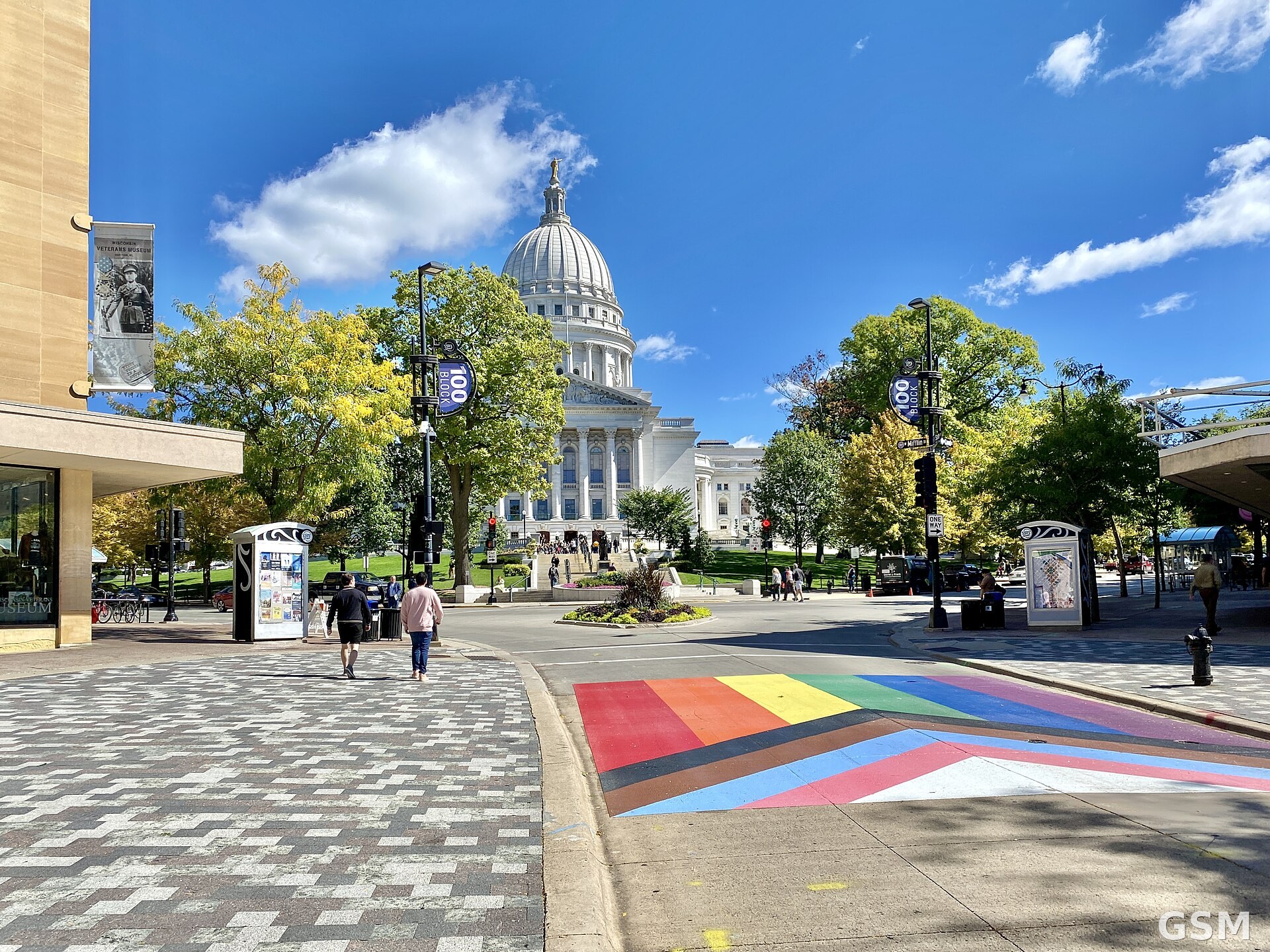
Photo: 图:位于 Madison 的威斯康星州议会大厦(本稿威斯康星州一案的当事州政府地标)。Warren LeMay 摄,CC BY-SA 2.0,经 Wikimedia Commons。 / Photo: The Wisconsin State Capitol in Madison, the seat of government of Wisconsin, a party state in one of the two cases in this report. Photo by Warren LeMay, CC BY-SA 2.0, via Wikimedia Commons.