California Reservoirs Ahead of the Rainy Season: Shasta Half Full, Oroville Below Average, San Luis More Than 40 Percent Above Average
California's major reservoirs are sitting at their seasonal pre-rainy-season lows, according to the Daily Reservoir Storage Summary released on November 6 by the California Data Exchange Center (CDEC) of the California Department of Water Resources (DWR), with data as of midnight on November 5. Shasta Lake, the state's largest reservoir, held 2,257,722 acre-feet, or 50 percent of capacity. Lake Oroville held 1,455,250 acre-feet, or 42 percent of capacity — just 81 percent of its average for this date. The new water year began on October 1, and the water drawn down over the summer and fall irrigation season will have to be replaced by winter storms and the Sierra snowpack.
In the north, Shasta Lake, with a capacity of 4,552,000 acre-feet, stood at 93 percent of its average for the date, below the 2,555,469 acre-feet (56 percent of capacity) it held a year ago. Lake Oroville, capacity 3,424,753 acre-feet, was at 81 percent of average, about 354,000 acre-feet less than the 1,809,262 acre-feet recorded on the same date last year. Trinity Lake held 1,629,764 acre-feet, 67 percent of capacity and 115 percent of average, while Whiskeytown Lake stood at 91 percent of capacity and 104 percent of average.
Most reservoirs in the central part of the state and along the western Sierra slope were near or above average. Folsom Lake held 367,386 acre-feet, 38 percent of capacity and 89 percent of average, down from 417,569 acre-feet a year ago. New Melones Reservoir held 1,507,159 acre-feet, 63 percent of capacity and 117 percent of average; Don Pedro Reservoir held 1,472,235 acre-feet, 73 percent of capacity and 110 percent of average; Lake McClure held 501,991 acre-feet, 49 percent of capacity and 115 percent of average; and Millerton Lake held 224,816 acre-feet, 43 percent of capacity and 99 percent of average, essentially even with its historical norm. The low outlier was Pine Flat Reservoir, at 185,708 acre-feet — only 19 percent of capacity and 66 percent of average, down from 268,933 acre-feet a year ago. Lake Isabella stood at 24 percent of capacity and 98 percent of average.
San Luis Reservoir, the jointly operated state-federal off-stream reservoir filled by pumping water from the Delta, had the highest relative level among major reservoirs: 1,341,166 acre-feet, 66 percent of capacity and 143 percent of average, up from 1,068,782 acre-feet a year ago. Southern California and coastal supply reservoirs were generally healthy: Castaic Lake held 271,515 acre-feet, 84 percent of capacity and 108 percent of average; Pyramid Lake was at 88 percent of capacity and 96 percent of average; Lake Perris at 89 percent and 126 percent; and Cachuma Lake at 83 percent and 133 percent. Lake Berryessa held 1,320,956 acre-feet, 82 percent of capacity and 117 percent of average.
The water year has started dry. CDEC precipitation indexes in the same daily report show the Northern Sierra at 0.71 inches for the season to date, only 19 percent of average and well below the 88 percent recorded at this point last year; the Southern Sierra stood at 66 percent of average and the Tulare Basin at 105 percent. Gauges in Redding, Sacramento, San Francisco and Los Angeles have recorded no measurable precipitation since October 1. Statewide snowpack water content currently measures 0.4 inches, 4 percent of average to date and just 1 percent of the April 1 average peak — the snow season has barely begun.
Storage at most major reservoirs trails last year's levels mainly because last year's season started wet, setting a high comparison base. Measured against historical averages for this date, most major reservoirs sit between roughly 80 and 120 percent of average, a normal position before the rainy season. The readings to watch are Lake Oroville and Pine Flat, both well below average, and Northern Sierra precipitation at only 19 percent of average so far. How much the reservoirs refill will depend on the strength of winter storms from December through March and on how the Sierra snowpack builds, since spring snowmelt is one of California's main water sources for the rest of the year.
Beyond existing reservoirs, California is adding new storage: the State Water Resources Control Board recently approved the water right permit for Sites Reservoir, clearing a key hurdle for the 1.5 million-acre-foot project, and the permit's detailed terms have since been published.
Related: California Approves Water Right Permit for Sites Reservoir, a 1.5 Million-Acre-Foot Project
(Source: California Department of Water Resources)
Source: California Department of Water Resources
Published by GSM · USA (original Chinese edition)
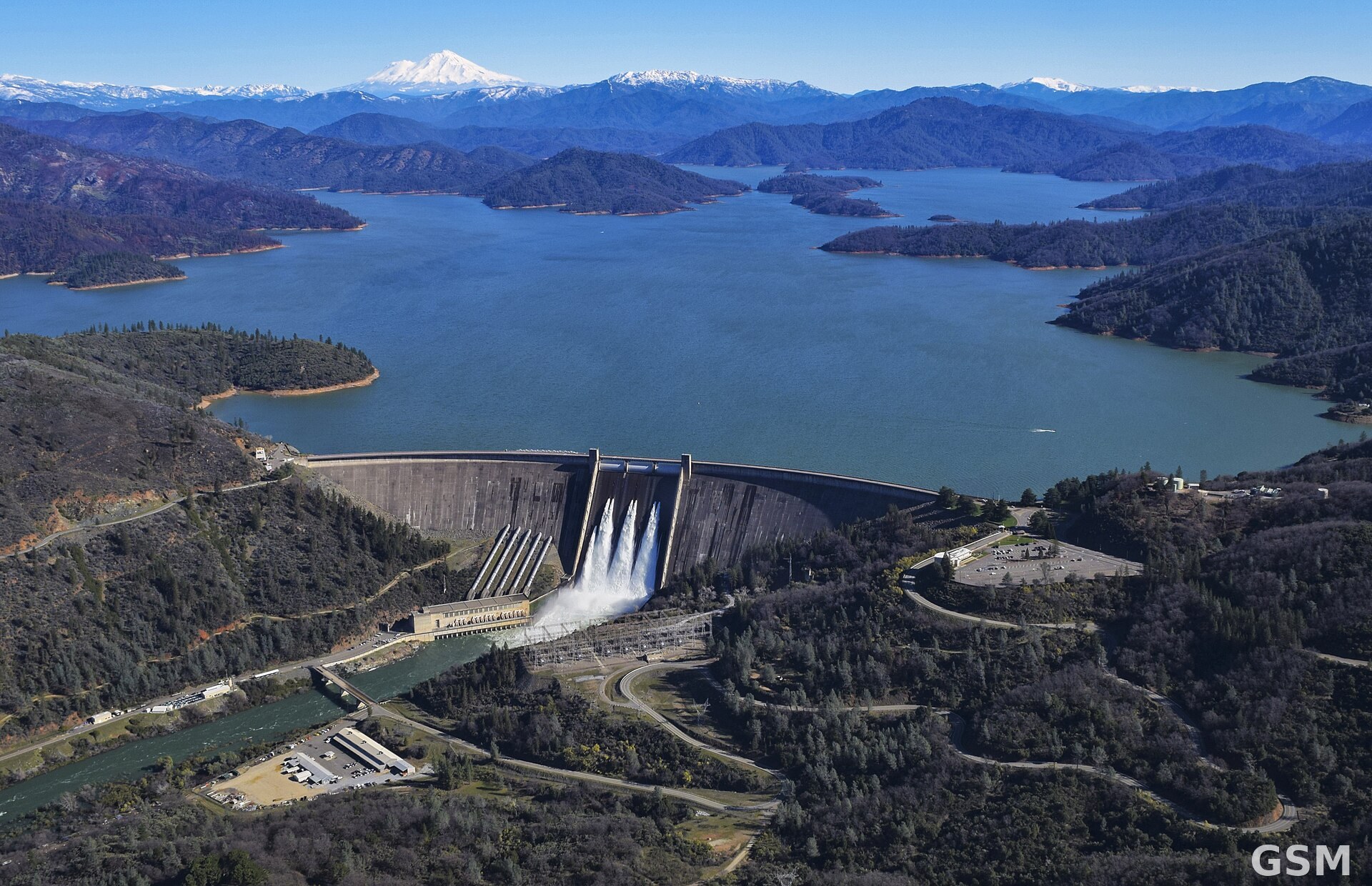
Photo: 图:沙斯塔大坝与沙斯塔湖航拍(资料图,摄于2019年3月)。美国垦务局(USBR)摄,Wikimedia Commons,CC BY-SA 2.0。 / Photo: Aerial view of Shasta Dam and Shasta Lake (file photo, March 2019). Photo by the U.S. Bureau of Reclamation, via Wikimedia Commons, CC BY-SA 2.0.