After the Affirmative Action Ruling: What Changed in American College Admissions
1. September 2024: two sets of numbers
In September 2024, the Massachusetts Institute of Technology released the racial composition of its first freshman class admitted after the Supreme Court's ruling: Black students made up 5 percent, Asian students 47 percent. A year earlier, those figures were 15 percent and 40 percent. On the same day, Yale's numbers moved in the opposite direction: its Asian share fell from 30 percent to 24 percent, while its Black share did not move at all, remaining at 14 percent.
This was the first freshman class admitted under the new rules after the Supreme Court's June 29, 2023 decision. Three years on, the numbers are still moving, and so are the rules.
2. The ruling: 6–3, 237 pages
On June 29, 2023, the U.S. Supreme Court decided two consolidated cases: *Students for Fair Admissions, Inc. v. President & Fellows of Harvard College* (600 U.S. 181) and *Students for Fair Admissions, Inc. v. University of North Carolina*. By a 6–3 vote, with the majority opinion written by Chief Justice Roberts, the Court held that Harvard's admissions policy violated Title VI of the Civil Rights Act of 1964 and that the University of North Carolina's policy violated the Equal Protection Clause of the Fourteenth Amendment. The opinions, including the dissents, ran to 237 pages.
The majority gave three reasons: the schools' stated admissions goals were not "sufficiently focused and measurable" for a court to evaluate; race was used as a "negative" factor, and the policy rested on the assumption that students of the same race think alike — "College admissions are zero-sum. A benefit provided to some applicants but not to others necessarily advantages the former group at the expense of the latter"; and the schools' stated endpoints amounted to "outright racial balancing," which had long been held unconstitutional. The majority concluded: "Eliminating racial discrimination means eliminating all of it."
The decision did not formally overrule the 1978 *Bakke* case or the 2003 *Grutter* case, but under strict scrutiny almost no race-conscious policy could pass. The Court also rejected the schools' plea to be allowed to continue at least until 2028 — *Grutter* had said race preferences would no longer be needed in 25 years, and the majority held that the endpoint had arrived. The ruling expressly exempted the military academies, on the ground that they may have "potentially distinct interests."
The majority opinion ended with an opening: nothing in the opinion should be construed as prohibiting universities from considering an applicant's discussion of how race affected his or her life, "be it through discrimination, inspiration, or otherwise." Justice Sotomayor began her dissent: "Today, this Court stands in the way and rolls back decades of precedent and momentous progress... In so holding, the Court cements a superficial rule of colorblindness as a constitutional principle."
The lawsuit lasted nine years. The plaintiff, Students for Fair Admissions, was founded by anti-affirmative-action activist Edward Blum. In 2014 it sued Harvard in federal court in Massachusetts and the University of North Carolina in federal court in North Carolina, alleging principally that Harvard intentionally discriminated against Asian applicants, including through a "personal rating" shaped by racial stereotypes. At a three-week trial in October 2018, the district court's findings of fact showed Asian applicants scored higher than white applicants on academic and extracurricular measures — 60 percent of Asian applicants scored above 3+ on academics (compared with 46 percent of white applicants), and 28 percent scored 2 or higher on extracurriculars (compared with 25 percent) — but scored lower on the personal rating. On September 30, 2019, District Judge Allison Burroughs ruled for Harvard; the First Circuit affirmed in 2020. The Supreme Court's 2023 decision did not directly address whether Harvard had discriminated against Asian applicants, instead holding on broader grounds that race-conscious admissions were themselves unconstitutional; the lower courts' conclusion that Harvard had not unlawfully discriminated against Asian applicants was left undisturbed.
3. Three years of data
The Class of 2028 was the first freshman class admitted under the new rules. The figures schools released are enrolled-class shares, not admit rates by race — no top university has ever published admit rates broken down by race.
Harvard: Black students fell from 18 percent to 14 percent, Asian students held at 37 percent, Latino students rose from 14 percent to 16 percent, 8 percent did not disclose their race (up from 4 percent), and international students were 16 percent. MIT: Black students fell from 15 percent to 5 percent, Asian students rose from 40 percent to 47 percent, Latino students fell from 16 percent to 11 percent; Black, Latino, and Native American students combined fell from 25 percent to 16 percent. Yale: Black students held at 14 percent, Asian students fell from 30 percent to 24 percent, Latino students rose 1 point to 19 percent, white students rose 4 points to 46 percent. Princeton: Black students were little changed at about 9 percent, Asian students fell about 2.2 points (from about 26 percent to 23.8 percent), Latino students were about 9 percent. Brown: Black students fell from 15 percent to 9 percent, Asian students rose from 29 percent to 33 percent, Latino students fell from 14 percent to 10 percent. University of Pennsylvania: historically underrepresented students fell from 25 percent to 23 percent. Duke: Black students held at 13 percent, Asian students fell from 35 percent to 29 percent, Latino students rose from 13 percent to 14 percent.
A warning about denominators: starting with the Class of 2028, Harvard changed its methodology — the denominator for its race percentages changed from the entire freshman class to "students who self-reported their race," and it recalculated the Class of 2027 figures. As a result, Harvard's Class of 2027 Asian share has two numbers: 29.9 percent under the old denominator (share of the whole class) and 37 percent under the new one (share of those who reported a race). Year-over-year comparisons must state the denominator; Harvard does not publish a white share. MIT's dean of admissions, Stuart Schmill, stated plainly that the change was caused by the Supreme Court's decision.
The change did not settle in the first year. Harvard's Class of 2029 (entering fall 2025, 1,675 students): Black students 11.5 percent (14 percent in the Class of 2028), Latino students 11 percent (down from 16 percent), Asian students 41 percent (up from 37 percent); applications totaled 47,893, down from 54,008 for the Class of 2028 and 56,937 for the Class of 2027; 2,003 students were admitted, an admit rate of 4.18 percent (3.65 percent for the Class of 2028). The Class of 2029 was the first class since the pandemic required to submit SAT or ACT scores. Princeton's Class of 2029: Black students 5 percent, the lowest since 1968; Asian students rose from about 24 percent to about 27 percent. Princeton's Class of 2028 had shown almost no change; the change arrived a year late. Yale's Class of 2029: Black students 12 percent (14 percent in the Class of 2028); the Asian share rose; 2,227 students were admitted from 57,517 applications, an admit rate of 3.9 percent. Yale's Class of 2030 (entering fall 2026, 1,652 students): white students 42 percent, Asian students 33 percent, Latino students 12 percent, Black students 10 percent, Native American students 1 percent; international students 10 percent. The Black share was the lowest in ten freshman classes.
4. The Asian puzzle
What drew the most attention after the Class of 2028 data was published was not the fall in Black shares but the opposite movement of Asian shares at different schools: MIT's Asian share rose from 40 percent to 47 percent, while Yale's fell from 30 percent to 24 percent, Duke's from 35 percent to 29 percent, and Princeton's from about 26 percent to 23.8 percent. Under the same ruling, MIT's Asian share rose 7 points while Yale's and Duke's each fell 6 points.
On September 17, 2024, SFFA wrote to the general counsels of Yale, Princeton, and Duke, expressing "deep concern" that the three schools were "not complying" with the ruling, holding up MIT as the counterexample, demanding an explanation of their demographic data, and demanding that they "preserve all potentially relevant documents and communications," warning that without an explanation SFFA would conclude the schools were "evading the Supreme Court's decision" and were "prepared to enforce the decision through litigation."
On April 22, 2025, the Asian American Coalition for Education (AACE) filed a civil rights complaint with the U.S. Department of Education's Office for Civil Rights, alleging that Yale used race proxies to discriminate against Asian applicants in the 2023–24 admissions cycle. The complaint cited the February 14, 2025 "Dear Colleague Letter" from acting assistant secretary Trainer, describing it as a concrete step in enforcing the Supreme Court's SFFA decision. Princeton says its readers cannot see race data before the class is finalized; several schools emphasize that one year's data fluctuates naturally. Experts caution that ending affirmative action takes an adjustment period, and early data may not represent the long-term trend.
5. The rule changes that followed
After the ruling, legacy preference — long criticized as "affirmative action for the wealthy" — became the next target for reform. Johns Hopkins University began phasing it out with the class entering in 2014; Amherst College announced its end in October 2021; Wesleyan University announced in July 2023 that it was "formally ending" legacy preference (legacy students had been about 7 percent of freshmen); Occidental College announced its end in July 2023 (legacy students were 8–11 percent of freshmen from 2014–2023); Virginia Tech ended it in July 2023 (legacy students had been more than 20 percent of freshmen); the University of Minnesota Twin Cities ended it in July 2023. MIT and the University of Virginia say they do not consider legacy status. Harvard confirmed in 2023 that it will continue to consider it.
Five states have legislated: Colorado in 2021 (public institutions, the first); Virginia, signed March 8, 2024 and effective July 1, 2024 (public institutions); Maryland, signed April 2024 and effective July 1, 2024 (public institutions and private institutions receiving state funds); Illinois in August 2024 (public institutions); California, which signed AB 1780 on September 30, 2024, effective September 1, 2025 (private nonprofit institutions tied to state financial aid; the University of California had already ended legacy preference in 1998). California was the fifth state to legislate a ban, and the second after Maryland to extend it to private institutions. According to a February 2025 briefing from Education Reform Now, 420 four-year colleges still consider legacy status; 452 have dropped it since 2015, a decline of 52 percent; 92 stopped in 2022–2023 alone.
Standardized tests are also coming back. During the pandemic, more than 80 percent of four-year colleges adopted test-optional policies; from 2022 the direction reversed. MIT announced its return in March 2022, the first school to restore the requirement. Dartmouth announced on February 5, 2024, the first Ivy League school; its own faculty research found test scores the strongest predictor of academic success on campus. Yale returned in February 2024, initially with a "flexible" policy; in May 2026 it tightened the policy to SAT or ACT only. Brown, Harvard, and Caltech returned in 2024; Cornell announced in 2024, effective fall 2026; Stanford announced in June 2025; Princeton announced in October 2025, becoming the seventh Ivy League school to restore the requirement. According to The College Investor's October 2026 check of admissions websites, 72 colleges and university systems require SAT or ACT scores for fall 2027 entry, including six of the eight Ivy League schools, MIT, Stanford, and all 12 of Florida's public universities. The return had knock-on effects: Harvard's applications fell from 56,937 for the Class of 2027 to 47,893 for the Class of 2029; Yale's single-choice early action applications fell 14 percent; Brown's early decision applications fell by 1,200; the number of students submitting test scores rose 11 percent in the 2024–25 cycle, the first significant increase since the pandemic.
6. The applicants and the control group
Common App data for the 2024–25 cycle show more than 1.497 million unique applicants (up 5 percent), submitting 10,193,579 applications (up 8 percent), an average of 6.80 applications per applicant (only 4.63 in 2013–14). Public universities received more applications than private universities for the first time. Early action applications grew 17 percent, and early decision grew 4 percent. After the ruling, Latino applicants grew 15 percent and Black applicants 12 percent; applicants receiving fee waivers and low-income applicants grew nearly fourfold. A demographic cliff lies ahead: the number of American high school graduates peaks at about 3.9 million in 2025 and is projected to fall about 13 percent by 2041, with the Northeast and Midwest hit hardest. Admit rates: Harvard 3.65 percent for the Class of 2028 and 4.18 percent for the Class of 2029; Yale 3.9 percent for the Class of 2029; Princeton 4.6 percent for the Class of 2029.
California is a natural control group for understanding the ruling's consequences — Proposition 209 (1996) banned public universities from considering race in admissions 28 years ago, and the University of California has not considered SAT or ACT scores since 2021. In fall 2024 admissions, the admit rate for California-resident freshmen was 70 percent; the share of historically underrepresented students rose to 45.4 percent; Latino students were 38.6 percent of California freshman admits, the largest group; Black admits grew nearly 10 percent. In fall 2025 admissions, California-resident freshman admits totaled 102,031, a record; the admit rate for California applicants was 78 percent; Berkeley and UCLA each admitted about 10 percent. The racial composition was nearly unchanged year over year: Latino students remained the largest group (38 percent); low-income students were 43 percent. Over the long term, California-resident freshman admits grew 42.2 percent from 2016 to 2025. These figures are cited by both supporters and opponents of the ruling. In March 2025, the U.S. Department of Justice opened investigations into Berkeley, Irvine, and Los Angeles; later that year it accused the medical schools at San Diego, Los Angeles, and Davis of favoring Black and Latino applicants and discriminating against white and Asian applicants. The University of California denies the accusations, saying it complies with the state's nearly 30-year-old ban on affirmative action.
7. The academies: an exemption that lasted two years
The ruling's exemption for the military academies lasted only two years. Less than three months after the decision, SFFA sued West Point on September 19, 2023, and the Naval Academy in October 2023, alleging that the schools' use of racial benchmarks in admissions violated the Fifth Amendment. SFFA called West Point's practice "worse than Harvard itself" and "unconstrained racial discrimination." The courts declined to halt the practice: on January 3, 2024, Judge Halpern declined to issue a preliminary injunction; on February 2, 2024, Justice Sotomayor declined an emergency injunction; in February 2024, the Supreme Court declined to intervene by unsigned order; on December 20, 2024, Judge Bennett declined to halt the Naval Academy's consideration of race.
In January 2025, President Trump signed Executive Order 14185, declaring that "no individual or group within the Armed Forces should be favored or disadvantaged on the basis of sex, race, ethnicity, color, or creed"; the Department of Defense ended consideration of race in academy admissions. In June 2025, the Naval Academy agreed to stop considering race in admissions; on August 12, 2025, West Point and the Air Force Academy agreed to the same; on August 13, 2025, the West Point case was voluntarily dismissed by agreement, closing the case.
8. Close: back to those two sets of numbers
Back to those two sets of numbers from September 2024: MIT, Black 5 percent, Asian 47 percent; Yale, Asian 24 percent, Black 14 percent. Three years on, the third class's data is out: Yale's Class of 2030 has Black students at 10 percent, the lowest in ten freshman classes, and Asian students at 33 percent. Harvard's Class of 2029 has Asian students at 41 percent and Black students at 11.5 percent. The numbers at each school are still moving, and the rules are still changing — the legislation on legacy preference, the return of standardized tests, and the end of the academy exemption all followed the same ruling.
Source: U.S. Supreme Court ruling and university-published data
Published by GSM · USA (original Chinese edition)
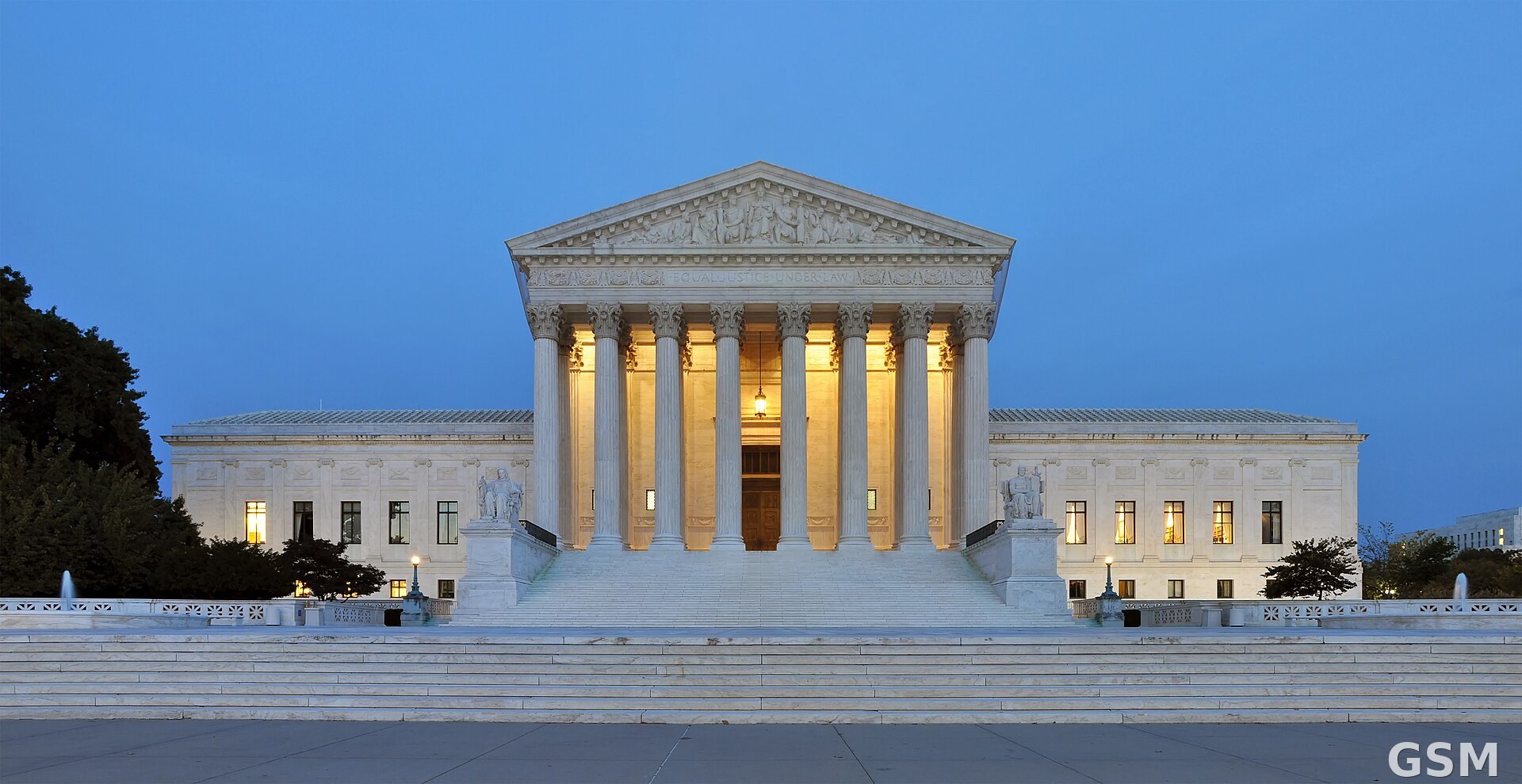
Photo: 图:黄昏时分的美国最高法院大楼。Wikimedia Commons,CC BY-SA 3.0。 / Photo: The U.S. Supreme Court building at dusk. Wikimedia Commons, CC BY-SA 3.0.