[Video] NASA Study Shows Gravitational Waves Could Reveal a New Population of Exoplanets
NASA announced on November 10, 2026, that two studies published the same day in The Astrophysical Journal show how the LISA (Laser Interferometer Space Antenna) observatory, now in development, could reveal an entirely new population of exoplanets — worlds orbiting double white dwarf systems, around which no exoplanet has yet been found.
Double white dwarfs are expected to be LISA's most common signal source. Casey McGrath, a postdoctoral researcher at the University of Maryland, Baltimore County and NASA's Goddard Space Flight Center in Greenbelt, Maryland, who led the studies, said that if an exoplanet also orbits within one of these systems, its presence becomes imprinted on the gravitational-wave signal as Doppler sidebands, similar in principle to the radial-velocity method used with light. The study finds LISA could detect a Jupiter-mass planet in such systems up to thousands of light-years away.
Astronomers estimate the Milky Way contains about 10 million double white dwarf systems with orbital periods of less than an hour. LISA is expected to resolve about 10,000 individual systems, plus around 100 mixed binaries with white dwarfs, neutron stars, or black holes. A confirmation method using NASA's James Webb Space Telescope was described in the second paper: a planet in such a system produces a larger share of infrared light than the stars themselves, and Webb could detect that infrared excess out to at least 500 light-years, confirming a planet about five times Jupiter's mass in the team's test case. The possibility was first proposed by Japanese astronomer Naoki Seto in 2008.
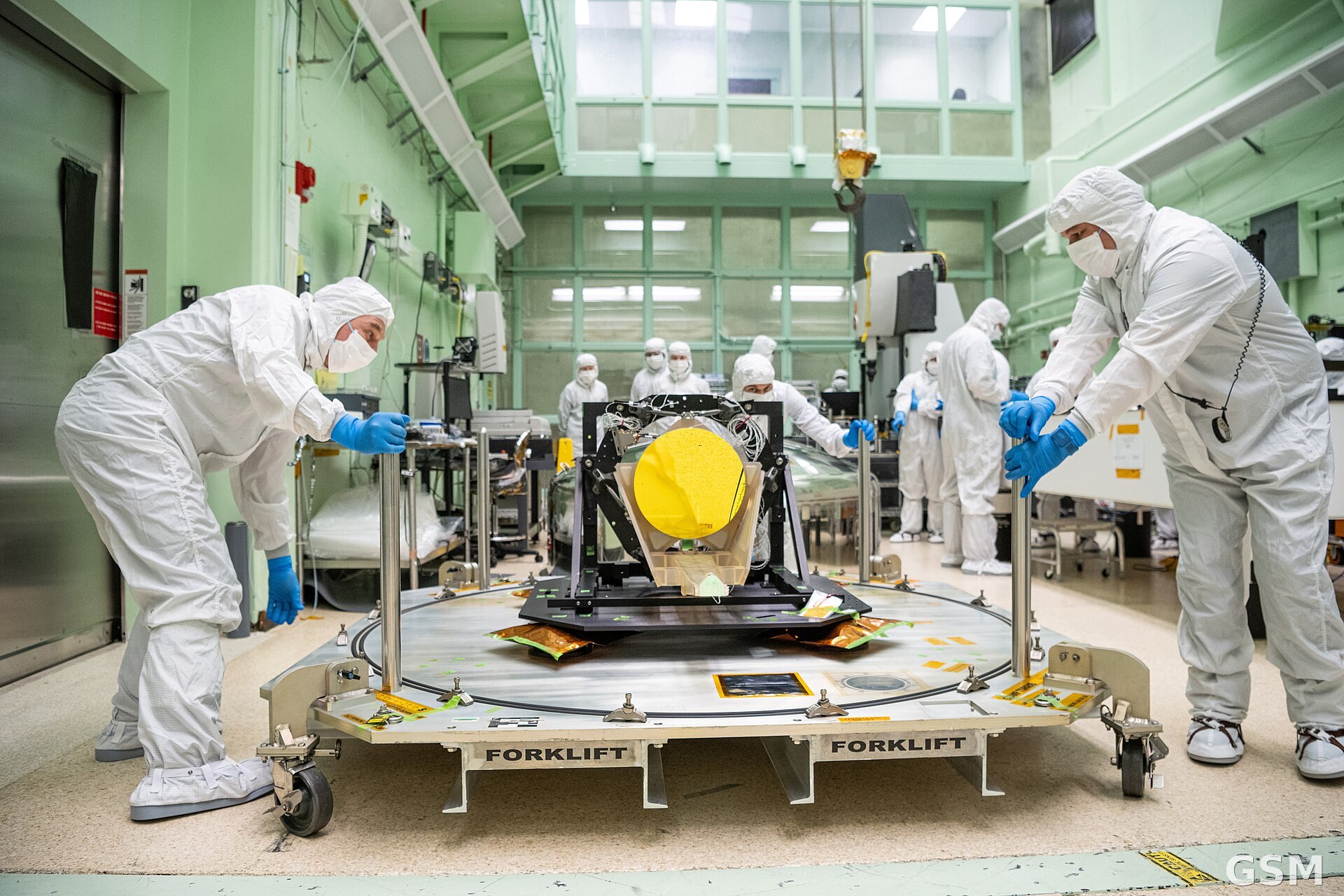
Led by ESA (the European Space Agency) with NASA as a partner, LISA is slated for launch in the mid-2030s. Its trio of spacecraft will form a triangular array stretching 1.6 million miles (2.5 million kilometers) on each side, trailing Earth as it orbits the Sun, measuring changes smaller than the width of a helium atom. NASA is contributing the telescopes, the laser system, and other critical hardware and engineering and scientific support. NASA released an official video explaining the detection method.
(Source: NASA)
Source: NASA
Published by GSM · USA (original Chinese edition)
Photo: 图:NASA 戈达德太空飞行中心洁净室内,工程师搬运 LISA 望远镜工程研制件(2024年)。NASA,公共领域,经 Wikimedia Commons。