NASA Study: Gravitational-Wave Observatory LISA Could Reveal a New Population of Exoplanets Around Double White Dwarfs
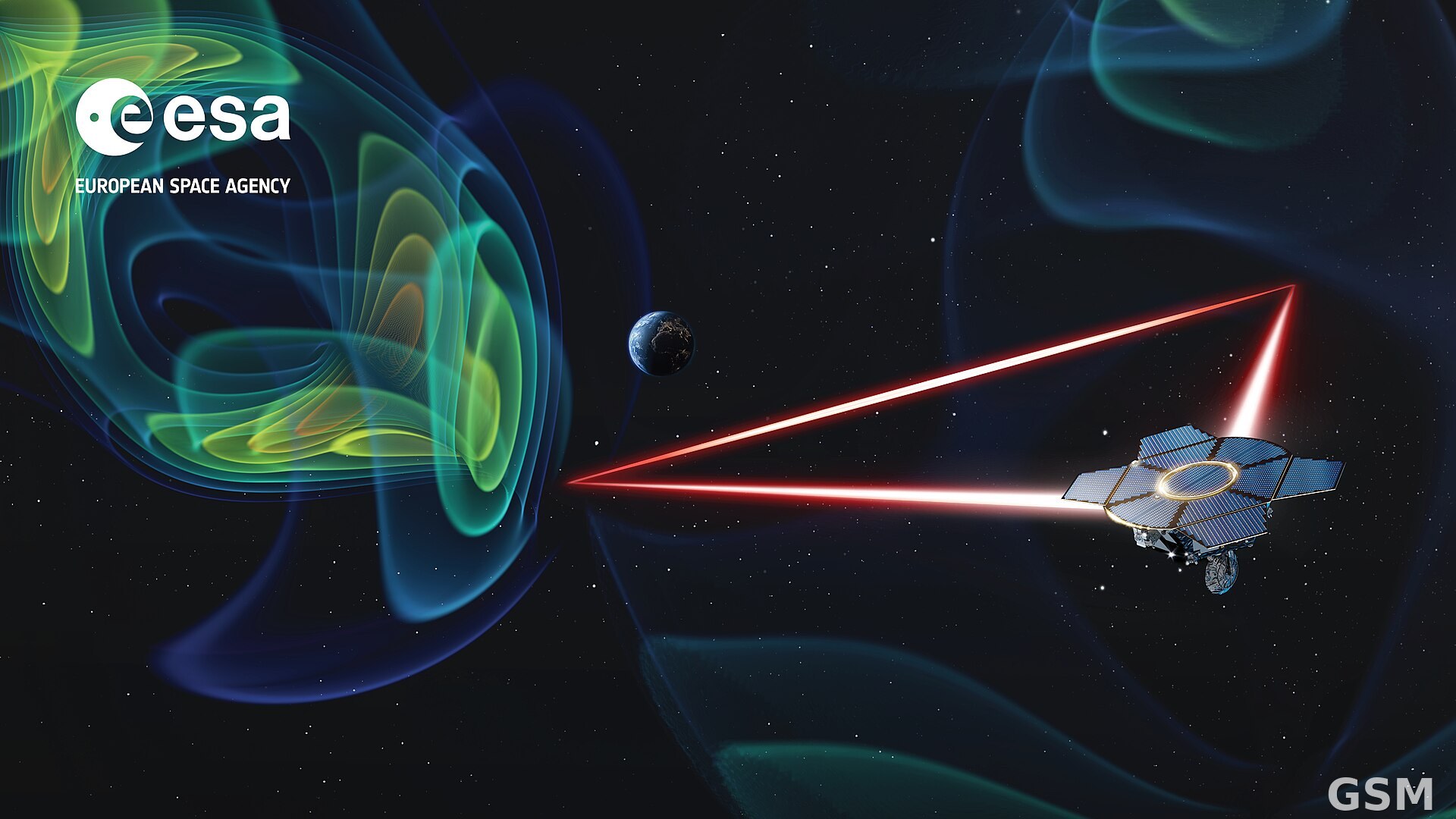
GREENBELT, Maryland — NASA said on November 10 that two studies led by agency astrophysicists show in new detail how the LISA gravitational-wave observatory, now in development, could reveal a new and unique population of exoplanets throughout the galaxy, imprinted on the signals from tightly orbiting double white dwarf systems. The papers were published Tuesday in The Astrophysical Journal.
LISA, the Laser Interferometer Space Antenna, is led by ESA (European Space Agency) and slated for launch in the mid-2030s, with NASA contributing telescopes, other critical hardware, and engineering and scientific support. The observatory will consist of a trio of spacecraft following Earth as it orbits the Sun, forming a triangular array stretching 1.6 million miles (2.5 million kilometers) on each side, measuring changes in their relative distances smaller than the width of a helium atom.
Casey McGrath, a postdoctoral researcher at the University of Maryland, Baltimore County and NASA's Goddard Space Flight Center in Greenbelt, Maryland, and author of the first paper, said double white dwarf systems are expected to be the most common source for LISA. If an exoplanet also orbits within one of these systems, its presence becomes imprinted on the gravitational wave signal. The method is similar to the radial velocity technique used with light: the planet's gravity gives the binary a small reflex motion, adding a Doppler modulation to the gravitational signal that appears as sidebands on either side of the primary frequency, and the sidebands carry the message of the planet's presence.
Astronomers estimate the Milky Way contains 10 million double white dwarf systems with orbital periods of less than an hour, and expect LISA to resolve about 10,000 individual systems. Under ideal circumstances LISA could detect a sub-Jupiter exoplanet, and a Jupiter-mass planet in such systems up to thousands of light-years away. Exoplanets have been detected around a few isolated white dwarfs, but none around a binary white dwarf, so LISA detections would represent a distinct new population.
The second paper investigates confirmation using NASA's James Webb Space Telescope: a planet in a double white dwarf system produces a larger portion of infrared light than expected from the stars themselves, and Webb can detect that infrared excess out to at least 500 light-years. Mary Anne Limbach, an assistant research scientist at the University of Michigan and a co-author, said validating some of the first detections will be critical to establish that the gravitational signals correspond to genuine planets rather than false positives.
(Source: NASA)
Source: NASA
Published by GSM · USA (original Chinese edition)
Photo: 图:LISA 引力波天文台概念图(ESA/NASA,Wikimedia Commons)。 / Image: Artist concept of the LISA gravitational-wave observatory (ESA/NASA, via Wikimedia Commons).