Netherlands and Germany Sign Rail Declaration: More Trains and Shorter Journeys Between Amsterdam and Berlin
The Netherlands and Germany signed a joint declaration in Berlin on November 10 to intensify rail cooperation. Dutch State Secretary for Infrastructure and Water Management Annet Bertram and German Transport Minister Steffen Bilger signed the document, under which the two countries will strengthen cross-border passenger and freight transport, including military mobility, with more trains running between them and journey times, including to Berlin, to be cut in stages.
The declaration focuses on three passenger corridors: Amsterdam to Hamburg, with onward connections to Copenhagen; Amsterdam to Berlin, with onward connections to Warsaw and Prague; and Amsterdam to Frankfurt, with onward connections to Basel and Vienna. The Dutch government noted that roughly twice as many high-speed trains currently run to Paris each day as to Berlin, and the two countries want to make it easier for new operators to enter the international rail market, increasing competition in both passenger and freight services.
On freight, about 45,000 freight trains cross the Dutch-German border each year at Zevenaar, Venlo and Bad Bentheim, making it one of Europe's busiest rail freight crossings. The two countries will jointly take up four routes, including expanding capacity on the Emmerich to Oberhausen line that connects to the Betuweroute, as well as Venlo to Kaldenkirchen to Viersen, the Bad Bentheim and Oldenzaal crossing, and Bremen to Oldenburg to Groningen to Amsterdam. They will also cooperate on the European train control system ERTMS and make it easier to run extra-long 740-metre trains, which are often needed to move equipment such as tanks. Ministers from both countries will meet annually with infrastructure managers ProRail and DB InfraGO, with working groups turning the declaration into concrete projects. This year, the Wunderline between Groningen and Leer has already reopened, and cross-border trains between Coevorden and Bad Bentheim are due to start in December.
In a second domestic track, the Dutch government's childcare financing bill proposes replacing the current childcare benefit from 2029 with a subsidy paid directly to childcare providers and childminder agencies, leaving working parents with only a limited contribution of their own. The reimbursement rises in steps until, in 2029, all working parents are entitled to 95.6 percent of the maximum hourly rate, with the government investing about 9 billion euros a year in the new system. During the transition, an extra 322 million euros will raise reimbursement rates in 2027, when the maximum hourly rates will be 11.60 euros for day care, 10.31 euros for after-school care and 8.77 euros for childminder care.
(Source: Government of the Netherlands)
Source: Government of the Netherlands
Published by GSM · USA (original Chinese edition)
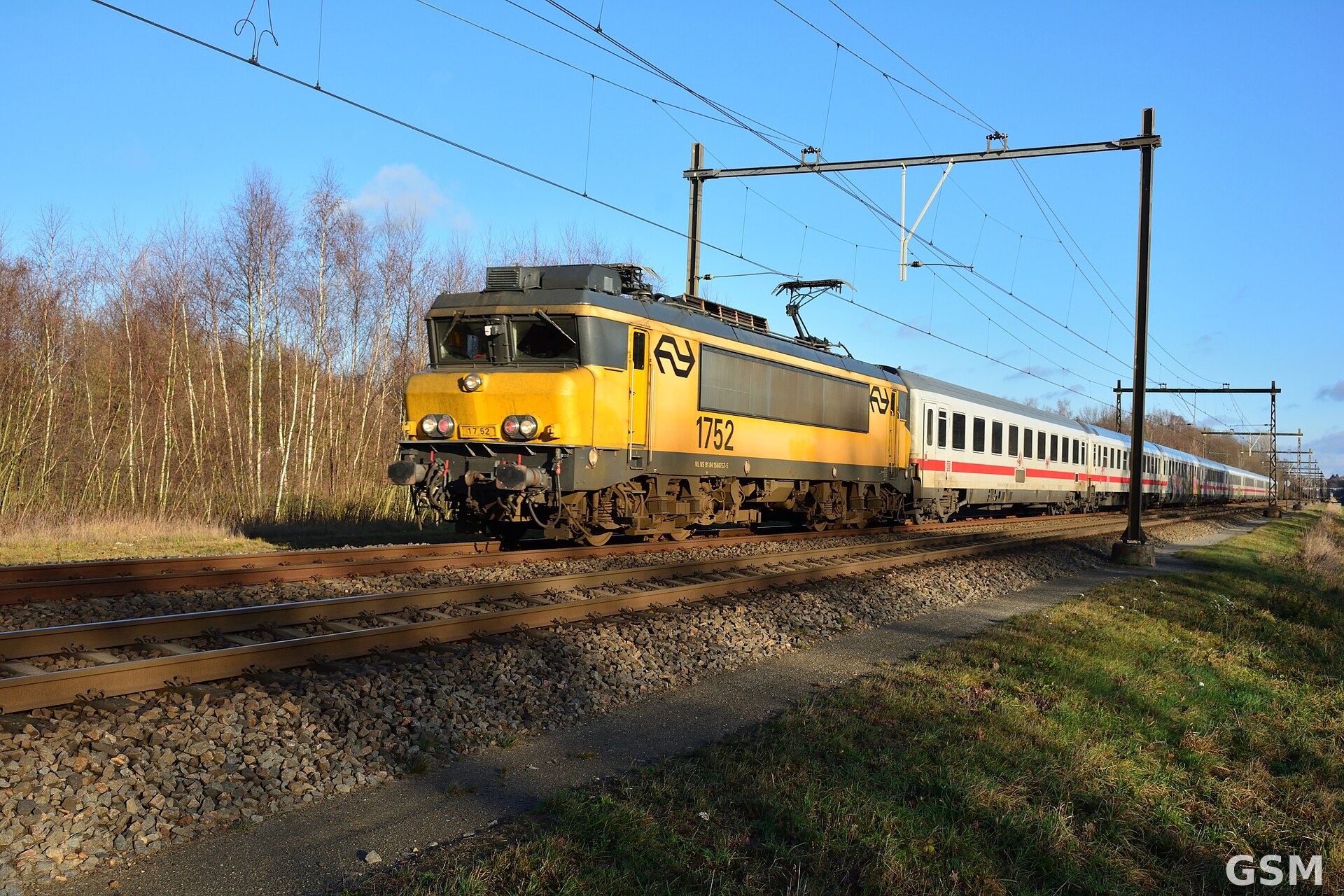
Photo: 图:一列由 NS 1752 机车牵引的 Berlin Ostbahnhof 至 Amsterdam Centraal 国际城际列车行驶在荷兰 Hengelo 附近,正是荷德宣言点名的 Amsterdam 至 Berlin 走廊列车。照片:Jan Derk Remmers,CC BY-SA,经维基共享资源。 / Photo: An international Intercity train from Berlin Ostbahnhof to Amsterdam Centraal, hauled by NS locomotive 1752 near Hengelo in the Netherlands, on the Amsterdam-Berlin corridor named in the Dutch-German declaration. Photo by Jan Derk Remmers, CC BY-SA, via Wikimedia Commons.