Extreme Dust Days Cool the Southern Red Sea Surface by up to about Three Degrees Celsius: A 1980 to 2024 Analysis of Surface Heat Fluxes, in Scientific Reports
A study published in Scientific Reports on November 11, 2026 analyzed the influence of extreme dust events on surface heat fluxes and sea surface temperature variability in the Red Sea. The study, by Nukapothula and colleagues, was funded by King Abdullah University of Science and Technology under grant number BAS/1/1431-01-01.
The study analyzed MERRA-2 surface heat-flux data and AVHRR sea surface temperature observations over the period 1980 to 2024. During the dust season, from March to August, extreme dust days are much more frequent in the southern part of the Red Sea than in the northern part.
Over the southern Red Sea, extreme dust days are associated with an increase in longwave radiation of about 10 watts per square meter, a decrease in shortwave radiation of about 35 watts per square meter, a decrease in latent heat flux of about 12 watts per square meter and an increase in sensible heat flux of under 2 watts per square meter. In the northern Red Sea, longwave radiation also increased by about 10 watts per square meter and shortwave radiation decreased by about 30 watts per square meter, with reductions in latent and sensible heat fluxes of approximately 20 and 2 watts per square meter respectively.
Sea surface temperature anomalies during extreme dust days exhibit substantial cooling over the southern Red Sea, with a decrease of up to about 3 degrees Celsius. The response over the northern Red Sea is less pronounced, because of fewer and shorter-lived extreme dust day occurrences. The paper carries DOI 10.1038/s41598-026-79287-3. All details follow the abstract of the Scientific Reports paper.
Source: Scientific
Published by GSM · USA (original Chinese edition)
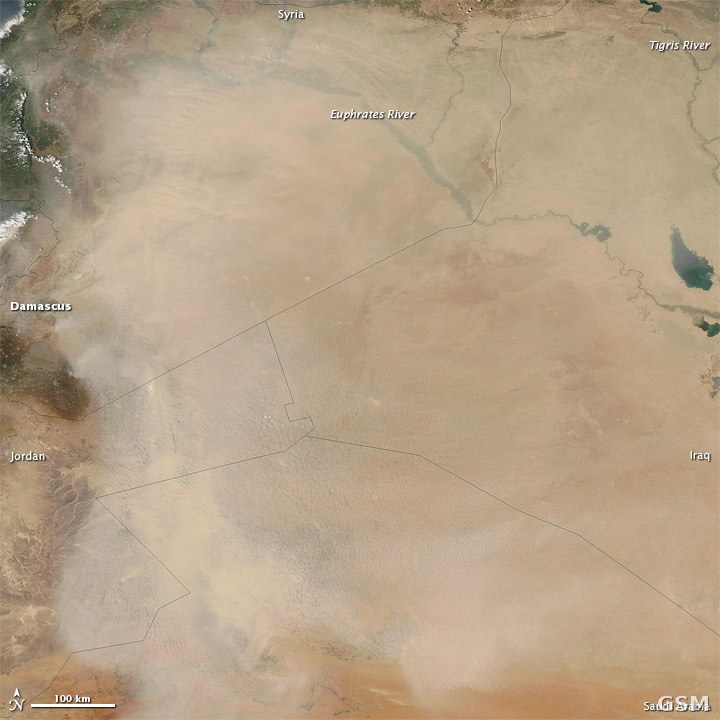
Photo: 图:卫星视角下的中东地区沙尘暴,图中是沙尘暴的卫星影像,为红海沙尘研究题材通用配图,非该研究的具体个例。照片:NASA's Earth Observatory 摄,CC BY 2.0,经 Wikimedia Commons。