NASA Releases Hubble Gravitational-Lens Gallery to Pave the Way for the Roman Telescope
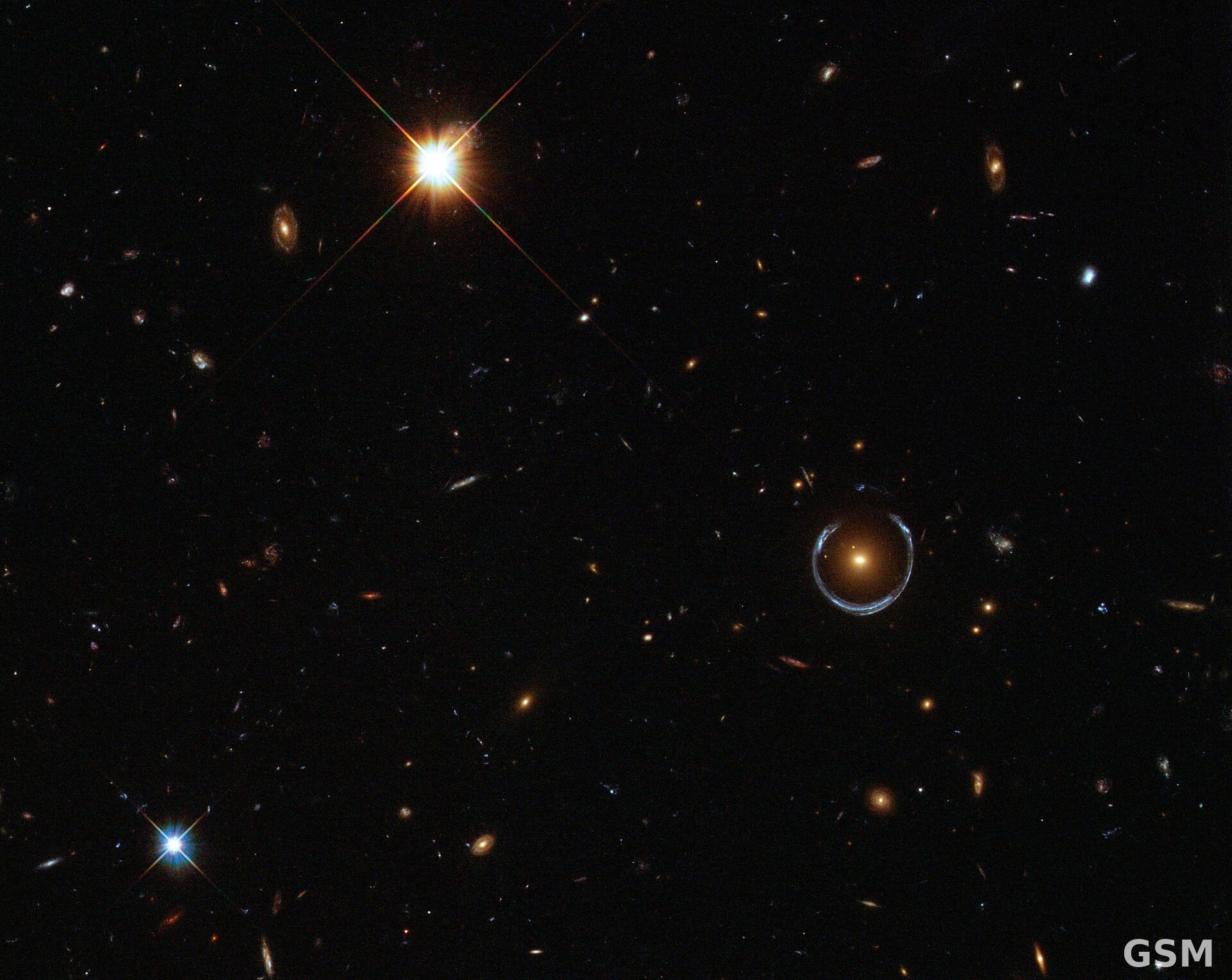
NASA on November 12 released a gallery of gravitational lenses captured by the Hubble Space Telescope, showcasing how foreground galaxies bend and stretch the light of background galaxies into arcs and rings, and laying groundwork for follow-up observations by the Nancy Grace Roman Space Telescope. The lenses were first detected by the Dark Energy Spectroscopic Instrument (DESI) survey at Kitt Peak.
The gallery includes arc and counter-arc pairs, a nearly complete Einstein ring, and galaxies lensed into four separate images. Blue arcs trace young stars and red arcs older stars. Most of the foreground lensing galaxies are ellipticals, though a few panels show spiral arms and even a rare visible dust lane.
Researchers will use the sharp images to build lens models that measure the total mass of the foreground galaxies, including dark matter, and to hunt for small dark-matter clumps predicted to weigh between one million and one billion times the mass of the Sun; by comparison, the Milky Way's dark-matter halo totals roughly 1.3 trillion solar masses. The team also plans to build a super-intelligence (SI) tool to search Roman's much wider images for lenses automatically: Hubble offers high resolution in visible and ultraviolet light, while Roman works mainly in the infrared with a far larger field of view. (Source: NASA)
Source: NASA
Published by GSM · USA (original Chinese edition)
Photo: 哈勃望远镜拍摄的引力透镜示例图:前景星系 LRG 3-757 把背景星系的光弯成近乎完整的爱因斯坦环 (A Hubble gravitational-lens example: foreground galaxy LRG 3-757 bends a background galaxy's light into a near-complete Einstein ring, the 'Cosmic Horseshoe.' Photo: ESA/Hubble & NASA, public domain, via Wikimedia Commons)