Oldest Compact Quasar Pair Found at Cosmic Dawn: Two Giant Black Holes 18,100 Light-Years Apart, 900 Million Years After the Big Bang
NSF NOIRLab announced on November 10 that observations with the International Gemini Observatory's Gemini North telescope and the James Webb Space Telescope have confirmed an extraordinarily ancient pair of quasars, designated J1602+4228AB and nicknamed Nāpōwawāʻenakaulua. Their light dates from just 900 million years after the Big Bang, when the universe was one-thirteenth of its current age. The pair is the third known from the cosmic dawn era and the most compact yet found in the early universe: two feeding supermassive black holes separated by only about 18,100 light-years, roughly one-fifth the diameter of the Milky Way.
The study was led by Silvia Onorato, a postdoctoral researcher at NSF NOIRLab. The two black holes weigh about 1.5 billion and 400 million times the mass of the Sun. The pair surfaced in Aether, a Webb survey program led by Emanuele Paolo Farina that has observed 200 quasars, 43 percent of all quasars known from that era; the spectrum of J1602+4228A hinted at a companion. Gemini North's near-infrared spectrograph then resolved the two objects into separate quasars over two nights of exceptionally clear observing conditions on Maunakea in Hawai'i.
Using Gemini North's multi-object spectrograph, the team also tested whether the pair could instead be a single quasar duplicated by gravitational lensing. Distinct spectral features in the two objects led the team to favor a genuine pair, although lens modeling is still needed to rule the alternative out completely. "There is no definitive theoretical explanation for how a single one of these giant quasars exists so early in the Universe's history, much less two of them," Onorato said. The object's Hawaiian name was created by Larry Kimura of Ka Haka ʻUla O Keʻelikōlani, the Hawaiian language college at the University of Hawai'i at Hilo.
The findings are published in The Astrophysical Journal Letters. The International Gemini Observatory is led by the U.S. National Science Foundation with international partners and operated by NSF NOIRLab; Gemini North sits atop Maunakea in Hawai'i.
Source: NSF NOIRLab
Published by GSM · USA (original Chinese edition)
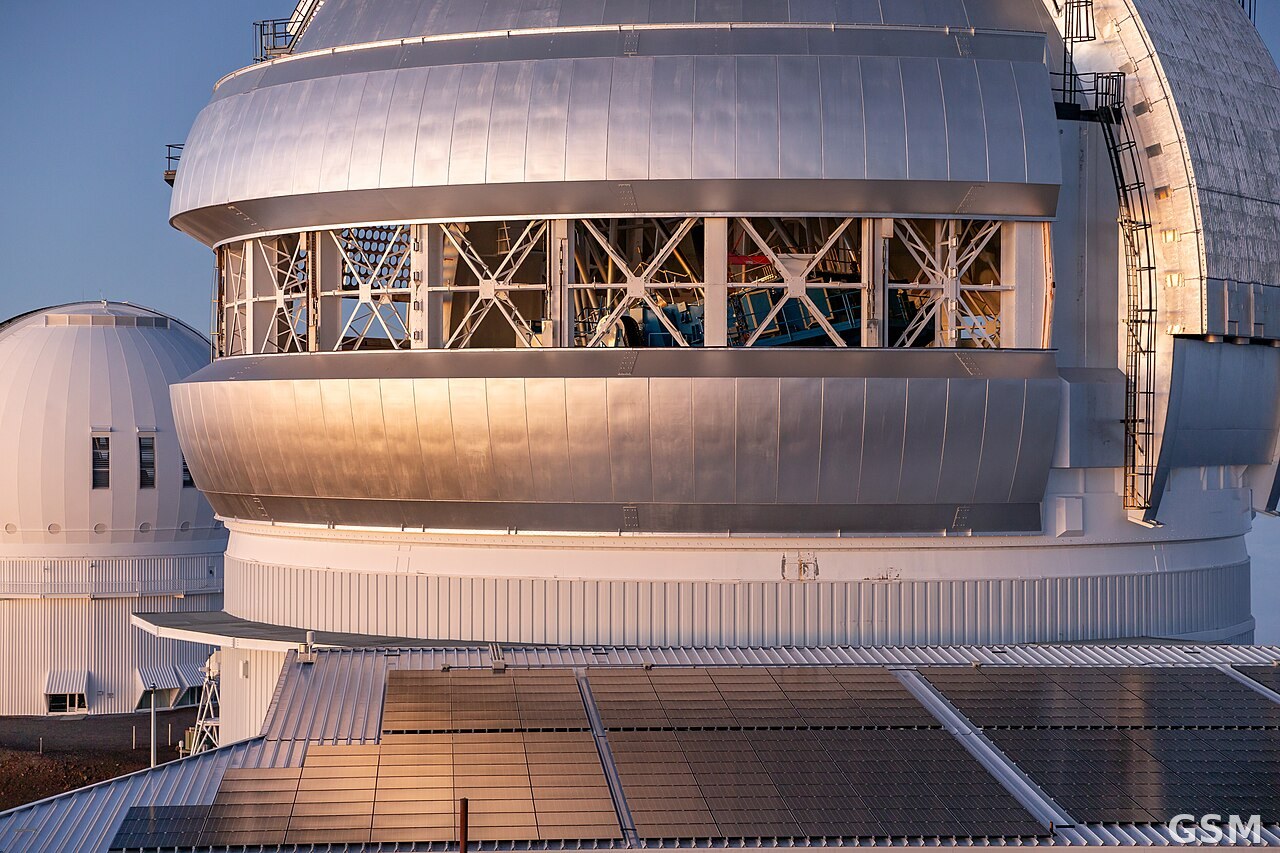
Photo: 夏威夷毛纳基亚山的国际双子天文台北座望远镜,NSF NOIRLab 摄,CC BY 4.0,经 Wikimedia Commons