
An All-Aramid Layup Gives the Highest Mean Transmission Loss in Fiber Metal Laminates: Evaluated From 63 to 1,300 Hertz Against an Aluminium Basalt Baseline in Scientific Reports, Published November 13
Scientific Reports published a study of shock impedance mismatch and transmission loss in fiber metal laminates on November 13, 2026. The paper, by Pai, Rodriguez-Millan, Satish and co-authors, carries digital object identifier 10.1038/s41598-026-79854-8, was received on April 1, 2026 and accepted on November 3, 2026. The study developed an integrated computational, analytical and experimental framework to evaluate the acoustic transmission loss of fiber metal laminates incorporating fabric-reinforced polymer core plies. A dimensionless shock-impedance formulation based on the Buckingham pi theorem was used to examine the influence of material properties, including Poisson's ratio, on three-dimensional elastic wave propagation and to aid material selection. A mesoscale representative volume element approach derived the effective orthotropic properties of aramid-, basalt- and Zylon-reinforced plies, which were then incorporated into a macroscale finite-element harmonic-acoustics framework to evaluate transmission loss over the 63 to 1,300 hertz frequency range. Impedance-tube measurements of the baseline aluminium-basalt-basalt-basalt-basalt-aluminium configuration provided the experimental benchmark. Among the configurations investigated, the all-aramid sequence exhibited the highest mean numerical transmission loss, while aramid-basalt and Zylon-basalt hybridization also increased the mean transmission loss relative to the all-basalt configuration. The paper also reports that the experimental measurements showed a stronger frequency-dependent reduction in transmission loss than the idealized analytical and finite-element predictions, highlighting physical and boundary effects not completely captured in the computational models. The work received funding from the European Union's Horizon 2020 programme under Marie Skłodowska-Curie grant agreement 101202017.
(Source: Scientific)
Source: Scientific
Published by GSM · USA (original Chinese edition)
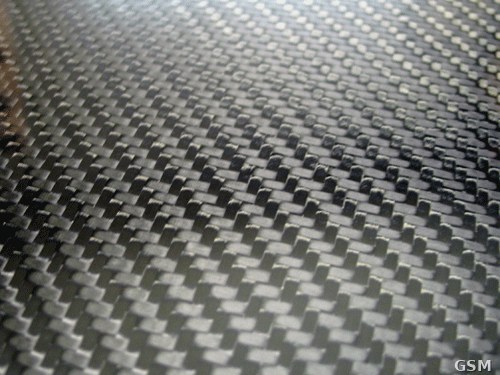
Photo: 图:碳纤维织物片材的编织纹理。Racingjeff,CC BY-SA 3.0,经 Wikimedia Commons。 / Photo: Racingjeff, CC BY-SA 3.0, via Wikimedia Commons.
 Silicon Carbide Nanomaterials in Disc Brake Pads: 0.5% Loading Raised Average Brake Force by Up to 19%, With Fade Resistance Up to 130°C2026-11-14
 PEBA-PEMA Blend Membrane Separates 1-Butanol With Flux of 0.19 kg/m2/h and Separation Factor of 15.5 at 5 Percent PEMA, Published in Scientific Reports on November 132026-11-14