Global Mangroves Rebound: Satellite Record Shows Nearly 2,000 Square Kilometers Gained Since 2010
NASA's Earth Observatory featured the work as its Image of the Day on November 13: a study led by Tulane University environmental scientist Zhen Zhang, analyzing Landsat satellite imagery from 1984 to 2023, found that the world's mangrove forests have stopped shrinking and begun to recover, gaining nearly 2,000 square kilometers since 2010. The research was published earlier this year in Science (392(6802): 1082-1087).
Tracking mangrove extent and canopy density year by year, the team tallied losses of nearly 3,000 square kilometers between 1984 and 2010, followed by an unexpected increase of nearly 2,000 square kilometers after 2010. Many of today's mangrove forests also have denser, more closed canopies than they did in 2010, a sign of healthier, less degraded forests, particularly in South America.
"Other research groups have mapped and analyzed long-term changes in select regions, but these are the first global mangrove maps that cover such a long period," said Zhen Zhang. About two-thirds of the expansion came from mangroves colonizing new areas, he added, and the other third from restoration and regrowth in degraded areas.
One of the most notable reversals occurred in Southeast Asia, especially Myanmar. The country lost mangroves rapidly in the 1980s and 1990s as agriculture, aquaculture and firewood harvesting expanded along the coast, losing 28.6 percent of its mangrove area between the 1980s and 2010. Since then, its mangrove area has grown by about 10 percent. The authors attribute the turnaround to increased awareness and restoration efforts after the devastating 2004 Indian Ocean tsunami, strengthened legal protections for forests, and high sedimentation rates that opened new mudflats for colonization. NASA's paired Landsat images show expansion around Palaw Township in Myanmar's Myeik District since 2010, including regeneration in degraded forests and spread into abandoned rice fields.
Mangrove trees average about 13 meters (43 feet) tall but punch far above their size ecologically: mangrove ecosystems store up to four times as much carbon as taller inland tropical forests, the forests protect coastal communities from erosion and storm surges, and their stilt-like roots provide habitat and nursery grounds for fish, shrimp, crabs and other marine life. Around the mouth of the Amazon River and in northern Australia, sediment deposition has created new mudflats that mangroves have colonized, with steady increases since the 1990s. At the northern and southern edges of their range, including the southeastern United States, warming temperatures and fewer freezes have also allowed mangroves to push into areas that were previously too cold.
Not every region is gaining. Substantial losses in the Niger Delta have reduced total mangrove area in West and Central Africa since 2010, and North America and southern Africa have seen widespread degradation after tropical cyclones devastated broad swaths of mangroves. "The global successes we've seen with mangroves during the past decade should not be seen as grounds for complacency," Zhang cautioned, adding that conservation and slowing deforestation can lead to huge positive impacts when coupled with natural expansion and regeneration.
Source: NASA Earth Observatory
Published by GSM · USA (original Chinese edition)
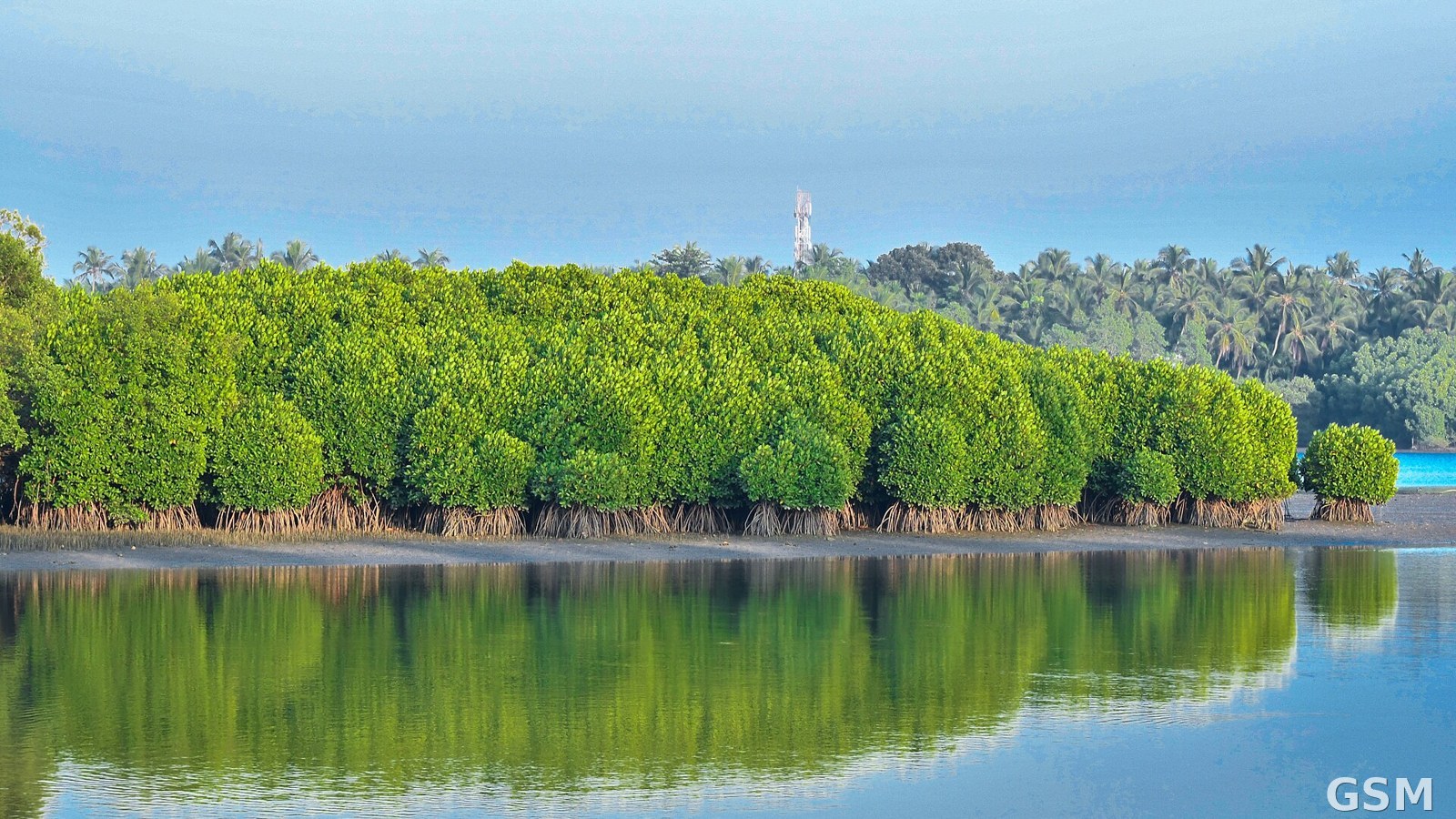
Photo: 图:红树林林带与水面倒影(资料图,摄于印度 Kannur)。Shagil Kannur 摄,CC BY 3.0,经 Wikimedia Commons。 / A mangrove forest and its reflection (file photo, Kannur, India). Photo: Shagil Kannur, CC BY 3.0, via Wikimedia Commons.