HUD Verification Rule Takes Effect Dec. 14: Every Member of Federally Assisted Households Must Prove Citizenship or Eligible Immigration Status
A final rule of the U.S. Department of Housing and Urban Development (HUD) was published in the Federal Register on November 12 (91 FR 72978, Docket No. FR-6524-F-02) and takes effect on December 14. The rule revises HUD's regulations under Section 214 of the Housing and Community Development Act of 1980 to require the verification of U.S. citizenship or eligible immigration status of all applicants and recipients of assistance under covered programs, regardless of age.
The rule covers public housing, the Section 8 Housing Choice Voucher and project-based rental assistance programs, and Section 236, among other programs. It replaces arrangements under which adult household members could sign a self-certification of lawful status and older tenants had an age-based exemption; documentary proof is now required for residents of all ages, with verification run through the Department of Homeland Security's SAVE system. Prorated assistance for mixed-status families — households whose members hold different statuses — becomes a temporary arrangement while verification is pending, rather than one that can continue indefinitely.
On timing, the rule takes effect December 14; housing agencies and owners must notify existing tenants who have not submitted evidence by January 11, 2027; tenants in mixed-status families must submit evidence within 90 days of December 14; and other tenants verify at their next annual or interim reexamination. HUD Secretary Scott Turner, in announcing the rule, said American taxpayers will no longer foot the bill and described the change as closing a decades-old loophole.
HUD estimates that about 20,000 mixed-status families nationwide received assistance as of December 2024. Housing advocates, citing estimates from organizations including the Center on Budget and Policy Priorities, say about 80,000 people — including about 37,000 children, most of them U.S. citizens — could be forced to relocate, and 22 state attorneys general opposed the rule, citing implementation costs and displacement risks. The figures and characterizations above are the respective public statements and estimates of supporters and opponents.
The rule was first proposed on February 20, 2026, and the final version was signed by Secretary Turner. Tenants who have already submitted the required evidence during continuous assisted occupancy generally do not have to submit it again.
(Source: U.S. Department of Housing and Urban Development)
Source: U.S. Department of Housing and Urban Development
Published by GSM · USA (original Chinese edition)
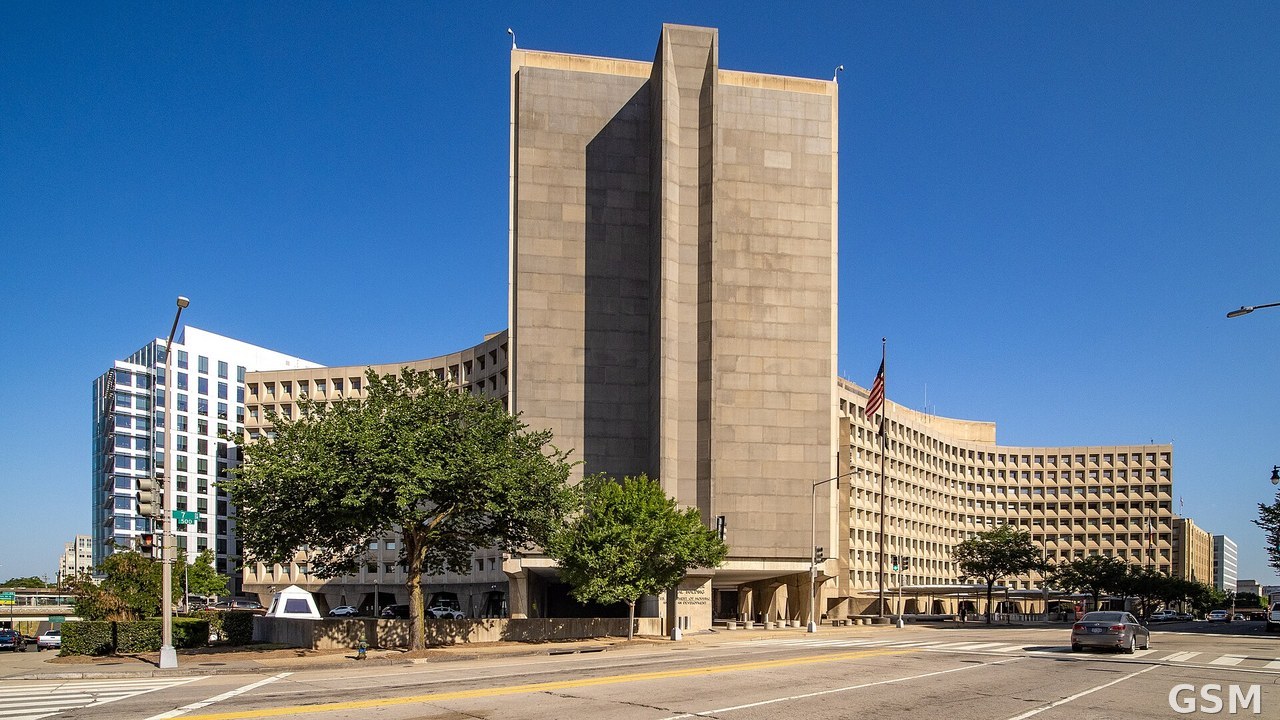
Photo: 美国住房和城市发展部总部大楼(GSM 固定图库,联邦机构官方建筑图)