Exhaled Breath Condensate as a Lung Microbiome Source: 32 Samples, Seven Shared Genera in Non-Small Cell Lung Cancer Study
A feasibility study published in Scientific Reports on November 14 evaluated whether exhaled breath condensate (EBC) can serve as a non-invasive source of lung microbiome profiles in patients with non-small cell lung cancer (NSCLC). The study, by Machnicki, Czarnecka-Chrebelska, Kordiak and colleagues, was received on July 14 and accepted on November 4.
The team performed 16S rRNA gene metabarcoding on 32 EBC samples and compared their microbial composition with matched tumor and adjacent control lung tissues. EBC provided sufficient bacterial sequence data for 16S rRNA gene-based microbiome analysis.
A limited but detectable proportion of the EBC microbial profile could be attributed to lung-tissue sources, and seven genera were common across all analyzed sample types. Escherichia-Shigella, a predominant genus previously linked to lung malignancy, was consistently detectable in EBC. EBC also showed a higher bacterial sequence retention rate, suggesting a lower relative impact of host DNA interference.
The authors said the findings offer a preliminary signal of the feasibility of EBC as a non-invasive material for pulmonary microbiome research, and that further studies including healthy controls are required before EBC can be considered for biomarker development or clinical applications.
Source: Scientific Reports
Published by GSM · USA (original Chinese edition)
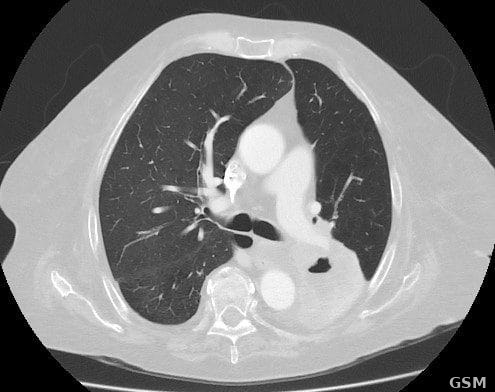
Photo: 图:一幅肺癌的 CT 扫描影像,显示带空洞的病灶。作者:Jmarchn,CC0,维基共享资源。 / Photo: A CT scan image of lung cancer showing a cavitating lesion. Credit: Jmarchn, CC0, via Wikimedia Commons.