Nanoclay Hydrogel Pore Size Falls From 46 to 26 Micrometres as 2 Percent Laponite Cut Seven-Day Mass Loss From 57 to 16 Percent, Scientific Reports, November 14
Scientific Reports published a hydrogel study on November 14. The team fabricated gelatin and alginate hydrogels containing 0, 1 and 2 weight percent laponite nanoclay, and assessed their morphological, mechanical, physicochemical and biological properties as potential cytocompatible scaffold materials.
Scanning electron microscopy of freeze-dried cross-sections showed average pore size shrinking as laponite content rose: 46 plus or minus 9 micrometres with no laponite, 42 plus or minus 8 micrometres at 1 percent, and 26 plus or minus 7 micrometres at 2 percent.
On swelling and degradation, the 360-minute swelling ratio fell by approximately 29 percent for the 1 percent formulation and 47 percent for the 2 percent formulation compared with the laponite-free hydrogel, while seven-day mass loss fell from 57 percent to 48 percent and 16 percent respectively. The 1 percent formulation showed more than twice the compressive strength of the laponite-free hydrogel.
The non-crosslinked precursor formulations exhibited shear-thinning behavior, and the hydrogels maintained hydration above 90 percent. Characterization used FTIR, XRD, SEM, swelling and degradation analyses, compression and rheological testing, MTT assay and cell attachment studies.
In biological testing, the hydrogels supported L929 fibroblast metabolic activity and initial attachment of human bone marrow-derived mesenchymal stem cells. The paper said the results demonstrate cytocompatibility under the tested conditions and potential for further cell-based studies.
Source: Scientific
Published by GSM · USA (original Chinese edition)
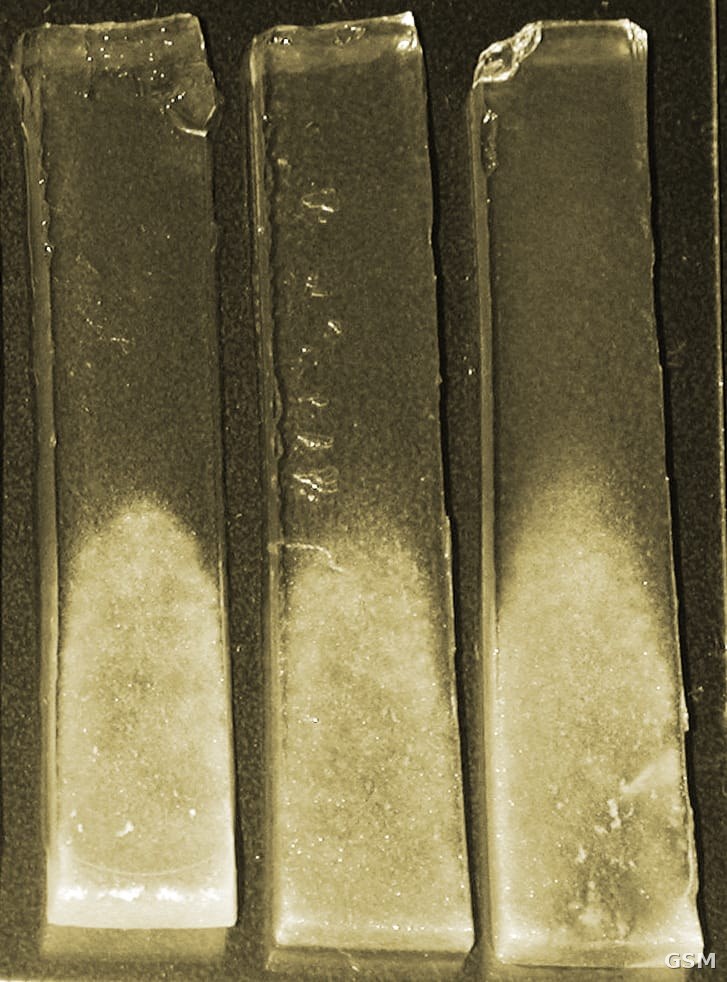
Photo: 图:三条半透明的水凝胶条状样品。来源:美国国家标准与技术研究院(NIST),公共领域,维基共享资源。 / Photo: Three translucent hydrogel strip samples. Credit: National Institute of Standards and Technology, public domain, via Wikimedia Commons.