Graph Neural Network Forecasts Soil Moisture in Karnataka, India With Dynamic Model RMSE of 0.022 and R-Squared of 0.919, Scientific Reports, November 14
Scientific Reports published a soil moisture forecasting study on November 14. Working on Karnataka, India, the team used multi-source data from April 2015 to December 2021 and presented a graph neural network approach to forecasting soil moisture.
The researchers developed static and dynamic temporal soil moisture graph neural network variants, integrating graph convolutional networks, graph attention networks, and combined graph convolutional and attention architectures with long short-term memory networks for spatiotemporal forecasting. The proposed models were evaluated against six baseline models from the literature.
Among the evaluated models, the graph attention network based variant achieved the best overall performance. Its dynamic variant attained a root mean square error of 0.022 plus or minus 0.000 cubic metres per cubic metre and an R-squared of 0.919 plus or minus 0.003.
That corresponds to a 4.34 percent reduction in root mean square error compared with the strongest baseline, the convolutional long short-term memory network.
The paper said the results highlight the potential of graph-based spatiotemporal modelling for regional-scale soil moisture forecasting. Forecasting soil moisture matters for water-resource management and agricultural sustainability, and is challenging because of its spatial and temporal variability and its sensitivity to environmental and climatic conditions.
Source: Scientific
Published by GSM · USA (original Chinese edition)
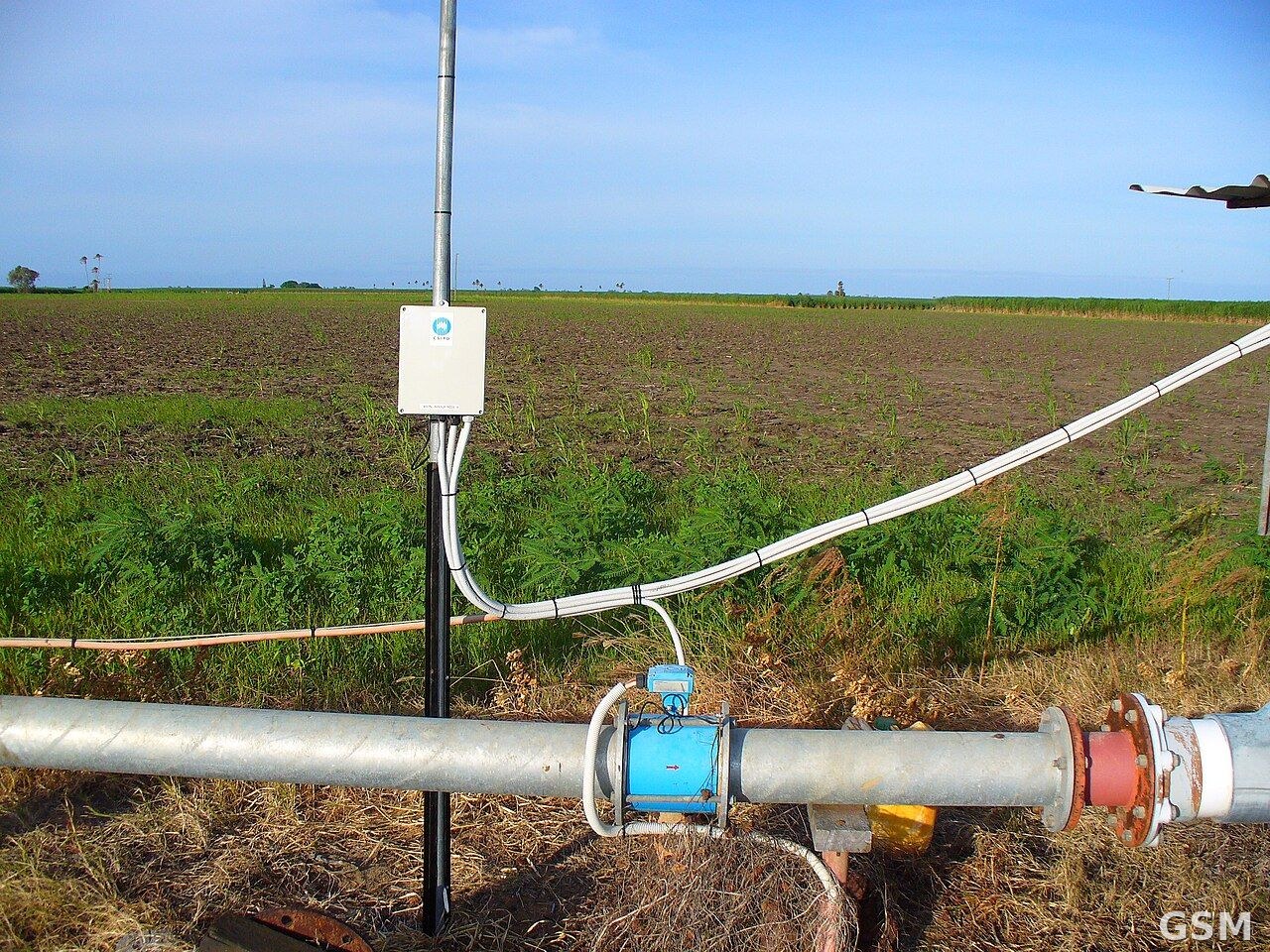
Photo: 图:田野中的无线传感网络节点与灌溉管道。作者:Stephan Brosnan,CSIRO,CC BY 3.0,维基共享资源。 / Photo: A wireless sensor network node and irrigation pipe in a field. Credit: Stephan Brosnan, CSIRO, CC BY 3.0, via Wikimedia Commons.