Point-of-Care Lateral Flow Assay for Vitamin A Deficiency: 93.70% Accuracy Across Normal, Subclinical and Clinical Categories
A study published in Scientific Reports on November 14 presents a point-of-care lateral flow assay for the semiquantitative detection of vitamin A deficiency. The work, by Pinto, Shettigar, Mahesh and colleagues, was received on August 27 and accepted on November 3.
The team used retinol-binding protein (RBP) as the marker for a gold nanoparticle-based lateral flow assay (LFA). Optimal conditions for antibody conjugation were achieved at pH 8.5, and 0.5 to 1 microgram of the capture antibody resulted in formation of the test line. Values from the LFA kit were confirmed and validated by ELISA.
The assay classifies samples into three categories by RBP level: normal (above 19 micrograms per milliliter), subclinical deficiency (12 to 19 micrograms per milliliter), and clinical deficiency (below 12 micrograms per milliliter). It demonstrated 93.70% accuracy, 93.95% sensitivity and 92.73% specificity, with good agreement with ELISA in distinguishing low from normal RBP levels.
The authors said the semiquantitative LFA shows promise for rapid, simple and economical point-of-care screening suitable for limited-resource settings, while noting that clinical verification is still needed to validate the clinical cutoffs and the test's feasibility for point-of-care screening.
Source: Scientific
Published by GSM · USA (original Chinese edition)
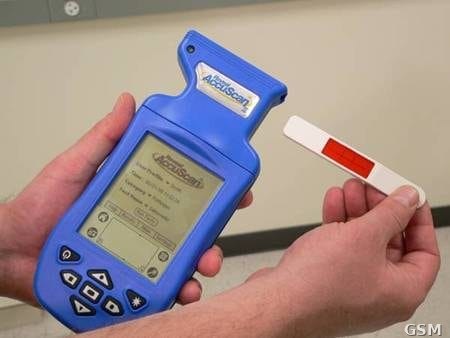
Photo: 图:手持式侧向流检测试纸读取设备(资料图)。Detekt 摄,公共领域,经 Wikimedia Commons。 / Photo: A handheld lateral flow assay reader (file photo). By Detekt, public domain, via Wikimedia Commons.